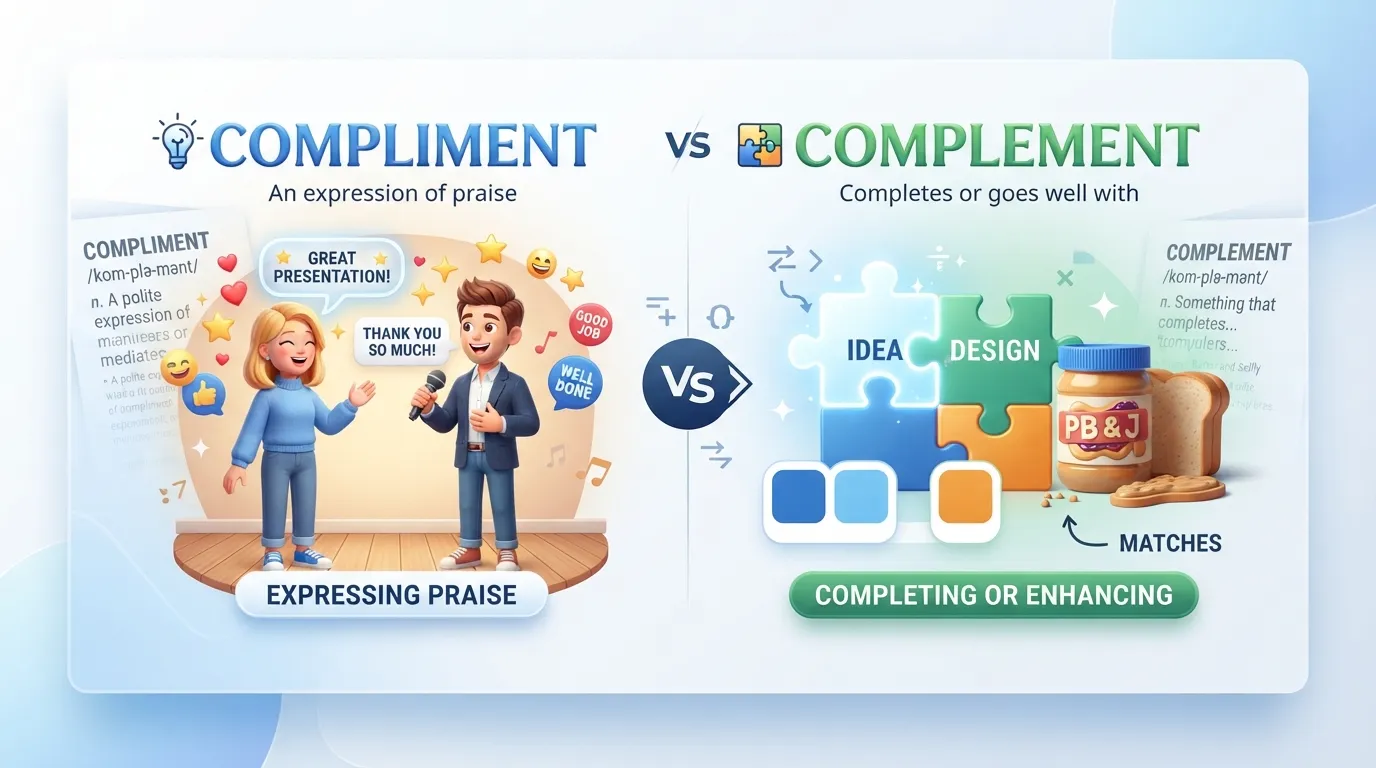
Compliment means a kind word or praise. Complement means something that completes, matches, or improves something else. They sound alike but have different meanings.
A few years ago, I was reviewing an article written by one of my students. Everything looked great until I reached this sentence: “Your shoes really complement you!” The writer meant to praise someone, but the word choice changed the meaning. It was a small mistake, yet it completely changed the message.
That moment reminded me how often even good writers confuse compliment and complement. The words sound almost the same. Their spelling is close too. That is why so many people search for the difference.
If you have ever paused before typing one of these words, you are not alone. Students, professionals, bloggers, and native English speakers make this mistake every day.
By the end of this guide, you will know exactly what each word means, when to use it, and how to remember the difference forever.
Compliment or Complement: Quick Answer
A compliment is praise or a nice remark.
A complement is something that completes, improves, or matches something else.
Examples
- “She gave me a compliment about my presentation.”
- “That blue tie complements your suit.”
One praises. The other matches.
The Origin and Background of Compliment or Complement
These words come from different Latin roots.
Compliment comes from a word meaning an expression of respect or praise. Over time, it became the English word we use for kind words.
Complement comes from the Latin word meaning to fill up or complete. That meaning has stayed almost the same for hundreds of years.
Because both words sound nearly identical, they became one of the most commonly confused pairs in English.
Their pronunciation is almost the same, but their meanings are very different.
Compliment or Complement Explained: Key Differences
The easiest way to remember them is this:
- Compliment = Praise
- Complement = Complete
| Term | Meaning | When to Use | Region/Context |
| Compliment | Praise or admiration | Saying something nice | Worldwide English |
| Complement | Completes or improves something | Matching or enhancing | Worldwide English |
Example of Compliment
- I received a compliment from my teacher.
- Your speech deserves a compliment.
Example of Complement
- The red curtains complement the white walls.
- Fresh herbs complement the soup perfectly.
Which Version Should You Use?
The right word depends on your meaning.
For students
Use compliment when writing about praise.
Example:
“My teacher gave me a compliment.”
For writers
Use complement when describing things that match or improve each other.
Example:
“The images complement the article.”
For business professionals
Choose carefully in emails.
- Praise someone → compliment
- Describe products working well together → complement
For global communication
Remember this simple trick:
If you can replace the word with “praise,” choose compliment.
If you can replace it with “complete” or “match,” choose complement.
Common Mistakes with Compliment or Complement
People usually confuse the spelling because the pronunciation is almost identical.
| Mistake | Correct |
| Your dress compliments the room. | Your dress complements the room. |
| She complemented me on my work. | She complimented me on my work. |
| Thanks for the complement. | Thanks for the compliment. |
| This sauce compliments the steak. | This sauce complements the steak. |
| He paid me a complement. | He paid me a compliment. |
Why these mistakes happen
- The words sound alike.
- Spell check may not catch them.
- Many people remember the pronunciation but forget the meaning.
Compliment or Complement in Real World Examples
Professional Email
“Thank you for the wonderful compliment about my presentation.”
News Headline
“New park design complements the city’s historic buildings.”
Social Media Post
“Your kind compliment made my day!”
Formal Report
“The new software will complement the existing security system.”
These examples show how each word naturally fits different situations.
Compliment or Complement: Data, Trends & Usage
Both words are searched thousands of times every month because they confuse many English learners.
Most interested audiences
- Students
- Teachers
- Bloggers
- Business professionals
- Job seekers
- English learners
Common search intent
Informational
People usually want to know:
- Which spelling is correct.
- What each word means.
- Which word fits a sentence.
Why this matters today
More people write emails, social posts, blogs, and business messages than ever before. Using the correct word helps your writing look clear and professional.
Comparison Table
| Term/Variant | Meaning | Region/Context | Best Used When |
| Compliment | Praise or admiration | All English varieties | Giving positive feedback |
| Complement | Something that completes or matches | All English varieties | Describing things that improve each other |
Easy Memory Trick
Here’s my favorite trick.
Compliment contains the letter “I.”
Think:
I like your shirt.
That is praise.
Complement contains “E.”
Think:
Everything fits together.
That means complete or match.
This simple trick helps many learners remember the difference instantly.
Examples in Everyday Life
Compliment
- You have a beautiful smile.
- Thank you for the compliment.
- My boss complimented my work.
Complement
- Cheese complements wine.
- This color complements your eyes.
- The new feature complements the existing app.
Frequently Asked Questions
Q: What does compliment mean?
A compliment is a kind word, praise, or admiration given to another person.
Q: What does complement mean?
A complement is something that completes, improves, or matches something else.
Q: How do you use compliment correctly?
Use compliment whenever you are talking about praise.
Example:
“She gave me a lovely compliment.”
Q: Compliment vs complement: what’s the difference?
A compliment praises someone.
A complement improves, matches, or completes something.
Q: Is compliment acceptable in formal writing?
Yes.
It is commonly used in business emails, academic writing, and professional communication when referring to praise.
Q: Which spelling is correct: compliment or complement?
Both are correct.
The correct spelling depends on the meaning you want.
Q: Can complement be used in business writing?
Absolutely.
Businesses often say products complement each other because they work well together.
Conclusion
Understanding compliment and complement is much easier once you know their core meanings.
Remember these key points:
- Compliment means praise.
- Complement means complete, improve, or match.
- Think “I like you” for compliment.
- Think “Everything fits” for complement.
These two words may look similar, but choosing the right one makes your writing more accurate and professional. Whether you are writing an email, a report, a social media post, or a school assignment, using the correct word helps your message stay clear.
Now you know exactly how to use compliment and complement with confidence. Bookmark this guide so you never second guess these words again, and share it with someone who has mixed them up before.
Read more: Fiance or Fiancee: The Complete Guide to Using Them Correctly

I started writing about English word differences after years of teaching students who kept making the same mistakes. My focus is on making spelling rules feel simple and easy to remember. At WordsCombo, I turn confusing word pairs into clear comparisons.





1 thought on “Compliment or Complement: Complete Guide”