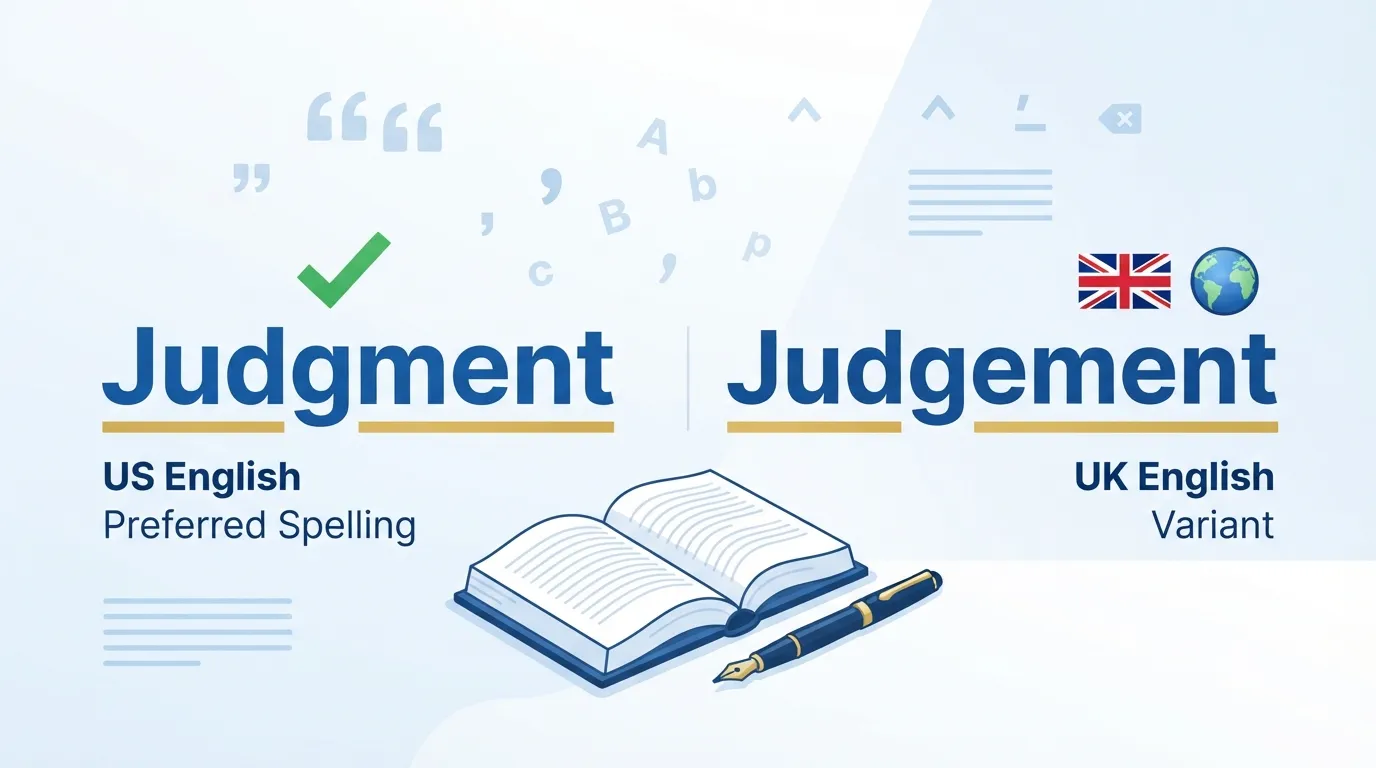
Judgment and judgement are both correct spellings of the same word. Judgment is the preferred spelling in American English and is also the standard legal spelling in most countries, while judgement is more common in British English outside legal writing.
A few years ago, I was editing an article for an international client. Everything looked perfect until I noticed the word judgement. I changed it to judgment without thinking. Minutes later, the client asked me to change it back because their audience was in the UK. That small spelling choice taught me an important lesson.
Many people search for judgment or judgement because both spellings appear online, in books, and even in official documents. Seeing two versions of the same word can make anyone stop and wonder which one is correct.
The good news is that you do not have to guess anymore. Once you understand where each spelling comes from and when to use it, the confusion disappears.
In this guide, you will learn the difference between judgment and judgement, where each spelling is used, common mistakes to avoid, and simple examples you can copy in your own writing.
Judgment or Judgement: Quick Answer
Both judgment and judgement mean the ability to make decisions, an opinion, or a decision made by a court.
Simple examples
- American English: “She showed good judgment.”
- British English: “He used excellent judgement.”
If you are writing for an international audience, judgment is usually the safest choice.
The Origin and Background of Judgment or Judgement
The word comes from the Old French word jugement, which later entered Middle English.
Over time, English spelling changed in different parts of the world.
In the United States, writers slowly dropped the extra e, making judgment the standard spelling.
In Britain, both forms continued to appear. Many publishers preferred judgement, while legal documents often kept judgment.
That is why both spellings still exist today.
The difference is mostly about regional spelling, not meaning.
Judgment or Judgement Explained: Key Differences
There is no difference in meaning.
The only real difference is the preferred spelling based on location or writing style.
| Term | Meaning | When to Use | Region/Context |
| Judgment | Opinion, decision, or court ruling | American English, legal writing, international content | USA, legal documents worldwide |
| Judgement | Opinion, decision, or court ruling | General British English | UK, Australia, New Zealand (non-legal writing) |
Example 1
American English:
“The manager showed good judgment.”
Example 2
British English:
“Her judgement impressed the entire team.”
Example 3
Legal writing:
“The court issued its final judgment.”
Notice that legal documents usually prefer judgment, even in many countries that normally use British spelling.
Which Version Should You Use?
Choosing the right spelling depends on your readers.
If you write for American readers
Use judgment.
It matches American dictionaries, schools, newspapers, and businesses.
If you write for British readers
Use judgement for general writing.
If you are preparing legal documents, use judgment unless local rules say otherwise.
If you write for students
Follow your teacher’s style guide.
Schools often require one spelling throughout the assignment.
If you write online for a global audience
Choose judgment.
It is widely accepted and appears more often in international business and legal writing.
Quick recommendation
- American English: Judgment ✅
- British English: Judgement ✅
- Legal writing: Judgment ✅
- Global audience: Judgment ✅
Common Mistakes with Judgment or Judgement
Many writers make the same mistakes.
Here are the most common ones.
| Mistake | Correct Version | Why It Happens |
| Mixing both spellings in one article | Pick one spelling and stay consistent | Switching between language styles |
| Using judgement in American writing | Judgment | American English prefers this spelling |
| Using judgment in casual British writing without checking style | Often judgement | British publishers may prefer the extra “e” |
| Thinking one spelling is wrong | Both are correct | Regional differences cause confusion |
| Assuming legal writing uses judgement | Judgment | Legal English usually drops the extra “e” |
Consistency matters more than anything else.
Judgment or Judgement in Real World Examples
Professional Email
“Your judgment during the project helped the team solve several problems quickly.”
News Headline
“Experts Praise Government’s Judgement After Emergency Response.”
Social Media Post
“Good judgment comes from experience, and experience comes from learning.”
Formal Report
“The committee’s judgment was based on available evidence and expert advice.”
These examples show how naturally the word fits into different types of writing.
Judgment or Judgement: Data, Trends & Usage
People search for judgment or judgement because they want to know which spelling is correct.
Search intent
Informational
Readers want a simple answer before using the word in writing.
Regions with the most interest
- United States
- United Kingdom
- Canada
- Australia
- India
Who searches for it?
- Students
- Bloggers
- Business professionals
- Teachers
- Copywriters
- English learners
Why it matters now
More people write for global audiences than ever before. Knowing the preferred spelling helps create content that feels natural to readers in different countries.
Comparison Table
| Term/Variant | Meaning | Region/Context | Best Used When |
| Judgment | Decision, opinion, court ruling | American English | Business, education, legal writing, international content |
| Judgement | Decision, opinion, court ruling | British English | Everyday British writing |
| Court Judgment | Official legal decision | International legal English | Legal documents and court records |
| Personal Judgment | Ability to make good decisions | All English varieties | Everyday conversations and writing |
Frequently Asked Questions
Q: What does judgment or judgement mean?
Both words mean an opinion, a decision, or the ability to make sensible choices. They also refer to a court’s official decision.
Q: How do you use judgment correctly?
Use judgment when writing in American English or legal English. Keep the spelling consistent throughout your document.
Q: Judgment vs judgement: what is the difference?
There is no difference in meaning. The only difference is spelling preference based on region.
Q: Is judgment acceptable in formal writing?
Yes. It is the preferred spelling in American English and is widely accepted in professional, academic, and legal writing.
Q: Which version is correct: judgment or judgement?
Both are correct. Choose the version that matches your audience and writing style.
Q: Where does judgment come from?
The word comes from Old French and Middle English. Different spelling traditions later developed in Britain and America.
Q: Can judgment be used in legal writing?
Yes. In fact, judgment is the standard spelling in most legal systems, even in many countries that otherwise use British English.
Conclusion
The debate over judgment or judgement is much simpler than it first appears. Both spellings are correct. They share the same meaning and have the same history. The biggest difference is where they are commonly used.
Remember these key points:
- Judgment is the standard spelling in American English.
- Judgement is common in general British English.
- Judgment is usually preferred in legal writing.
- Stay consistent throughout your document.
If you are unsure which spelling to choose, think about your readers first. Matching their language style makes your writing look more natural and professional.
Now you know exactly how to use judgment or judgement with confidence. Bookmark this guide so you never second-guess the spelling again, and share it with someone who has asked the same question.

I studied English literature and have spent years editing content for blogs and digital platforms. I noticed most people struggle with choosing between two similar words. At WordsCombo, I make that choice simple and clear.