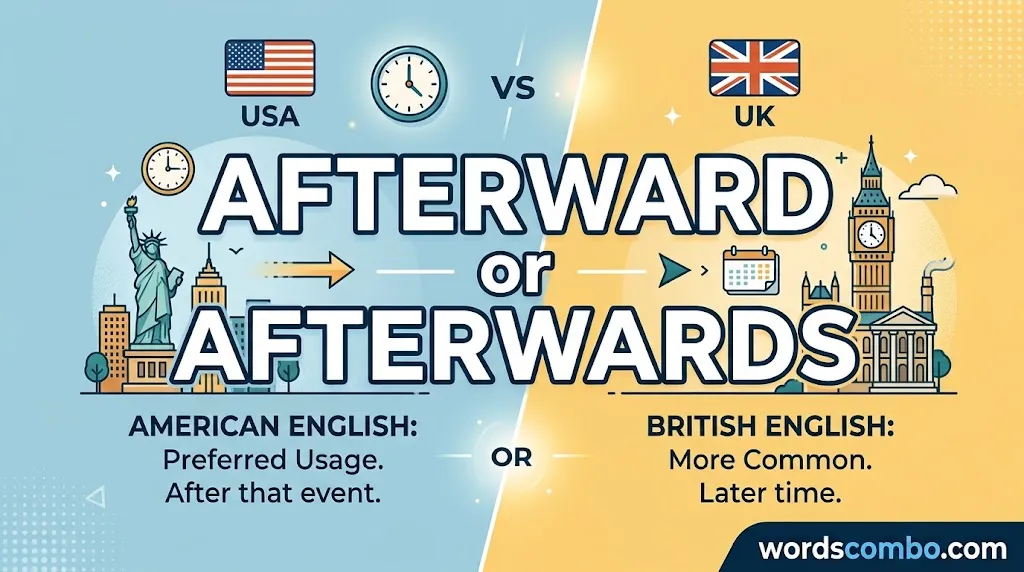
Afterward or afterwards means later or after something happens. Both are correct, but afterward is more common in American English, while afterwards is more common in British English.
I remember editing a short business email where the writer had stopped halfway through the final sentence. The message was simple: “We can discuss the changes afterward.” Then came the hesitation. Was that spelling right, or should there be an s at the end?
That tiny doubt is surprisingly common. The two words look almost identical, sound the same, and carry the same meaning. The extra s makes it tempting to think one must be a spelling mistake.
It is not.
Both forms are accepted English. The real difference is mostly about regional preference, especially between American and British English. That matters when you are writing an essay, email, article, report, or website copy for a specific audience.
Once you know which version is more natural for your readers, the choice becomes easy. You do not need a complicated grammar rule. You simply need to know where each form fits best.
Afterward or Afterwards: Quick Answer
Afterward and afterwards are adverbs that mean later or after that.
For example:
- We went home afterward.
- We went home afterwards.
Both sentences have the same meaning.
The main difference is regional. Afterward is usually preferred in American English, while afterwards is especially common in British English.
The Story Behind Afterward and Afterwards
The difference between these forms has a long history.
The word afterward developed from older English forms connected with the ideas of after, following, and later. Over time, it became an adverb used to describe something that happens after an earlier event.
Afterwards developed as a related form with the additional s ending. Both forms survived as English changed.
This is why the extra s does not create a new meaning. It is not the difference between a correct word and a misspelling.
English has several similar pairs, such as toward/towards and upward/upwards. Regional English often determines which form feels more natural.
Today, the pattern is especially clear with afterward and afterwards. American English tends to favor the form without the final s, while British English often uses the form ending in s.
Afterward vs Afterwards: What Is the Difference?
There is no meaningful difference in basic meaning between the two words.
Both tell the reader that something happens later.
| Term | Meaning | When to Use | Region/Context |
| afterward | Later; after that | When referring to a later event | Common in American English |
| afterwards | Later; after that | When referring to a later event | Common in British English |
Consider these examples:
American-style usage:
We finished the meeting and talked about the problem afterward.
British-style usage:
We finished the meeting and talked about the problem afterwards.
The meaning does not change. The spelling simply reflects a different regional preference.
Can Afterward Start a Sentence?
Yes.
You can place afterward at the beginning of a sentence when you want to show that something happened later.
Afterward, we went back to the office.
You can also do the same with afterwards:
Afterwards, we went back to the office.
Both are grammatically sound.
Which Version Should You Use?
Your audience should guide your choice.
For American English
Use afterward.
It is the more natural default for:
- US school assignments
- American business emails
- US websites
- American news writing
- Academic writing for a US audience
For example:
We reviewed the proposal afterward.
For British English
Use afterwards if it fits the style of your writing.
For example:
We reviewed the proposal afterwards.
This form is especially natural in British English.
For a Global Audience
Either form can work.
The best approach is to choose one and stay consistent. Switching between afterward and afterwards in the same article is not a serious grammar error, but consistent wording makes your writing look cleaner.
For a website aimed mainly at US readers, I would choose afterward.
Common Mistakes with Afterward or Afterwards
These mistakes are easy to make because the words look so similar.
| Mistake | Better Version | Why |
| We talked afterwards in a US-focused article. | We talked afterward. | Afterward is the usual US preference. |
| We met after word the event. | We met afterward. | Afterward is one word. |
| I read the afterward of the book. | I read the afterword of the book. | Afterword is a different noun. |
| Afterward of the meeting, we left. | After the meeting, we left. | Use after before a noun phrase. |
One especially useful distinction is afterward vs afterword.
Afterward means later.
Afterword is a section at the end of a book.
We talked afterward.
I enjoyed the author’s afterword.
They look similar, but they have completely different jobs.
Afterward or Afterwards in Real-World Examples
Seeing the words in everyday settings makes the rule easier to remember.
Professional Email
Thanks for joining the call today. We can review the remaining questions afterward.
For a US business audience, afterward is the natural choice.
News Article
The team celebrated afterward following a close win.
The word works naturally when describing an event that happened later.
Social Media Post
We were exhausted after the hike, but the view was worth it. We grabbed dinner afterward.
This sounds natural and conversational.
Formal Report
The samples were reviewed afterward to confirm the results.
The word is not too casual for formal writing. It works in professional and academic contexts as well.
Afterward or Afterwards: Data, Trends & Usage
The search intent behind afterward or afterwards is clearly informational. People are usually not looking to buy something. They want a quick answer to a spelling, grammar, or regional usage question.
For a US audience, the strongest practical choice is afterward. American English generally favors the form without the final s, while British English more often uses afterwards.
This matters because online writing now reaches readers from many English-speaking regions. A word that feels completely normal to a British reader may sound slightly less typical to an American reader.
The useful lesson is not that one form is “good” and the other is “bad.” Both are established forms. The better choice depends on who will read your writing.
Afterward or Afterwards: Comparison at a Glance
| Term/Variant | Meaning | Region/Context | Best Used When |
| Afterward | Later; after that | American English | Writing for US readers |
| Afterwards | Later; after that | British English and other varieties | Writing for UK readers |
| After | Later than something | All major English varieties | Before a noun or clause |
| Afterword | A concluding section of a book | Books and publishing | Referring to a book’s final section |
The key point is simple: afterward and afterwards are not different in meaning.
The difference is mainly one of regional preference.
FAQs About Afterward or Afterwards
What does afterward or afterwards mean?
Both words mean later or after something has happened. For example, “We went for coffee afterward” means that the coffee came after another event.
Is afterward or afterwards correct?
Both are correct. Afterward is more common in American English, while afterwards is more common in British English.
Is afterward more correct than afterwards?
No. Neither form is inherently more correct. If you are writing for a US audience, afterward is usually the better stylistic choice because it matches common American usage.
Is afterwards acceptable in American English?
Yes. Afterwards is acceptable in American English, even though afterward is generally more common. Using afterwards does not make your sentence grammatically wrong.
Should I use afterward in formal writing?
Yes. Afterward is completely suitable for formal writing, including reports, essays, professional emails, and academic work. It is a normal adverb, not an informal expression.
Where does the word afterward come from?
Afterward comes from older English forms built around the idea of after and something that follows. The related afterwards form developed with the additional s ending.
Can I use afterward at the beginning of a sentence?
Yes. You can write, “Afterward, we reviewed the results.” The same sentence can also use afterwards: “Afterwards, we reviewed the results.”
What is the difference between afterward and afterword?
Afterward means later. Afterword is a noun for a section placed at the end of a book. For example, “We spoke afterward,” but “I read the author’s afterword.”
Final Thoughts on Afterward or Afterwards
The choice between afterward or afterwards is much simpler than it first appears.
Both words mean later or after that. Neither is a spelling mistake. The main difference is regional preference.
If you are writing for an American audience, afterward is the safest and most natural choice. If your readers use British English, afterwards may sound more familiar.
There is one more rule worth keeping: be consistent. If your article, essay, or website follows American English, stick with afterward. If it follows British English, afterwards is a natural option.
Also watch out for afterword. It looks similar but refers to a concluding section of a book.
You do not need to second-guess this word every time you type it. Choose the version that matches your audience, use it consistently, and move on with confidence.
Bookmark this guide so you never have to pause over afterward or afterwards again.
Curious about similar word choices? Explore Towards or Toward: The Easy Guide to Correct Usage

I studied English literature and have spent years editing content for blogs and digital platforms. I noticed most people struggle with choosing between two similar words. At WordsCombo, I make that choice simple and clear.


1 thought on “Afterward or Afterwards: The Easy Rule to Get It Right”