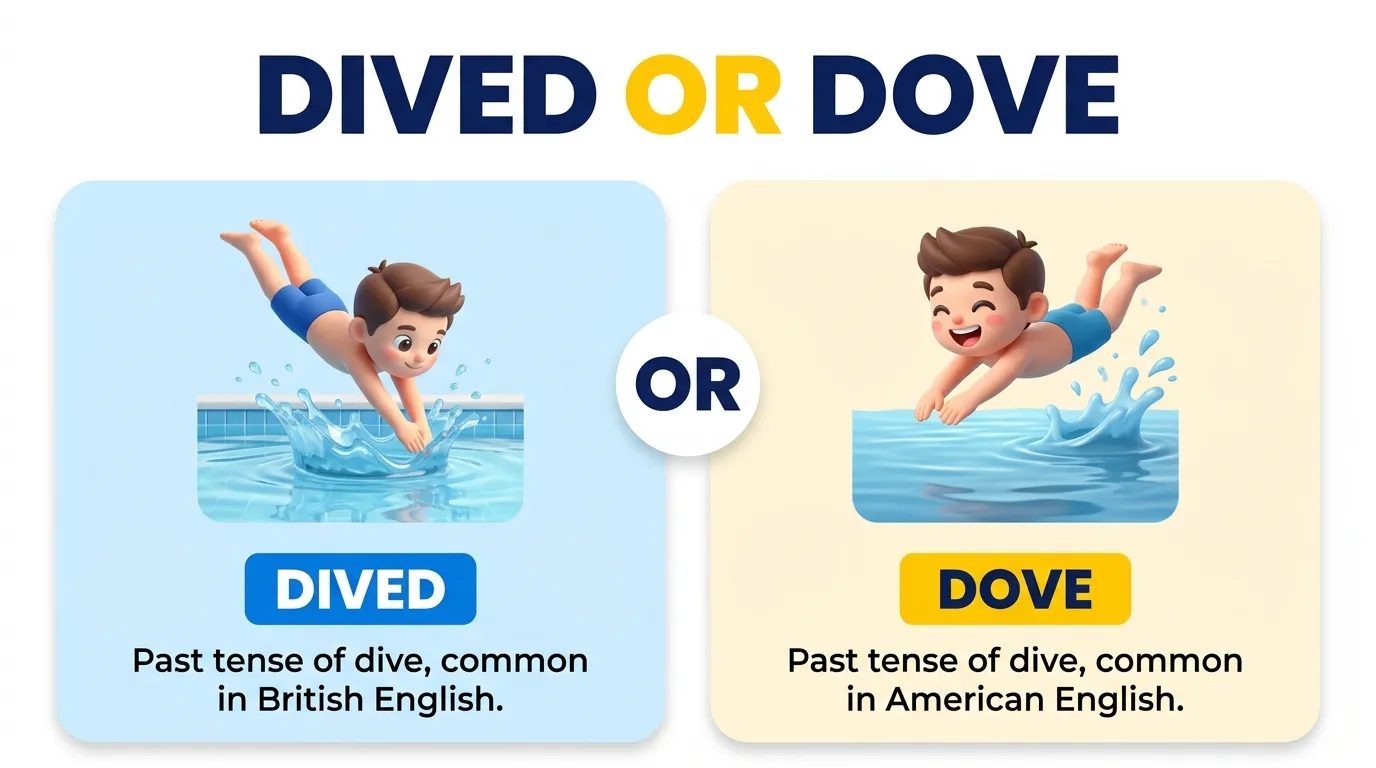
Both dived and dove are correct past tense forms of the verb dive. However, dove is more common in American English, while dived is widely used in British English and other forms of English. For the past participle, use dived.
You are writing a short story about a swimming trip. You type, “She dove into the pool,” but then your spell checker suggests “dived.” Now you are unsure which word is right.
The good news is that both dived and dove can describe the same action. The main difference is where each form is used. However, there is one more grammar rule to know when using words like “has” and “had.” Let’s make the choice easy.
Dived or Dove: Quick Answer
Both dived and dove are correct when you talk about something that happened in the past. They are past tense forms of the verb dive, which means to jump or move headfirst into water or another place.
For example:
- She dived into the swimming pool.
- She dove into the swimming pool.
Both sentences are correct. However, American writers often prefer “dove,” while British writers usually prefer “dived.”
Remember, when you use “has,” “have,” or “had,” choose dived.
The Origin of Dived and Dove
The word dive has a long history in the English language. It comes from an old English word that meant to dip or sink into something.
For many years, people used dived as the past tense of dive. This form follows a simple English rule. You add “-ed” to the end of a verb to show that an action happened in the past.
However, English also has verbs that change their middle vowel in the past tense. For example:
- Drive becomes drove.
- Ride becomes rode.
- Write becomes wrote.
During the 1800s, American English began using dove in the same way. The change likely happened because people saw a similar pattern in words like drive and drove.
As a result, both forms became part of standard English. Today, Americans commonly use “dove,” while British English still favors “dived.”
Dived or Dove Explained: Key Differences
The main difference between these words is regional use. Their meaning is almost the same when they describe a past action.
Dived is the regular past tense of dive. It is common in British English and is also correct in American English.
Dove is an irregular past tense. It is especially common in American English and sounds natural in everyday American speech and writing.
Here are some examples:
- The boy dived into the lake yesterday.
- The boy dove into the lake yesterday.
Both examples tell us that the boy entered the water in the past.
However, there is another important difference. The word “dived” is also the standard past participle used with has, have, and had.
For example:
- She has dived into this pool before.
- They had dived into the water before the rain started.
Avoid writing “She has dove into the pool” in standard formal English.
Comparison of Dived and Dove
| Term | Meaning | When to Use | Region/Context |
|---|---|---|---|
| Dived | Past action of diving | Simple past and past participle | British and American English |
| Dove | Past action of diving | Simple past only | Common in American English |
| Dive | Present form of the verb | Current or future actions | All English varieties |
The Three Forms of Dive
It helps to learn all three verb forms together.
| Verb Form | Word | Example |
|---|---|---|
| Present | Dive | I dive every summer. |
| Simple past | Dived | I dived yesterday. |
| Simple past | Dove | I dove yesterday. |
| Past participle | Dived | I have dived before. |
| Present participle | Diving | I am diving today. |
Notice that “dove” works as a simple past form. However, “dived” is the form to use with has, have, and had.
Which One Should You Use?
Your choice depends on your audience and the type of writing you are doing.
Here is a simple guide to help you choose.
For American English, use dove when talking about a past action. It sounds natural to most American readers.
Example: “The child dove into the swimming pool.”
For British English, use dived because it is the usual past tense form.
Example: “The child dived into the swimming pool.”
For formal writing, use dived if you want a form that works across different English-speaking regions. It is also the correct choice for the past participle.
Example: “The swimmer has dived into the pool many times.”
For schoolwork and English learners, use dived when you want a simple form that is widely accepted. However, you can also use dove in American English when your teacher or style guide accepts it.
In short, both words are correct, but your audience can help you make the best choice.
Common Mistakes with Dived and Dove
Many people mix up these words because English has different rules for regular and irregular verbs. Here are some common mistakes and easy ways to avoid them.
Using Dove in Every Situation
Incorrect: She has dove into the lake.
Correct: She has dived into the lake.
Why does this happen? People know that “dove” is a correct past tense form. However, they may not know that “dived” is the standard past participle.
Thinking Dove Is Always Wrong
Incorrect idea: Dove is never a correct past tense form.
Correct: He dove into the river.
Why does this happen? Some people learn only the regular form, “dived.” However, “dove” is also accepted in standard American English.
Using Dived and Dove Together Without a Reason
Incorrect: He dove into the pool and then dived into the lake.
Better: He dove into the pool and then dove into the lake.
Why does this matter? Both forms are correct, but changing between them without a reason can make your writing feel uneven. Choose one style and keep it consistent.
Using Dove After Did
Incorrect: Did she dove into the water?
Correct: Did she dive into the water?
Why? The helping verb “did” already shows that the action happened in the past. So, the main verb must stay in its base form.
Confusing Dove with the Bird
Incorrect idea: Dove always means a bird.
Correct: The swimmer dove into the water.
Why does this happen? The word “dove” can be a noun or a verb. As a noun, it can mean a type of bird. As a verb, it is the past tense of dive.
Dived or Dove in Real-World Examples
Seeing these words in everyday situations makes their use easier to understand. Here are examples from different types of writing.
In a Professional Email
“Hello Team,
The rescue swimmer dived into the water to help the person in need. Thankfully, everyone was safe.
Best regards.”
This example uses “dived” because it works well in professional writing.
In a News Headline
“Young Swimmer Dove Into the Lake to Save a Dog”
Here, “dove” gives the headline a natural American English style.
In a Social Media Post
“Had a great day at the beach! I finally dove into the ocean for the first time.”
This sentence sounds natural for an American social media post.
In a Formal Document
“The trained swimmer has dived into the pool several times during the test.”
In this case, “dived” is the correct past participle after “has.”
In Everyday Conversation
“My brother dove into the pool before anyone else.”
This is a natural way to describe a past action in American English.
Dived or Dove: Data, Trends and Usage
People search for “dived or dove” because they want to know which word is correct. The confusion often comes from seeing both forms in books, school lessons, news stories, and everyday conversations.
The search usually has an informational purpose. Readers want a quick grammar answer, clear examples, and a rule they can use in their own writing.
Here are some common groups of readers who care about this difference:
- Students: They want to use the correct verb form in homework and exams.
- Teachers: They need to explain regular and irregular verbs.
- Writers: They want their work to sound natural and clear.
- Editors: They need to keep the same English style throughout a document.
- English learners: They want to understand why one verb has two past tense forms.
In American English, “dove” is a familiar choice. Meanwhile, “dived” remains widely accepted and is more common in British English.
One useful point is that people may also search for “dove vs. dived,” “past tense of dive,” and “is dove a word?” These searches all show the same need: people want a simple way to understand the two forms.
Therefore, learning the difference can help you write better emails, school papers, stories, and everyday messages.
Dived or Dove: Comparison at a Glance
Still unsure which word to choose? This table gives you a quick way to remember the rules.
| Term/Variant | Meaning | Region/Context | Best Used When |
|---|---|---|---|
| Dived | Past tense of dive | British English | Writing for British readers |
| Dove | Past tense of dive | American English | Writing for American readers |
| Dived | Past participle of dive | All English varieties | Used after has, have, or had |
| Dive | Present form | All English varieties | Talking about a current or future action |
| Diving | Ongoing action | All English varieties | Talking about an action in progress |
Easy memory tip: Use “dove” or “dived” for a simple past action. Use “dived” after has, have, or had.
Frequently Asked Questions
1. Is it dived or dove?
Both dived and dove are correct past tense forms of the verb dive. However, dove is more common in American English, while dived is preferred in British English.
2. Is dove the past tense of dive?
Yes, dove is an accepted past tense form of dive, especially in American English. For example, “The boy dove into the pool” is correct.
3. Is dived or dove correct in American English?
Both forms are correct in American English. However, dove is very common in everyday American speech and writing, while dived is also accepted.
4. Can you say has dove or has dived?
The standard form is has dived. For example, “She has dived into the ocean before” is correct. Avoid “has dove” in standard formal writing.
5. Is dove more correct than dived?
No, neither word is more correct in every situation. Both are accepted past tense forms, but their popularity depends on the type of English you use.
6. Why do Americans say dove instead of dived?
The word dove developed in American English during the 1800s. It likely followed the pattern of other verbs, such as drive and drove.
7. Should I use dived or dove in a school essay?
Both can be correct, depending on the English style your school follows. However, dived is a safe choice because it is accepted across English varieties and also works as the past participle.
Final Thoughts on Dived or Dove
Choosing between dived and dove is easier once you know the simple rule. Both words are correct past tense forms of dive, but they are used more often in different parts of the English-speaking world.
Remember these key points:
- Use dove for a past action in American English.
- Use dived for a past action in British English.
- Use dived after has, have, and had.
- Keep your word choice consistent throughout your writing.
The best advice is to think about your readers before choosing a form. If you write for an American audience, dove is a natural choice. For British readers or a style that works across regions, dived is a great option.
Now that you know the difference, you can use both words with confidence. Keep practicing with real examples, and your English will become clearer every day.
Curious about more confusing English words? Check out our guide to You and I or You and Me.

I have been writing about English spelling and word usage for the past five years. My goal is to give readers a clear answer without overwhelming them with complicated rules. At WordsCombo, I focus on making everyday English easier for everyone.