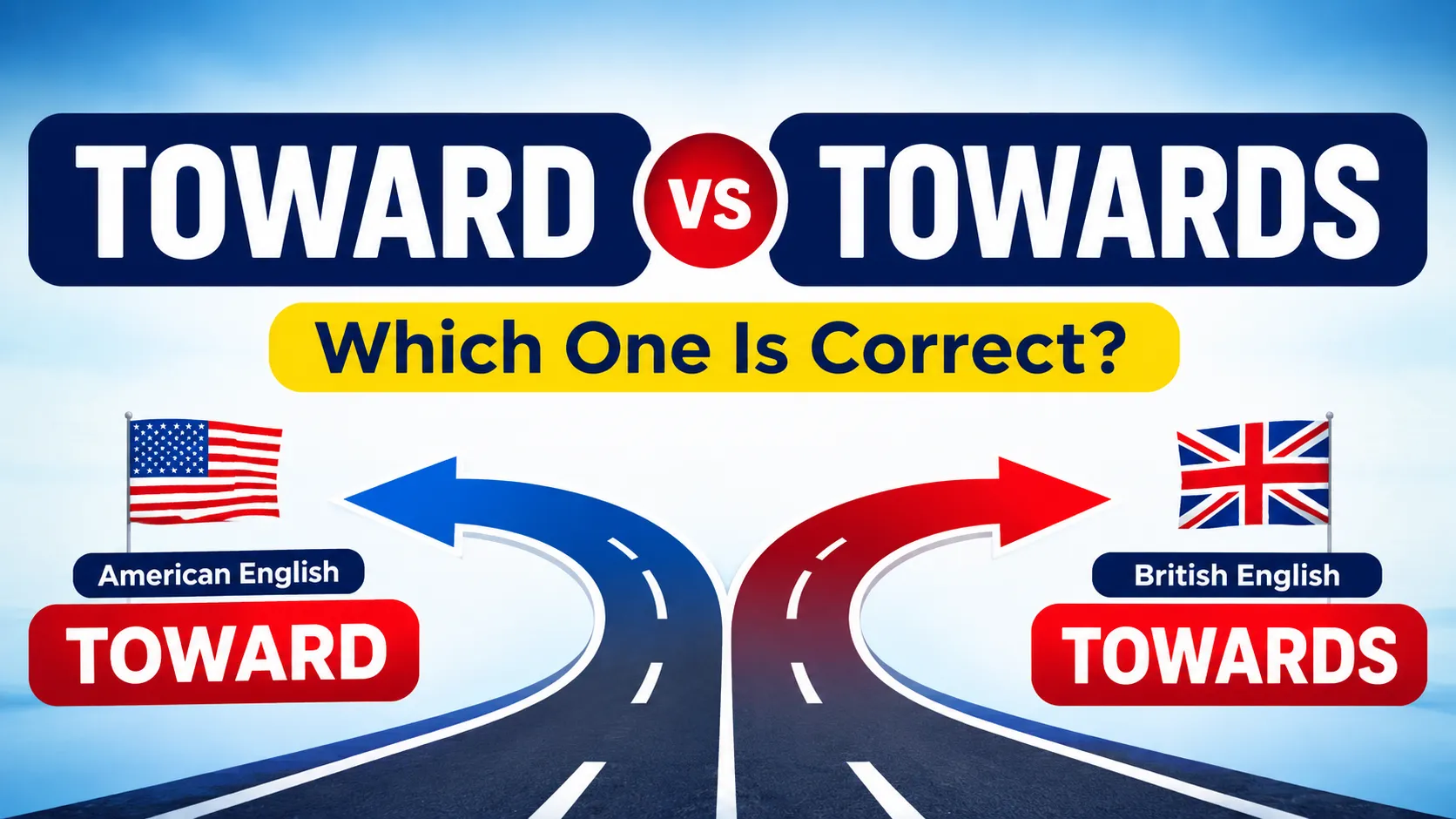
Towards or toward means “in the direction of” or “closer to.” Both spellings are correct, but toward is more common in American English, while towards is more common in British English.
Have you ever written a sentence like “She walked toward the door” and then stopped to wonder, Should it be towards instead?
This is a small English choice, but it can cause a surprising amount of doubt. Many learners think one form must be right and the other must be wrong. That is not the case.
Both toward and towards are standard English words. They have the same basic meaning. The main difference is regional preference and style.
When teaching English, one of the most useful lessons is that not every spelling difference is an error. English has many pairs that vary by region. Toward/towards is one of them.
The good news is that you do not need to memorize a long list of rules. Once you understand where each form is common, the choice becomes simple.
This guide explains the meaning, history, regional differences, common mistakes, and real world use of towards or toward. By the end, you will know which form to choose with confidence.
Towards or Toward
Toward and towards are prepositions. They usually describe movement or direction.
For example:
- She walked toward the station.
- She walked towards the station.
Both sentences are correct.
The same rule applies when the word describes a change in attitude, time, or a goal:
- We are working toward a solution.
- We are working towards a solution.
The key difference is simple:
- Toward → preferred in American English.
- Towards → preferred in British English and common in other varieties of English.
Neither form is grammatically wrong.
The Origin and Background of Towards or Toward
The word toward has a long history in English.
It comes from older English forms that combined the idea of “to” with a word meaning “direction” or “side.” Over time, English speakers developed both toward and towards.
This is not unusual in English.
You can see similar variation in words such as:
- afterward / afterwards
- backward / backwards
- forward / forwards
- upward / upwards
- downward / downwards
In many cases, the version with s is more common in British English, while the version without s is often preferred in American English.
That explains why you may see toward in an American news story and towards in a British newspaper.
Language changes through use. English does not always follow one single pattern across every country.
So if you learned towards at school but later see toward in American writing, there is no need to think you learned it incorrectly.
Towards or Toward Explained: Key Differences and Variations
The biggest difference is regional usage, not meaning.
| Term | Meaning | When to Use | Region/Context |
|---|---|---|---|
| toward | In the direction of | Movement, goals, time, attitudes | Common in American English |
| towards | In the direction of | Movement, goals, time, attitudes | Common in British English |
| forward | In front or ahead | Direction or progress | Common worldwide |
| forwards | In front or ahead | Direction or progress | More common in British English |
1. Toward
Toward is especially common in American English.
Examples:
The child ran toward his mother.
We are moving toward a better solution.
The meeting starts toward the end of the day.
2. Towards
Towards is especially common in British English.
Examples:
The child ran towards his mother.
We are moving towards a better solution.
The meeting starts towards the end of the day.
Notice something important: the meaning does not change.
You can replace one with the other in these examples without changing the basic message.
Which Version Should You Use?
Your best choice depends on your audience.
If you write for an American audience
Use toward.
For example:
The company is working toward its annual goal.
This form is widely preferred in American English.
If you write for a British audience
Use towards.
For example:
The company is working towards its annual goal.
This form sounds natural in British English.
If you write for a global audience
Either form is correct. The most important thing is consistency.
If your article uses toward, keep using toward. Do not switch randomly between the two forms.
For international websites, toward can be a useful choice because it is common in American English and widely understood elsewhere. But towards is also completely acceptable.
If you are taking an English exam
Follow the variety of English your course teaches.
If your school teaches British English, towards may be the more natural choice. If your course follows American English, toward may be preferred.
The main rule is simple:
Do not treat a regional preference as a grammar error.
Common Mistakes with Towards or Toward
Mistake 1: Thinking “towards” is always wrong
Wrong idea: “Toward is the only correct spelling.”
Correction: Both toward and towards are correct.
This mistake often comes from learning one variety of English and assuming it is the only variety.
Mistake 2: Thinking “towards” has a different meaning
Mistake: Believing that towards means something different from toward.
Correction: They normally have the same meaning.
Compare:
He walked toward the building.
He walked towards the building.
The meaning is the same.
Mistake 3: Mixing styles without a reason
You might write:
We moved toward the goal and later worked towards a solution.
There is nothing grammatically wrong with the sentence. However, if you are following one style guide, consistent usage is usually cleaner.
Better: Choose one form and use it throughout your document.
Mistake 4: Using “to” when “toward” is needed
These words can have different meanings.
She walked to the library.
This usually means the library was her destination.
She walked toward the library.
This means she moved in the library’s direction. It does not always mean she reached it.
That small difference can matter.
Mistake 5: Assuming the longer word is more formal
Some learners think towards sounds more formal because it has an extra letter.
It does not.
Toward is not less formal than towards, and towards is not more formal than toward.
The choice is mainly about English variety and style.
Towards or Toward in Real World Examples
Seeing both forms in real situations makes the rule easier to remember.
Professional Email
We are working toward a final agreement and hope to complete the process soon.
A British writer could use:
We are working towards a final agreement and hope to complete the process soon.
Both are professional.
News Headline
City Moves Toward a Cleaner Transport System
A British publication might write:
City Moves Towards a Cleaner Transport System
Again, the meaning stays the same.
Social Media Post
Small steps toward a big goal. Keep going!
Or:
Small steps towards a big goal. Keep going!
Both sound natural.
Formal Report
The project has moved toward its main objectives.
Or:
The project has moved towards its main objectives.
The right choice depends on the style of the document and the variety of English being used.
Towards or Toward: Data, Trends, and Usage
The usage pattern is strongly linked to regional English.
Toward is especially common in the United States. Towards is especially common in the United Kingdom and is also widely used in other countries influenced by British English.
This matters for writers, students, editors, and SEO content creators.
If your readers are mainly American, toward will usually feel more natural. If your readers are mainly British, towards may sound more natural.
Searches such as “towards or toward,” “toward vs towards,” “is towards correct,” and “towards meaning” often come from learners who are trying to remove uncertainty from their writing.
The real lesson is useful beyond this one word:
English has regional standards. Correct English does not always mean one spelling for every English speaking country.
Towards or Toward: Standalone Comparison Table
| Term/Variant | Meaning | Region/Context | Best Used When |
|---|---|---|---|
| toward | In the direction of | American English | Writing for U.S. readers |
| towards | In the direction of | British English | Writing for U.K. readers |
| toward | Closer to a goal or result | International/formal writing | When following American style |
| towards | Closer to a goal or result | International/formal writing | When following British style |
The easiest rule to remember is:
American English → toward
British English → towards
But both are correct.
Frequently Asked Questions About Towards or Toward
Q: What does toward or towards mean?
A: Both words usually mean “in the direction of” or “closer to.” They can describe physical movement, progress, time, goals, or attitudes.
Q: How do you use toward correctly?
A: Use toward before a noun or noun phrase to show direction or progress. For example: “She walked toward the door” or “We are working toward a solution.”
Q: What is the difference between toward and towards?
A: There is usually no difference in meaning. Toward is more common in American English, while towards is more common in British English.
Q: Is towards acceptable in formal writing?
A: Yes. Towards is fully acceptable in formal writing, especially in British English. It is not an informal or incorrect form.
Q: Which is correct: toward or towards?
A: Both are correct. Choose the form that matches your preferred English variety. Use toward for American English and towards for British English.
Q: Where does the word toward come from?
A: Toward developed from older English words linked to the ideas of “to” and “direction.” The form towards developed as a variant with the added s.
Q: Can I use toward in British English?
A: Yes. British English speakers understand toward, and it is not grammatically wrong. However, towards is often the more natural British preference.
Q: Can I use towards in American English?
A: Yes. Americans understand towards, and it does appear in American writing. However, toward is generally the more common American choice.
Q: Is toward a preposition?
A: Yes. Toward is commonly used as a preposition. It can show direction, movement, or a relationship to a goal or result.
Q: Is toward more formal than towards?
A: No. Neither word is more formal by itself. The difference is mainly regional preference and writing style.
Conclusion
So, towards or toward? The answer is much easier than it first appears.
Both words are correct. Both usually carry the same meaning. The main difference is where they are most commonly used.
Remember these three points:
- Toward is more common in American English.
- Towards is more common in British English.
- Both forms work in formal and informal writing.
If you are writing for American readers, toward is the safest natural choice. If you are writing for British readers, towards is often the better fit.
Most importantly, do not worry when you see the other form. It is not a grammar mistake. It is simply one of the many small variations that make English such a rich language.
Once you know your audience, the choice becomes easy. Pick one style, stay consistent, and keep writing with confidence.
Bookmark this guide so you never second guess “towards or toward” again.
Read more: Treck or Trek: The Easy Spelling Guide

I started writing about English word differences after years of teaching students who kept making the same mistakes. My focus is on making spelling rules feel simple and easy to remember. At WordsCombo, I turn confusing word pairs into clear comparisons.




1 thought on “Towards or Toward: The Easy Guide to Correct Usage”