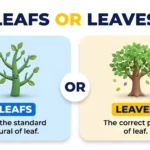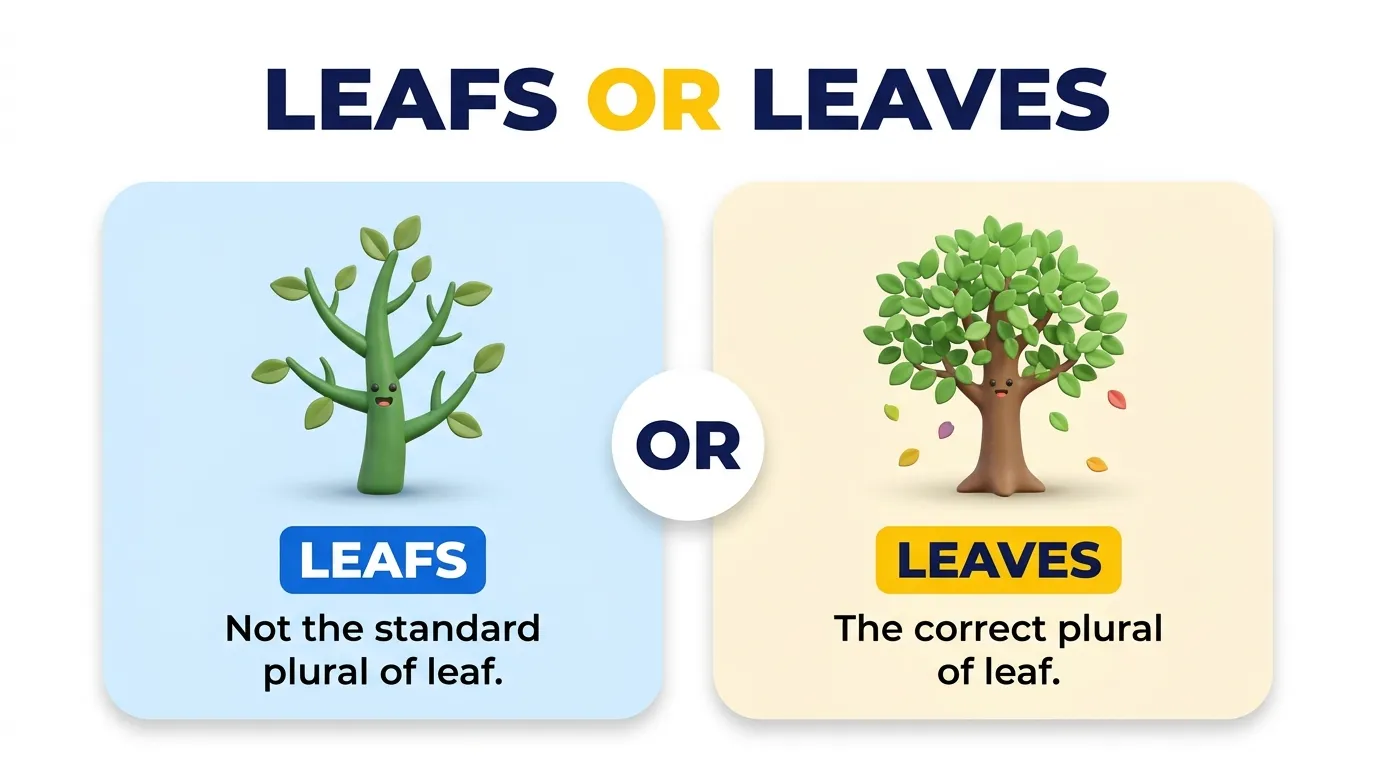
Leaves is the correct plural of leaf when talking about more than one leaf on a tree. Leafs is not the standard plural form, but it can be used as a verb or in certain proper names.
When you write about a tree, the word leafs or leaves on a tree can cause a spelling mix-up. You might type “leafs” in a school assignment, email, or nature post without knowing it is wrong. The correct word is leaves because most nouns ending in F change to VES in the plural. However, some words follow different rules. Let’s look at the difference, see real examples, and learn how to use each word correctly.
Leafs or Leaves: The Quick Answer
Leaves is the correct plural of leaf when you talk about trees, plants, or flowers. You should use leaves whenever you mean two or more plant leaves.
For example:
- Correct: The tree has many green leaves.
- Incorrect: The tree has many green leafs.
However, leafs can be correct in other cases. For example, “She leafs through a book” uses leafs as a verb.
The Origin of Leafs or Leaves
The word leaf comes from Old English lēaf. It has been used for the green parts of plants for hundreds of years.
Over time, English developed different ways to make nouns plural. Some words simply add S, but others change their spelling.
Leaf follows the F-to-V pattern. The final F changes to V, and ES is added. As a result, the plural becomes leaves.
You can see the same pattern in these words:
- Knife becomes knives.
- Wife becomes wives.
- Life becomes lives.
- Wolf becomes wolves.
- Shelf becomes shelves.
However, not every word ending in F follows this rule. For example, roof becomes roofs, and chief becomes chiefs.
This is why you should learn the correct plural form of leaf instead of guessing.
Leafs or Leaves Explained: Key Differences
The main difference between leafs and leaves is their use in a sentence. Leaves is the standard plural noun, while leafs has a few special uses.
Here are some simple examples:
- The leaves on the tree are turning yellow.
- She leafs through her old photo album.
- The Toronto Maple Leafs play ice hockey.
In the first sentence, leaves means more than one plant leaf. In the second, leafs describes someone turning pages. The third uses Leafs as part of a team name.
| Term | Meaning | When to Use | Region/Context |
| Leaf | One plant leaf | Talking about one leaf | Standard English |
| Leaves | More than one leaf | Talking about tree or plant leaves | Standard English |
| Leafs | A form of the verb leaf | Describing someone turning pages | Standard English |
| Leafs | Part of a team name | Writing the Toronto Maple Leafs name | Canadian sports |
Why Is Leaves the Correct Plural?
Most people know that you can make a word plural by adding S. However, some English words change their final letters.
Leaf is one of these words.
- One leaf
- Two leaves
- Three leaves
- Many leaves
Therefore, adding only S does not give you the standard plural form.
Is Leafs Ever Correct?
Yes, leafs is a real English word. However, you should not use it as the normal plural of leaf when talking about trees.
It can be correct in these situations:
- As a verb: He leafs through the newspaper every morning.
- In a team name: The Toronto Maple Leafs won the game.
- In special technical contexts: Some writers use leafs for certain leaf-like parts or tree structures.
For everyday writing, remember that a tree has leaves, not leafs.
Which One Should You Use?
Your choice depends on what you want to say. If you are writing about nature, trees, or plants, leaves is the right word.
Here is some simple advice for different readers:
For students: Use leaves in schoolwork, essays, and homework because it is the correct plural of leaf.
For writers and bloggers: Choose leaves when describing trees, gardens, flowers, and plants. This spelling is clear and accepted in standard English.
For teachers: Teach the F-to-V spelling pattern with examples such as leaf to leaves and knife to knives.
For professional writing: Use leaves in reports, emails, articles, and formal documents when you mean more than one plant leaf.
For neutral everyday writing: Always choose leaves when you are talking about several leaves on a tree.
If you are unsure, try replacing the word with “one leaf.” If you mean more than one, write leaves.
Common Mistakes with Leafs or Leaves
Many people make spelling mistakes because English plural rules are not always simple. However, a few easy examples can help you avoid these errors.
Using Leafs Instead of Leaves
- Incorrect: The tree has many green leafs.
- Correct: The tree has many green leaves.
This mistake happens because most nouns form their plural by adding S. However, leaf follows a different spelling rule.
Writing Leafes Instead of Leaves
- Incorrect: The garden is full of leafes.
- Correct: The garden is full of leaves.
Some writers add ES without changing the F. Remember that the F changes to V before adding ES.
Using Leaves for One Leaf
- Incorrect: I found several leaves, but this one leaves is beautiful.
- Correct: I found several leaves, but this one leaf is beautiful.
The word leaves means more than one leaf when it is a noun. Therefore, use leaf when you mean only one.
Confusing Leafs with Leaves as a Verb
- Incorrect: She leaves through the magazine.
- Correct: She leafs through the magazine.
Here, leafs means turning pages. However, leaves comes from the verb leave, which means to go away.
Changing a Proper Name
- Incorrect: The Toronto Maple Leaves played last night.
- Correct: The Toronto Maple Leafs played last night.
The team’s official name uses Leafs. Proper names keep their official spelling, even when it differs from a normal plural rule.
Leafs or Leaves in Real-World Examples
Seeing the words in everyday situations makes their meanings easier to understand. Here are examples from different types of writing.
Professional Email
Subject: Garden Maintenance Update
“The garden looks much better after the recent cleanup. We removed the dry leaves and trimmed the damaged branches.”
News Headline
“Strong Winds Blow Colorful Leaves Across City Streets”
Social Media Post
“Autumn is here! The colorful leaves make every walk feel special.”
Formal Document
“Several leaves showed signs of damage after the heavy rain.”
School Assignment
“A tree uses its leaves to collect sunlight and make food.”
Sports Report
“The Toronto Maple Leafs played an exciting game last night.”
Notice how the spelling changes with the meaning. Use leaves for plant parts, but keep Leafs when writing the official team name.
Leafs or Leaves: Data, Trends and Usage
The keyword leafs or leaves on a tree reflects a common spelling and grammar question. People often search for this phrase when they are unsure how to write the plural form of leaf.
The search has a clear informational purpose. Most readers want a quick answer, simple examples, and an easy rule they can use in their own writing.
Different groups may search for this topic:
- Students want the right spelling for homework and school assignments.
- English learners want to understand irregular plural nouns.
- Teachers look for simple examples to explain spelling rules.
- Bloggers and writers want to avoid spelling mistakes in their content.
- Nature lovers may want the right words for describing trees and plants.
Search interest can also rise during autumn because people write more about falling leaves, colorful trees, and seasonal changes.
Another reason this topic matters is that spelling tools may not explain the difference between a noun and a verb. A reader might see leafs in a sentence and think it is always wrong. However, its meaning depends on how it is used.
The easiest lesson is simple: leaves is the standard plural of leaf, while leafs has special uses.
Leafs or Leaves: Comparison at a Glance
Use this table whenever you need a quick spelling check.
| Term/Variant | Meaning | Region/Context | Best Used When |
| Leaf | One plant part | All English varieties | Talking about one leaf |
| Leaves | Two or more plant parts | American, British, and other English varieties | Describing tree foliage |
| Leafs | Verb form of leaf | Standard English | Talking about turning pages |
| Leafs | Official proper name | Canadian sports | Naming the Toronto Maple Leafs |
| Leafes | Incorrect plural spelling | Not standard English | Do not use it |
| Leaf’s | Possessive form | Standard English | Showing that something belongs to one leaf |
Frequently Asked Questions About Leafs or Leaves
Is it leafs or leaves on a tree?
Leaves is correct when talking about more than one leaf on a tree. For example, “The leaves on the tree are green.” You should not write “The leafs on the tree are green.”
What is the correct plural of leaf?
The correct plural is leaves. The spelling changes from F to V before adding ES, so one leaf becomes two leaves.
Why do we say leaves instead of leafs?
English has some irregular plural spelling rules. Because leaf follows the F-to-V pattern, its standard plural form is leaves.
Is leafs ever correct in formal writing?
Yes, but only in the right context. You can write “He leafs through a report” or use Leafs in the official name Toronto Maple Leafs. However, leafs is not the standard plural noun for tree leaves.
What is the difference between leafs and leaves?
Leaves is the plural form of the noun leaf. On the other hand, leafs is a verb form that can describe someone turning pages, or it can appear in a proper name.
Is it maple leafs or maple leaves?
Use maple leaves when talking about the leaves growing on a maple tree. However, use Maple Leafs when referring to the Toronto hockey team.
How do you write leaves in a sentence?
You can write, “The leaves fell from the tree during the storm.” Here, leaves is a plural noun because it refers to more than one leaf.
Is leafes a correct spelling?
No, leafes is not the correct plural spelling of leaf. The correct form is leaves, with V before ES.
Final Thoughts on Leafs or Leaves
Choosing between leafs or leaves on a tree is easy once you know the plural rule. The correct word is leaves when you are talking about two or more leaves growing on a tree or plant.
Remember these simple points:
- Leaf means one plant leaf.
- Leaves means more than one leaf.
- Leafs is used as a verb or in special names.
- Leafes is not a correct standard spelling.
So, whenever you write about green trees, autumn colors, or fallen leaves, choose leaves. It is the correct spelling in standard English. Keep practicing with simple sentences, and you will remember the difference. Share this easy spelling rule with someone learning English today!
Curious about more confusing English words? Explore Meny or Many.

I started writing about English word differences after years of teaching students who kept making the same mistakes. My focus is on making spelling rules feel simple and easy to remember. At WordsCombo, I turn confusing word pairs into clear comparisons.