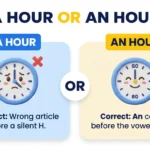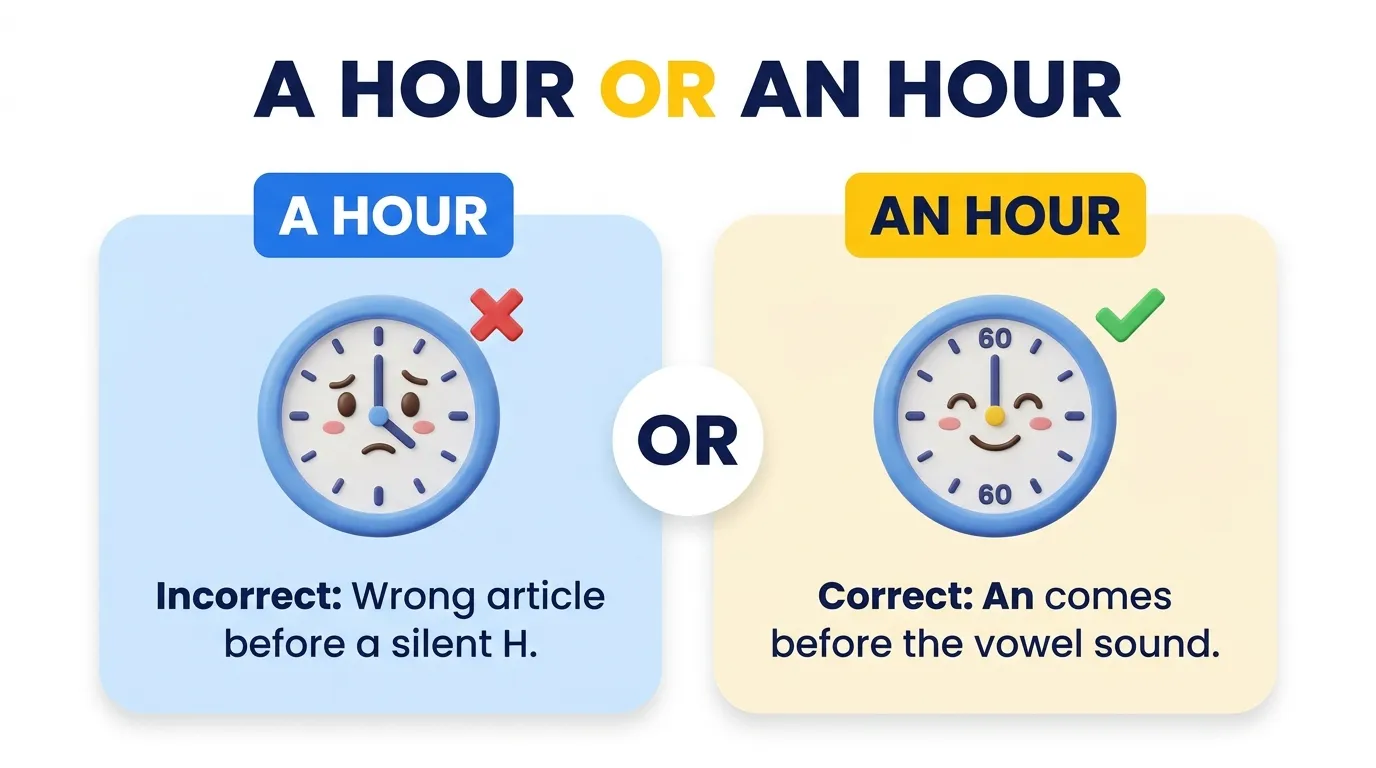
An hour is correct. A hour is incorrect because the letter H in hour is silent. The word begins with a vowel sound, so you must use an before it.
Have you typed “a hour” in an email and then stopped because it looked wrong? This small grammar mistake can make anyone pause. The correct choice between a hour or an hour depends on pronunciation, not spelling. Since hour sounds like “our,” it needs an before it. In this guide, you will learn the simple rule, see real examples, and discover how to avoid this mistake in everyday and professional writing.
A Hour or An Hour: Quick Answer
An hour is the only correct choice in standard English. The H in hour is silent, so the word starts with a vowel sound.
Use these examples:
- Correct: I will finish the work in an hour.
- Incorrect: I will finish the work in a hour.
- Correct: She waited for an hour outside.
Remember, a comes before consonant sounds, while an comes before vowel sounds.
The Origin of An Hour
The word hour has a long history. It comes from the Old French word hore, which came from the Latin word hora. Both words referred to a set period of time.
The Latin word came from the Greek word hora, which also meant time or season. Over time, the word became part of the English language.
However, the letter H in hour is not pronounced in modern English. This is why the word sounds like “our” rather than “how-er.”
The words a and an also have an interesting history. Both come from an older form of English that meant one. As English sounds changed, speakers began using an before vowel sounds to make speech flow more easily.
That is why we say an hour, not a hour.
A Hour or An Hour Explained: Key Differences
The main difference between a and an is the sound that follows them. You should listen to the first sound of the next word instead of looking only at its first letter.
Why An Hour Is Correct
The H in hour is silent. When you say the word aloud, it sounds like “our.”
Because the first sound is a vowel sound, an is the correct article.
Examples:
- I need an hour to finish my homework.
- The meeting lasted an hour.
- We will reach the airport in an hour.
- Give me an hour to get ready.
Why A Hour Is Incorrect
The article a normally comes before a word that starts with a consonant sound.
However, hour does not have a spoken H sound. Therefore, using a before hour breaks the basic sound rule.
For example:
- Incorrect: I have a hour before my next class.
- Correct: I have an hour before my next class.
A vs. An: Understanding the Rule
Here is an easy way to remember the difference:
| Term | Meaning | When to Use | Region/Context |
| A | An indefinite article | Before consonant sounds | Standard English |
| An | An indefinite article | Before vowel sounds | Standard English |
| An hour | A period of 60 minutes | Before hour | American and British English |
| A hour | Incorrect phrase | Not used in standard English | No standard regional use |
The rule also works with other words.
- An honest person: The H is silent.
- An honor: The H is silent.
- A house: The H is pronounced.
- A hotel: The H is pronounced.
- A university: The word starts with a Y sound.
- An umbrella: The word starts with a vowel sound.
In short, always focus on pronunciation rather than the first written letter.
Which One Should You Use?
The answer is simple. Use an hour whenever you talk about a period of 60 minutes.
Here is how to use it in different situations.
For students: Use an hour in school assignments, essays, and homework.
Example: I spent an hour studying English.
For professionals: Use an hour in business emails, reports, and meeting plans.
Example: The client meeting will take an hour.
For everyday conversations: Use an hour when talking about time with friends or family.
Example: I will call you in an hour.
For formal writing: Choose an hour because it follows standard English grammar.
No matter who you are writing for, an hour is the correct choice.
Common Mistakes with A Hour or An Hour
Even people who speak English every day can make small article mistakes. Here are some common errors and their correct forms.
Using A Before Hour
Incorrect: I will be there in a hour.
Correct: I will be there in an hour.
Why it happens: People see the letter H and think it must take a. However, the H is silent.
Using An Before Hotel
Incorrect: We stayed at an hotel.
Correct: We stayed at a hotel.
Why it happens: Some people think every word starting with H needs an. But hotel has a clear H sound.
Writing A Hour in Emails
Incorrect: Please give me a hour to check the report.
Correct: Please give me an hour to check the report.
Why it happens: People may write quickly and forget to check how the word sounds.
Confusing Half an Hour with An Hour
Incorrect: The class lasted half an hour and a half.
Correct: The class lasted half an hour.
Why it happens: Both expressions include the word hour, but their meanings are different. Half an hour means 30 minutes.
Using An Before One-Hour
Incorrect: We had an one-hour meeting.
Correct: We had a one-hour meeting.
Why it happens: One begins with a W sound, not a vowel sound. Therefore, it needs a.
A Hour or An Hour in Real-World Examples
Seeing the correct phrase in different situations can help you remember it. Here are some examples you can use in daily life.
Professional Email
Subject: Meeting Schedule
Hello,
The project review will take an hour. Please make sure you are available at the scheduled time.
Thank you.
News Headline
Heavy Traffic Causes an Hour of Delay
The traffic problem caused long delays for drivers during the morning rush.
Social Media Post
“Finally finished my work after an hour of hard work. Time for a break!”
Formal Document
“The training session will last an hour, followed by a short question and answer session.”
Everyday Conversation
- I will be back in an hour.
- It takes an hour to reach the office.
- She spent an hour reading her favorite book.
- We talked for an hour last night.
These examples show that an hour works naturally in both casual and formal English.
A Hour or An Hour: Data, Trends and Usage
People search for a hour or an hour because the written form can be confusing. The letter H is a consonant, but it is silent in the word hour.
This creates a common problem for English learners, students, writers, and people who use English at work.
Where Is This Phrase Commonly Used?
The phrase appears in many everyday situations:
- Education: Students use it when writing about study time and class schedules.
- Work: Employees use it in meeting plans and time reports.
- Travel: People use it to describe journey times and delays.
- Daily conversations: Friends and family use it when making plans.
What Do People Want to Know?
Most searches have an informational purpose. People want to know which phrase is correct and why.
Common search interests include:
- Is it a hour or an hour?
- Why do we say an hour?
- Is an hour grammatically correct?
- Why is the H in hour silent?
- Is it half an hour or half a hour?
Why Does This Grammar Rule Matter?
Small grammar errors can affect the quality of your writing. Using the correct article makes your sentences sound natural and clear.
Also, learning this rule helps you understand other words with silent letters. Once you know why an hour is correct, choosing the right article becomes much easier.
A Hour or An Hour: Comparison at a Glance
Use this table as a quick reference whenever you are unsure about the correct phrase.
| Term/Variant | Meaning | Region/Context | Best Used When |
| An hour | A period of 60 minutes | All standard English | Talking about one hour |
| A hour | Incorrect grammar | Nonstandard usage | Never in standard writing |
| Half an hour | 30 minutes | British and American English | Talking about half of an hour |
| A half hour | 30 minutes | Common in American English | Talking about a 30-minute period |
| An hour-long meeting | A meeting lasting 60 minutes | All standard English | Describing the length of a meeting |
| A one-hour meeting | A meeting lasting 60 minutes | All standard English | Using one-hour before a noun |
The easiest rule is to remember that an hour is correct, while a hour is not.
Frequently Asked Questions
Is It A Hour or An Hour?
An hour is correct. The H in hour is silent, so the word starts with a vowel sound. Therefore, you should use an instead of a.
Why Do We Say An Hour Instead of A Hour?
We say an hour because English articles depend on sound, not just spelling. Since hour sounds like “our,” it needs an before it.
Is A Hour Ever Correct in English?
No, a hour is not correct in standard English. You should always write an hour in schoolwork, emails, professional documents, and everyday messages.
Is It Half an Hour or Half a Hour?
Half an hour is correct. The H in hour is silent, so an is needed. This phrase means 30 minutes.
Is An Hour Correct in Formal Writing?
Yes, an hour is fully correct in formal English. You can use it in business emails, school essays, reports, and official documents.
Why Is the H Silent in Hour?
The word hour came into English through French, from the Latin word hora. Its spelling kept the H, but the sound became silent in modern English.
Is It A One-Hour Meeting or An One-Hour Meeting?
A one-hour meeting is correct. The word one starts with a W sound, so it takes a rather than an. However, you should write an hour-long meeting because hour starts with a vowel sound.
Final Thoughts on A Hour or An Hour
Choosing between a hour or an hour is easy once you understand the sound rule. An hour is always the correct choice in standard English because the H in hour is silent. Remember that a comes before consonant sounds, while an comes before vowel sounds.
Use an hour in emails, school assignments, business reports, and everyday conversations. Also, remember similar words like an honest person and an honor. These examples follow the same rule.
The next time you write about 60 minutes, choose an hour with confidence. Keep practicing this simple rule, and your English writing will become clearer and more natural!
Curious about more English grammar tips? Explore Chris’s or Chris’.

I have been writing about English spelling and word usage for the past five years. My goal is to give readers a clear answer without overwhelming them with complicated rules. At WordsCombo, I focus on making everyday English easier for everyone.