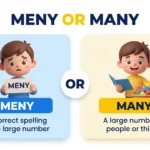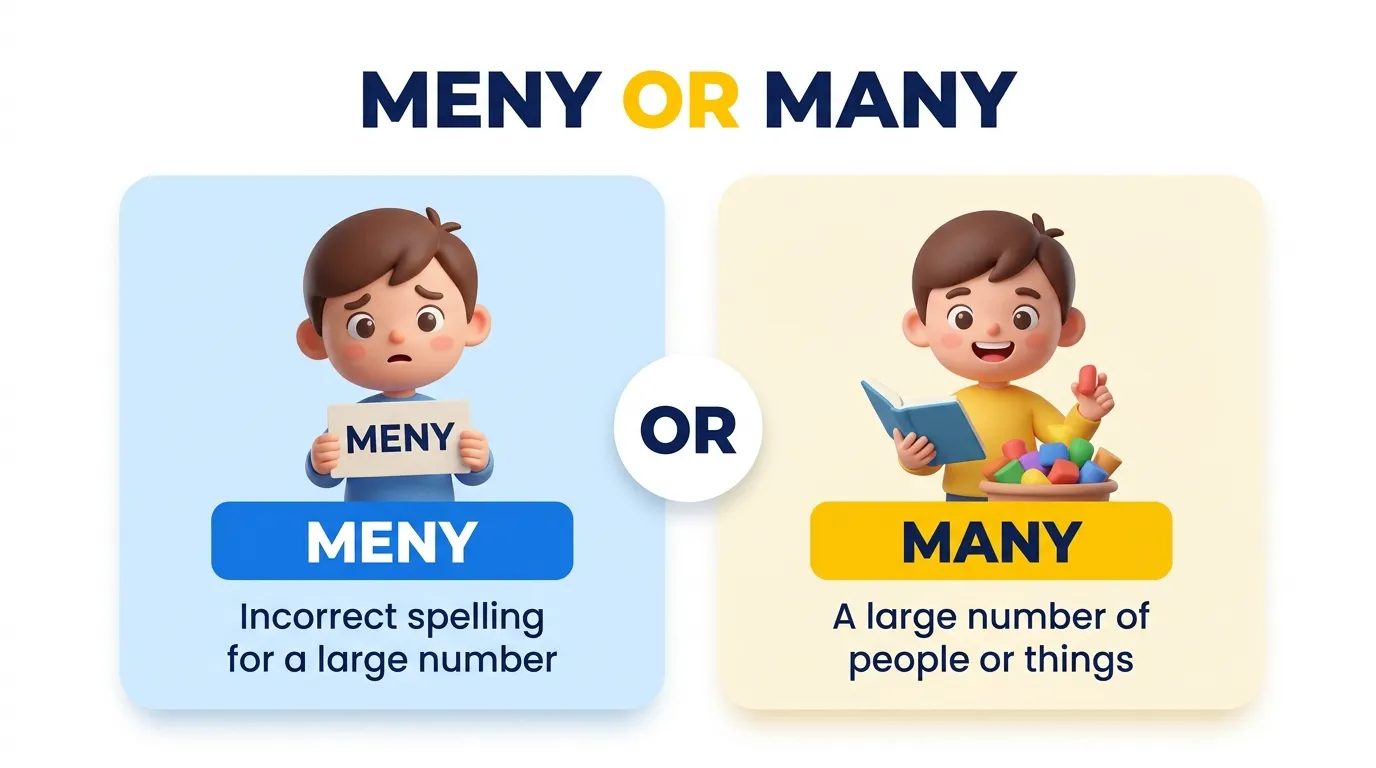
Many is the correct spelling when you mean a large number of people or things. Meny is a spelling mistake when used with this meaning.
You are writing an email and type, “I have meny questions.” Then, a red line appears under the word. Should you write meny or many? The answer is many, and the same spelling works in American and British English.
Although the two forms may sound alike, only many is the standard spelling for a large number. This guide explains the meaning, grammar, common mistakes, and easy ways to remember the correct word.
Meny or Many: Quick Answer
Many is the correct English word. It means a large number of people, animals, or things that you can count.
For example:
- Correct: Many students joined the class.
- Incorrect: Meny students joined the class.
So, whenever you mean a large number, choose many. The spelling does not change between American and British English.
The Origin of Many
The word many has a long history in English. It comes from the Old English word manig, which meant a large number or a great amount.
Over time, the spelling changed into the form we use today. However, the word meny did not become a standard spelling of many.
The confusion often comes from pronunciation. Many is pronounced like “MEN-ee,” so some learners may think the first vowel should be an e. Still, English spelling does not always match the way a word sounds.
Meny or Many Explained: Key Differences
The main difference is simple. Many is a standard English word, but meny is not the standard spelling when you want to describe a large number.
What Does Many Mean?
Many means a large number of people or things. You use it with plural countable nouns, such as books, chairs, students, and questions.
For example:
- Many books are on the shelf.
- She has many friends.
- How many days are left?
- We received many questions after the meeting.
In each sentence, you can count the people or things being discussed.
What Does Meny Mean?
Meny is not the standard English spelling of the word meaning a large number. If you write “meny people,” readers will usually understand what you mean, but the spelling is incorrect.
However, a similar group of letters might appear as a name or in another language. That does not make meny a correct replacement for many in ordinary English writing.
Many vs. Meny at a Glance
| Term | Meaning | When to Use | Region or Context |
|---|---|---|---|
| Many | A large number | Before plural countable nouns | American and British English |
| Meny | Not the standard spelling of many | Do not use for this meaning | Usually a spelling error |
Check These Examples
- Correct: There are many cars outside.
- Incorrect: There are meny cars outside.
- Correct: How many tickets do you need?
- Incorrect: How meny tickets do you need?
As you can see, the correct spelling is always many when you mean a large number.
Which One Should You Use?
Choose many whenever you want to talk about a large number of things you can count. The word is correct in everyday writing, schoolwork, business messages, and formal reports.
Here is how to use it in different settings:
- For students: Use many in homework, essays, and class notes because it is the correct spelling.
- For business writers: Write many in emails, reports, and work messages to keep your writing clear.
- For bloggers and website owners: Use many in articles and web pages because correct spelling helps readers trust your content.
- For social media users: Write many in posts and comments, even when the tone is casual.
- For English learners: Remember that many has an a, not an e, in the middle.
In short, there is no standard American or British spelling choice to make here. Use many in both varieties of English.
Common Mistakes with Meny or Many
Spelling is not the only thing to watch. You also need to use many with the right kind of noun.
Writing Meny Instead of Many
Incorrect: We have meny plans for the weekend.
Correct: We have many plans for the weekend.
This mistake often happens because the word sounds like it begins with an e sound. However, the correct spelling uses the letter a.
Using Many With a Singular Noun
Incorrect: She has many friend.
Correct: She has many friends.
Because many refers to a large number, it normally goes with a plural noun.
Using Many Instead of Much
Incorrect: I do not have many money.
Correct: I do not have much money.
The word many goes with countable things, but much usually goes with things we do not count one by one. For example, you can count coins, but money is often treated as an uncountable noun.
Misspelling Common Phrases
Incorrect: How meny books did you buy?
Correct: How many books did you buy?
The same rule applies to familiar phrases such as these:
- Too many people
- So many choices
- How many questions
- As many as ten students
Once you learn the correct spelling, these phrases become easier to write.
Thinking Meny Is a British Spelling
Incorrect: British English uses meny, while American English uses many.
Correct: Both varieties use many.
Some words do have different British and American spellings, such as colour and color. However, many is spelled the same way in both.
Meny or Many in Real-World Examples
Seeing the word in everyday situations can help you remember how to spell and use it.
In a Professional Email
Subject: Questions About the Project
“Hi Alex, I have many questions about the project timeline. Could we arrange a short meeting to discuss them?”
Here, many tells the reader that you have a large number of questions.
In a News Headline
“Many Families Prepare for Winter Storm”
News headlines often use many to describe a large number of people or things without giving an exact count.
In a Social Media Post
“Many small steps can lead to big changes. Keep going, even when progress feels slow!”
In this example, many makes the message clear and easy to understand.
In a Formal Document
“Many applicants submitted their forms before the deadline.”
This sentence works well in a report, school paper, or business document because many is correct in formal writing too.
In Everyday Conversation
“How many apples should I buy?”
“We need many apples for the party.”
The first sentence is a natural question. The second is grammatically possible, though “We need a lot of apples for the party” sounds more natural in everyday conversation.
Meny or Many: Data, Trends and Usage
People who search for meny or many usually want a quick spelling answer. They may be checking a message, correcting schoolwork, or learning English.
The search has a clear purpose: the reader wants to know which spelling is right and how to use it.
These are the main reasons the topic matters:
- Spelling checks: Writers want to fix errors before sending emails or publishing posts.
- English learning: Students need to learn how spelling and pronunciation can differ.
- Grammar help: Some readers also need to know when to use many instead of much.
- Formal writing: Workers and students want to avoid simple mistakes in important documents.
There is no need to guess how popular either spelling is without reliable search data. Still, the practical lesson is clear: learning many helps you write common questions and statements correctly.
Meny or Many: Comparison at a Glance
| Term or Variant | Meaning | Region or Context | Best Used When |
|---|---|---|---|
| Many | A large number | Standard English worldwide | You mean several or a large number of countable things |
| Meny | A nonstandard spelling for this meaning | Common typing or spelling error | You should correct it to many |
| Much | A large amount | Standard English | You refer to an uncountable noun |
| A lot of | A large number or amount | Everyday English | You want a natural phrase for casual conversation |
| Numerous | A large number | More formal English | You want a formal alternative to many |
For most everyday sentences, many is the best choice when you are talking about countable things. However, much is better for uncountable nouns, while “a lot of” often sounds more natural in casual statements.
Frequently Asked Questions
Is it many or meny?
Many is the correct standard English spelling when you mean a large number of people or things. However, meny is not the standard spelling for this meaning.
What does many mean in English?
Many means a large number of people or things that can be counted. For example, “Many students passed the test” means a large number of students passed.
Is meny a real English word?
Meny is not the standard English spelling of many. It may appear as a name or in another language, but you should use many when writing about a large number in standard English.
Is many correct in formal writing?
Yes, many is correct in formal writing, including reports, essays, and work emails. For example, “Many customers shared their feedback” is clear and grammatically correct.
Is many spelled differently in British and American English?
No, both American and British English use many. Unlike words such as color and colour, this word has no standard regional spelling difference.
Why do people spell many as meny?
People may write meny because many sounds like “MEN-ee.” However, pronunciation does not always tell you which letters to use, so it helps to remember the spelling M-A-N-Y.
Should I use many or much?
Use many with countable nouns, such as books, chairs, and people. On the other hand, use much with uncountable nouns, such as water, time, and money.
Final Thoughts on Meny or Many
Choosing between meny or many is easy once you learn the correct spelling. Many is the right word when you mean a large number of people or things. Meanwhile, meny is a spelling error when used with that meaning.
Remember these key points:
- Spell the word M-A-N-Y.
- Use many with plural countable nouns.
- Choose much for most uncountable nouns.
- Use many in both American and British English.
Now you can write emails, school assignments, reports, and social posts with more confidence. Before you send your next message, check your spelling and make sure you have used many, not meny. Keep practicing, and correct spelling will soon feel natural!
Curious about similar words? Explore Marriage or Mariage.

I started writing about English word differences after years of teaching students who kept making the same mistakes. My focus is on making spelling rules feel simple and easy to remember. At WordsCombo, I turn confusing word pairs into clear comparisons.