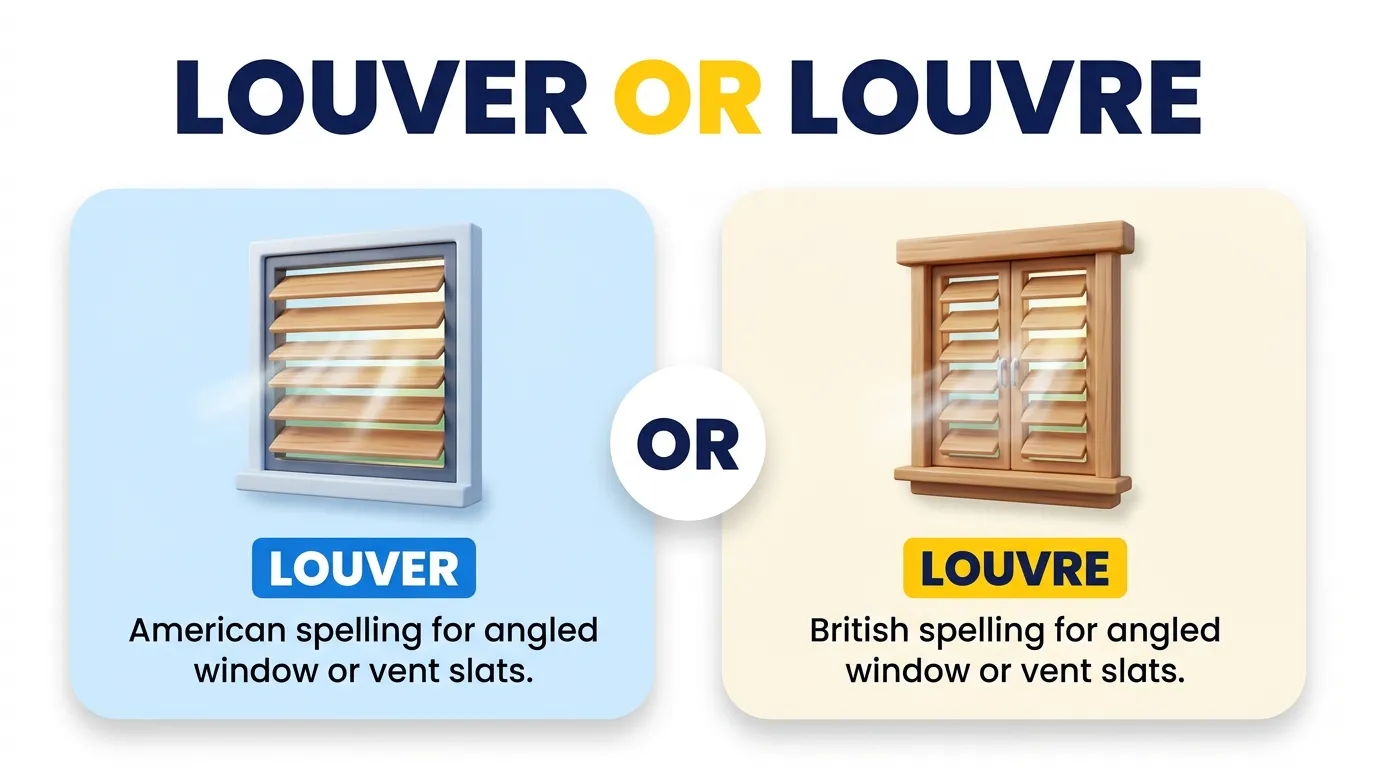
Louver and louvre are two spellings of the same word. Louver is the standard American English spelling, while louvre is the standard British English spelling. Both describe sloping slats in doors, windows, or vents that let air and light pass through.
You are about to finish a home improvement email when you notice two spellings: louver and louvre. Both look right, but which one should you choose? The answer depends on your audience. Louver is preferred in the United States, while louvre is common in British English. Both words describe angled slats that allow air and light to enter while helping keep rain and direct sunlight out. This guide explains their meanings, origins, differences, and correct uses so you can choose the right spelling with confidence.
Louver or Louvre: The Quick Answer
Both louver and louvre are correct spellings of the same word. The main difference is the region where each spelling is used.
- Louver: The preferred spelling in American English.
- Louvre: The preferred spelling in British English and other forms of English that follow British spelling.
For example:
- The new house has wooden louvers on its windows.
- The office has metal louvres for better air flow.
Both sentences are correct. However, the first follows American spelling, while the second follows British spelling.
The Origin of Louver and Louvre
The word has a long history that goes back to the Middle Ages. It entered English through Old French, with older forms linked to a roof opening or structure that allowed smoke to escape.
In early buildings, people needed a way to let smoke out without allowing too much rain or snow inside. So, they used raised roof structures with angled openings.
Over time, these structures became more advanced. Builders added sloping wooden boards to control air and light.
As the word spread, different English-speaking regions began to favor different spellings. American English adopted louver, while British English kept louvre.
Today, both spellings describe the same basic feature. The difference is mainly a matter of regional spelling.
Louver and Louvre Explained: Key Differences
The easiest way to understand these words is to look at where they are used.
Louver is the usual choice in American writing. You will often see it in building plans, product descriptions, home improvement guides, and heating or cooling systems.
On the other hand, louvre is common in British writing. It appears in descriptions of windows, doors, shutters, and ventilation systems.
Here are the main differences:
| Feature | Louver | Louvre |
| Meaning | Angled slats for air and light | Angled slats for air and light |
| Region | American English | British English |
| Plural | Louvers | Louvres |
| Adjective | Louvered | Louvred |
| Pronunciation | LOO-ver | LOO-vuh |
| Common use | US building and home design | UK building and home design |
Both spellings refer to slats that can be made from wood, metal, plastic, or glass.
For example, a louvered window may let fresh air enter while reducing direct sunlight. Similarly, a louvred door can provide air flow while giving people some privacy.
Remember: The spelling changes, but the basic meaning stays the same.
Which One Should You Use?
Your choice should depend on the people who will read your writing. Both forms are correct, but using the local spelling makes your work look more natural.
For American readers, use louver.
If you are writing for people in the United States, choose louver. It is the standard American form.
Examples:
- The kitchen has a wooden louver.
- We need new louvers for the ventilation system.
- The contractor installed louvered shutters.
For British readers, use louvre.
If your audience is in the United Kingdom, choose louvre. This is the standard British form.
Examples:
- The bedroom has a wooden louvre.
- The building needs new ventilation louvres.
- The house has louvred window shutters.
For international readers, choose one spelling and stay consistent.
If your readers come from different countries, either form can work. However, choose the spelling that matches your main audience.
For example, an American company should normally use louver in its product guides. A British company should use louvre.
Common Mistakes with Louver and Louvre
These spellings are easy to mix up. However, a few simple rules can help you avoid common errors.
1. Using louvre in American writing
Incorrect for standard US usage: The house has wooden louvres.
Correct: The house has wooden louvers.
This mistake happens because British spelling is also widely understood. Still, American readers normally expect the spelling with an e missing at the end.
2. Using louver in British writing
Incorrect for standard UK usage: The windows have metal louvers.
Preferred British form: The windows have metal louvres.
The meaning is clear either way, but British writing usually keeps the extra e.
3. Mixing plural forms
Incorrect: The room has three louvres and two louvers.
Better: The room has three louvers and two more louvers.
Alternatively, British writing should use louvres throughout.
The mistake happens when writers switch between regional spelling styles.
4. Confusing louver with the Louvre museum
The word Louvre can also refer to the famous art museum in Paris, France.
For example: We visited the Louvre during our trip to Paris.
However, this is a proper name. It is not the same use as the common noun louvre, which describes angled slats.
5. Using the wrong adjective form
American English uses louvered, while British English often uses louvred.
For example:
- US: The house has louvered doors.
- UK: The house has louvred doors.
Therefore, remember to match the adjective to the spelling style you are using.
Louver and Louvre in Real-World Examples
Seeing these words in everyday writing makes their differences easier to understand. Here are some examples from common situations.
Professional Email
“Hello Mark, we have selected wooden louvers for the office windows. They will help improve air flow.”
This example uses American English. For a British customer, you could write “wooden louvres.”
News Headline
“New Office Building Adds Modern Louvers for Better Ventilation”
The spelling fits an American news headline. However, a British newspaper would likely use “Louvres.”
Social Media Post
“Fresh air makes a big difference! Our new louvered windows help create a comfortable home.”
This is a natural example of American spelling.
Formal Document
“The building design includes adjustable louvers to control sunlight and improve ventilation.”
This spelling works well in an American building plan or report. For a British document, use “louvres.”
Home Improvement Description
“These wooden louvers offer a simple way to improve air flow while adding style to your home.”
This example shows how the word appears in product descriptions and home design content.
Louver or Louvre: Usage, Search Trends and Why It Matters
People usually search for louver or louvre when they need to choose the correct spelling for a building, window, door, or ventilation product.
The search has a clear spelling and meaning intent. Readers want to know whether the two forms mean different things or simply follow different regional rules.
Several groups may look for this information:
- Homeowners: They may see both spellings while shopping for window shutters or doors.
- Builders and architects: They need the right terms for plans, designs, and building reports.
- Students: They may want to understand the difference between American and British English.
- Writers and editors: They need to keep spelling consistent in articles and documents.
- Product sellers: They may use either spelling in product names and descriptions based on their target market.
American spelling is especially useful for US websites, product pages, and home improvement content. Meanwhile, British spelling fits UK readers and many other audiences that follow British English.
Another reason this topic matters is online shopping. A person searching for louvers may find American products, while someone searching for louvres may see British product listings.
Although the spelling differs, the search goal is often the same. People want to find the right product or understand how it works.
The best approach is simple: use the spelling that matches your audience and keep it consistent across your content.
Louver or Louvre: Comparison at a Glance
Here is a quick table to help you remember the main differences.
| Term/Variant | Meaning | Region/Context | Best Used When |
| Louver | Angled slat or ventilation opening | American English | Writing for US readers |
| Louvre | Angled slat or ventilation opening | British English | Writing for UK readers |
| Louvers | More than one louver | American English | Describing multiple slats |
| Louvres | More than one louvre | British English | Describing multiple slats |
| Louvered | Having louvers | American English | Describing doors or windows |
| Louvred | Having louvres | British English | Describing doors or windows |
Quick tip: If you are writing for an American audience, remember the spelling without the final e. For British readers, keep the final e.
Frequently Asked Questions
Is louver or louvre correct?
Both louver and louvre are correct English spellings. However, louver is the standard American form, while louvre is the standard British form.
What does louver mean?
A louver is a set of angled slats placed in a door, window, shutter, or vent. These slats allow air and some light to pass through while helping keep rain and direct sunlight out.
What is the difference between louver and louvre?
There is no major difference in meaning. Louver is used in American English, while louvre is used in British English.
Is louver acceptable in formal writing?
Yes, louver is perfectly acceptable in formal American English. You can use it in reports, building plans, emails, product descriptions, and other professional documents.
Is it louver or louvre in American English?
Louver is the correct standard spelling in American English. For example, an American builder would normally write “wooden louvers” when describing window slats.
Where did the word louvre come from?
The word has roots in Middle English and Old French. It was linked to openings in older buildings that allowed smoke to escape while helping keep rain out.
Is it louvered or louvred?
Both forms are correct, but the choice depends on regional spelling. Louvered is the usual American form, while louvred is the British form.
Final Thoughts on Louver or Louvre
Choosing between louver and louvre is easy once you know the regional rule. Both words have the same basic meaning, but their spelling changes between American and British English.
Remember these simple points:
- Use louver for American readers.
- Choose louvre for British readers.
- Write louvers or louvres for the plural.
- Use louvered or louvred for the describing form.
The best choice is the one your audience expects. So, before you publish an article, send an email, or finish a building report, check your target region and stay consistent.
Now you can use either spelling with confidence. Keep this simple rule in mind, and you will not have to second-guess yourself again.
Curious about more confusing English words? Explore Optimization or Optimisation.

I studied English literature and have spent years editing content for blogs and digital platforms. I noticed most people struggle with choosing between two similar words. At WordsCombo, I make that choice simple and clear.