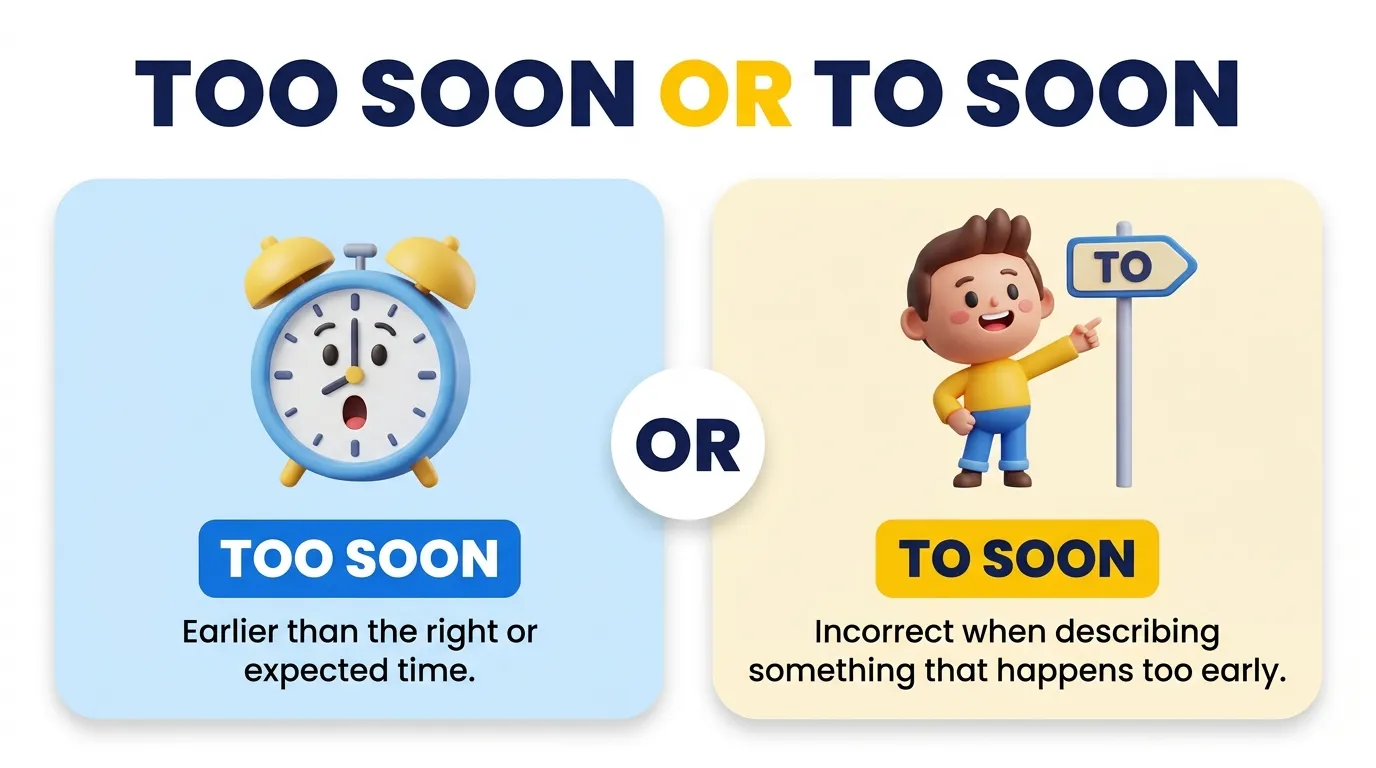
Too soon is the correct phrase when something happens earlier than expected or before the right time. To soon is incorrect when you want to express this meaning.
You are writing an email and type, “Is it too soon to ask for an update?” Then you pause because “to soon” also looks familiar. This is a common mix-up because to and too sound the same. However, they have different jobs in a sentence. The good news is that the rule is simple. Once you know what each word means, you can choose the right phrase in emails, schoolwork, social posts, and everyday writing.
Too Soon or To Soon: Quick Answer
Too soon is the correct phrase when you mean something is happening before the right, expected, or desired time.
The word too means more than needed or more than is right. The word soon means in a short time. Together, they describe something that happens earlier than it should.
For example:
- Correct: It is too soon to make a final choice.
- Incorrect: It is to soon to make a final choice.
- Correct: She arrived too soon for the meeting.
Remember, use too soon when you want to say that more time is needed.
The Origin of Too Soon and To Soon
The confusion between too soon and to soon comes from the way English words sound. Both words are pronounced the same, but their meanings are different.
The word to comes from Old English and has long been used to show direction, movement, or a link to an action. For example, you can go to school or learn to swim.
The word too also has roots in Old English. Over time, its spelling gained an extra letter o to help separate it from to. Today, too can mean also or more than needed.
Meanwhile, soon comes from an old English word that meant quickly or immediately. Its meaning still relates to something happening in a short time.
This history helps explain why people mix up these words. However, their roles in modern English are clear.
Too Soon or To Soon Explained: Key Differences
The main difference is that too describes an amount or degree, while to often shows direction or comes before a verb.
When you say something is too soon, you mean it is happening earlier than you would like or expect. The phrase can describe a meeting, decision, visit, message, or event.
On the other hand, to soon is not correct when you want to describe early timing. You need the word too for that meaning.
Consider these examples:
- The team announced the news too soon.
- It is too soon to talk about the results.
- I need to go to work soon.
Notice the last example. Here, to comes before the verb “go,” while soon tells us when the action will happen.
Understanding the Words To, Too, and Soon
| Word | Meaning | When to Use | Example |
| To | Shows direction or comes before a verb | Movement or action | I want to learn. |
| Too | Means also or more than needed | Extra amount or degree | It is too cold. |
| Soon | Means in a short time | Future timing | See you soon. |
| Too soon | Earlier than the right time | Premature timing | It is too soon to leave. |
| To soon | Incorrect for this meaning | Avoid this phrase | It is to soon to leave. |
Simple Ways to Remember Too Soon
You can use a few easy tricks to remember the right spelling.
- The extra O trick: Too has an extra O, which can remind you of extra or more than needed.
- The too early trick: Replace too soon with too early. If the sentence keeps its meaning, use too.
- The meaning trick: Ask yourself if something is happening before the right time. If yes, choose too soon.
For example, “It is too soon to call” means the same basic thing as “It is too early to call.”
Which One Should You Use?
The right choice depends on what you want to say. However, when you mean something is happening earlier than the right time, too soon is always the correct choice.
Here is what to use in different situations:
- For students: Use too soon when writing about an early event, result, or decision. For example, “It is too soon to submit the assignment.”
- For professionals: Choose too soon when discussing deadlines, plans, or business choices. For example, “It is too soon to share the report.”
- For bloggers and social media users: Write too soon when talking about early news, jokes, or personal events.
- For formal writing: Use too soon because it is correct in both formal and informal English.
- For neutral future timing: Use soon without too. For example, “The meeting will start soon.”
In short, choose too soon for premature timing and soon for normal future timing. Never use to soon to express that something is early.
Common Mistakes with Too Soon or To Soon
Even good writers can mix up to and too. This often happens because the words sound alike. However, a few simple rules can help you avoid these errors.
Using To Instead of Too
- Wrong: It is to soon to make a choice.
- Right: It is too soon to make a choice.
This mistake happens because people forget that too means more than is right or needed.
Forgetting the Extra O
- Wrong: We arrived to soon.
- Right: We arrived too soon.
The extra O matters because it changes the word’s meaning. So, check the spelling before you send your message.
Confusing Soon with Too Soon
- Wrong: I will reach home too soon. (If you only mean that you will arrive shortly.)
- Right: I will reach home soon.
Use soon for normal future timing. However, use too soon when you think the timing is earlier than expected or wanted.
Writing Too-Soon with a Hyphen
- Wrong: It is too-soon to make a choice.
- Right: It is too soon to make a choice.
The normal phrase does not need a hyphen. Keep both words separate in everyday and formal writing.
Using Too Soon When You Mean Also
- Wrong: I want to join too soon. (If you mean you also want to join.)
- Right: I want to join too.
Here, too means also, not earlier than expected. Therefore, the meaning of the full sentence matters.
Too Soon or To Soon in Real-World Examples
Knowing the rule is helpful, but real examples make it easier to use the phrase correctly. Here are some common situations where you may need too soon.
Professional Email
Imagine you are asking your manager about a project update.
Subject: Project Update
“Hi, I wanted to ask if it is too soon to discuss the next stage of the project. Please let me know when you have time.”
This sentence works because you are asking whether the timing is right.
News Headline
A news writer may use the phrase when a major event has just taken place.
Example: “It Is Too Soon to Predict the Final Election Results”
The phrase tells readers that there is not enough time or information to make a fair judgment yet.
Social Media Post
You may want to share your feelings after a recent event.
Example: “Is it too soon to start planning another vacation?”
This sounds natural because the writer is asking whether enough time has passed.
Formal Document
In a business report, you may need to explain why a decision should wait.
Example: “It is too soon to confirm the final results of the review.”
This is clear and professional. It also shows that more time is needed before a final decision.
Everyday Conversation
You can use the phrase when talking with friends or family.
- “Is it too soon to call her?”
- “We left too soon to see the full show.”
- “It is too soon to celebrate.”
- “They moved into their new home too soon.”
These examples show that the phrase works in many everyday situations.
Too Soon or To Soon: Data, Trends and Usage
People search for too soon or to soon because they want to know which spelling is correct. Most of these searches have a clear learning goal. Users want a quick answer, simple grammar rules, and examples they can use right away.
The topic is useful for several groups:
- English learners: They want to understand the difference between to and too.
- Students: They need the right spelling for homework, essays, and exams.
- Professionals: They want to avoid spelling mistakes in emails and reports.
- Content writers: They need clear grammar for articles, posts, and web pages.
- Everyday users: They want to check a phrase before sending a text or message.
Why Do People Search for This Phrase?
The main reason is pronunciation. Since to and too sound alike, it can be hard to know which one belongs in a sentence.
However, the search also connects to other common grammar questions, such as:
- Too early or to early
- Too late or to late
- To much or too much
- To long or too long
- Too fast or to fast
These phrases follow the same basic rule. Use too when you mean more than needed or more than is right.
What Is the Main Search Intent?
The search intent is mainly informational. People want to learn the correct phrase, understand its meaning, and see examples.
A useful way to answer this search is to give the correct spelling first. Then explain the difference between the two words. Simple examples and a short comparison table also help readers find the answer quickly.
The key insight is that this small spelling choice can change how clear and professional your writing looks. Therefore, learning the rule can help you write better in almost any setting.
Too Soon or To Soon: Comparison at a Glance
Use this table to check the correct phrase and its meaning whenever you are unsure.
| Term/Variant | Meaning | Region/Context | Best Used When |
| Too soon | Earlier than expected or right | US and UK English | Something happens too early |
| To soon | Incorrect for this meaning | Nonstandard usage | Avoid this spelling |
| Soon | In a short time | US and UK English | Talking about the near future |
| Too early | Before the right time | US and UK English | Describing premature timing |
| Too late | After the right time | US and UK English | Describing a missed time |
Frequently Asked Questions
Is it too soon or to soon?
Too soon is correct when you mean something happens earlier than expected or wanted. The phrase to soon is incorrect when used with this meaning.
What does too soon mean?
Too soon means something happens before the right or expected time. For example, “It is too soon to make a final decision” means more time is needed.
What is the difference between too soon and too early?
Both phrases describe something that happens before the right time. However, too soon often focuses on timing, while too early can also describe an early time of day or an early stage.
Is too soon acceptable in formal writing?
Yes, too soon is correct in formal and informal writing. You can use it in business emails, reports, school assignments, and professional documents.
Is to soon ever correct?
No, to soon is not correct when you want to say that something happens earlier than expected. However, you can use to and soon separately in a sentence, such as “I want to visit soon.”
Why do people confuse to and too?
People confuse these words because they sound exactly the same. However, to often shows direction or comes before a verb, while too means also or more than needed.
How do you use too soon in a sentence?
Place too soon after the subject and linking verb or after the action it describes. For example, “It is too soon to leave” and “She arrived too soon” are both correct.
Final Thoughts on Too Soon or To Soon
Choosing between too soon and to soon is easy once you know the difference. The correct phrase is too soon when you mean something happens before the right time. On the other hand, soon works when you simply talk about something happening in the near future.
Remember these simple points:
- Use too to show more than needed.
- Use soon to talk about the near future.
- Avoid to soon when describing early timing.
- Keep too soon as two separate words without a hyphen.
The best way to improve is to practice using these words in your daily writing. So, before sending your next email or post, check the phrase and make the right choice. A small spelling fix can make your writing much clearer!
Curious about more confusing English words? Discover our guide to Sew or Sow.

I have a background in academic writing and spent several years as a proofreader for digital publications. Spotting differences between easily confused words became second nature to me. At WordsCombo, I share that knowledge so readers can write with confidence.