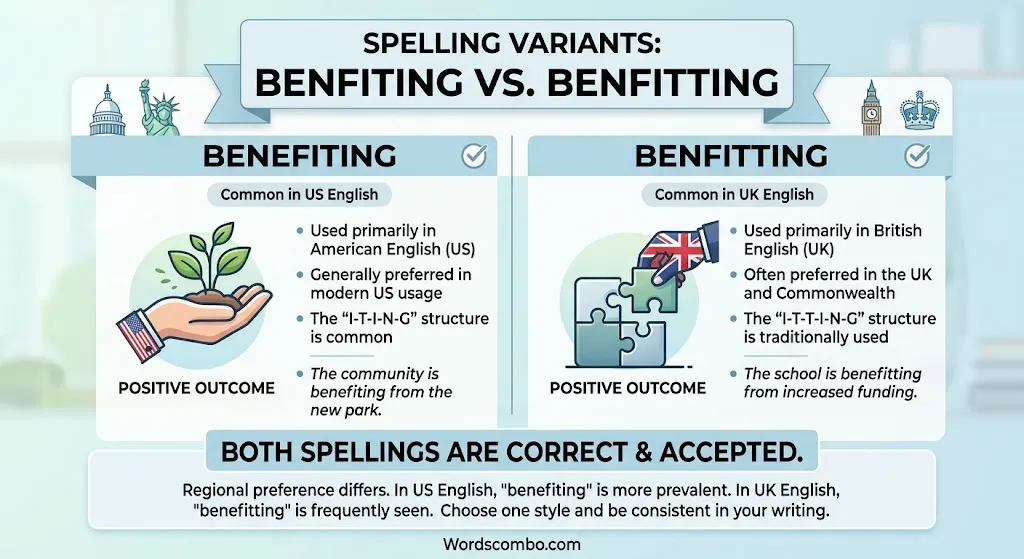
Both benefiting and benefitting are correct spellings of the -ing form of benefit. Benefiting is generally preferred in American English, while benefitting is a recognized British variant. The meaning is the same, so your choice mainly depends on the English style you are following.
If you are writing for an American audience, benefiting is the safer choice. If you are following British English, benefitting is also acceptable, although benefiting is used there too.
Why the Confusion Happens
The confusion comes from the final t in benefit. When English verbs take the -ing ending, some verbs double their final consonant:
- run → running
- sit → sitting
- begin → beginning
- permit → permitting
That makes benefitting look like the obvious form of benefit. However, English spelling patterns are not completely uniform, and benefit can take either benefiting or benefitting. Major dictionaries recognize both forms.
Regional spelling preferences also add to the uncertainty. American English generally favors benefiting, while British English permits benefitting as a variant. This is a spelling preference, not a difference in meaning or grammar.
So, if you see both forms in books, websites, or professional writing, that does not automatically mean one is a mistake.
Meanings of Benefiting and Benefitting
What does benefiting mean?
Benefiting is the present participle or gerund form of the verb benefit. It means receiving an advantage, getting help, or gaining something useful.
It can also describe something that provides an advantage to another person or group.
For example:
- Students are benefiting from the new learning program.
- The new policy is benefiting small businesses.
The word can therefore describe either receiving a benefit or providing one.
What does benefitting mean?
Benefitting has the same meaning as benefiting. It is simply the double-t spelling of the same -ing form.
For example:
- Local businesses are benefitting from increased tourism.
- Many employees are benefitting from flexible working arrangements.
There is no separate definition that makes benefitting mean something different from benefiting. The difference is spelling preference, not meaning.
Correct Usage Examples
Both forms can be used correctly. The important point is to choose the spelling that fits the English variety or style you are using.
Examples with benefiting
- The students are benefiting from extra practice.
- Many families are benefiting from the new program.
- The company is benefiting from increased demand.
- Local farmers are benefiting from better access to markets.
Benefiting is especially suitable when following American English spelling conventions.
Examples with benefitting
- The students are benefitting from additional support.
- Small businesses are benefitting from the changes.
- The community is benefitting from the new facilities.
- Employees are benefitting from improved working conditions.
Benefitting is also correct and can be used when following a British English spelling style.
Should you use both in the same document?
It is better not to switch randomly between benefiting and benefitting in the same piece of writing.
For example, using benefiting in one paragraph and benefitting in the next may make your spelling style look inconsistent. Choose the form that matches your intended audience and keep it throughout the document.
If your publication uses American English, benefiting is usually the natural choice. If it follows British English and its style guide prefers doubled consonants, benefitting may be appropriate.
Memory Trick
Use this simple trick:
One T for the US, two Ts for the UK style.
Think:
benefiting = simpler American choice
benefitting = double-T British variant
The trick is not an absolute rule because British English also uses benefiting, but it gives you a quick way to remember the most common regional preference.
You can also connect it with other familiar spelling pairs:
- traveling / travelling
- canceled / cancelled
- labeling / labelling
- modeling / modelling
These examples can help you remember that American and British English sometimes handle doubled consonants differently.
Benefitting vs Benefiting at a Glance
| Word | Status / Context | Why | Example |
| benefiting | Preferred in American English | Standard single-t spelling | The company is benefiting from the change. |
| benefitting | Valid British variant | Double-t spelling is accepted | The company is benefitting from the change. |
| benefiting | Also used in British English | Both forms can occur | Students are benefiting from the course. |
| benefitting | Not a different word | Same meaning as benefiting | Workers are benefitting from the policy. |
The key point is that benefiting vs benefitting is not a meaning-based choice. Both forms come from benefit, and both refer to gaining or providing an advantage.
Which Spelling Should You Use?
If you are unsure which version to choose, use benefiting.
It is the straightforward choice for American English and is also used in British English. Benefitting is perfectly acceptable when it matches the spelling style of your publication, school, employer, or audience.
For example:
American English:
The new system is benefiting customers.
British English:
The new system is benefitting customers.
Neither sentence changes meaning because of the extra t.
For international writing, consistency matters more than trying to force one spelling into every variety of English. If the rest of your writing follows American spelling, use benefiting. If you consistently follow a British style that uses the double-t form, benefitting is appropriate.
Similar Word Pairs to Watch For
Benefited vs Benefitted
These are the corresponding past-tense and past-participle forms of benefit. Both spellings are recognized, just as benefiting and benefitting are.
Traveling vs Travelling
This is a familiar American and British spelling difference involving a doubled consonant. American English generally uses traveling, while British English commonly uses travelling.
Canceled vs Cancelled
Both forms are widely recognized. Canceled is the usual American spelling, while cancelled is common in British English.
Labeled vs Labelled
American English generally uses labeled, while British English commonly uses labelled.
Modeling vs Modelling
American English usually uses modeling, whereas British English commonly uses modelling.
These comparisons are useful because they show why writers may hesitate over benefiting and benefitting. English spelling can vary by regional convention, even when the meaning remains exactly the same.
Mini FAQ
Is benefitting a correct spelling?
Yes. Benefitting is a recognized spelling of the -ing form of benefit. It is not automatically a spelling mistake.
Is benefiting or benefitting more common?
Benefiting is generally the safer and more widely used form, particularly in American English. Benefitting is also established, especially as a British variant.
Should I use benefiting in American English?
Yes. Benefiting is the preferred choice for most American English writing.
Is benefitting wrong in British English?
No. Benefitting is a valid British English variant. British English also uses benefiting, so the double-t spelling is not mandatory.
Do benefiting and benefitting have different meanings?
No. They have the same meaning. Both are forms of benefit and can describe receiving an advantage or providing an advantage.
Conclusion
Both benefiting and benefitting are correct. Choose benefiting for American English and as a broadly suitable option, while benefitting works when it matches your preferred British spelling style.
Want to check another similar spelling pair? See our guides to Potatoes or Potatos.

I started writing about English word differences after years of teaching students who kept making the same mistakes. My focus is on making spelling rules feel simple and easy to remember. At WordsCombo, I turn confusing word pairs into clear comparisons.




1 thought on “Benefitting or Benefiting: Which Spelling Should You Use?”