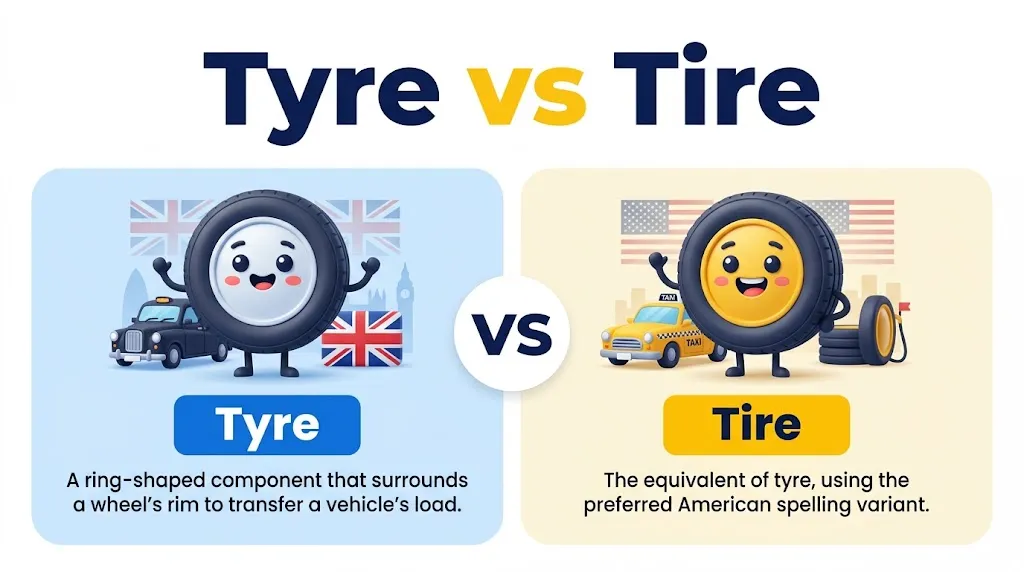
Tyre or tire refers to the rubber covering around a wheel. Tire is the standard American English spelling, while tyre is mainly used in British English.
I once caught this spelling while editing a car-related article just before it was ready to publish. The sentence looked perfectly normal, but the rest of the page was written for American readers. One small word stood out: tyre. Changing it to tire took seconds, but it showed how easily regional spelling can slip into otherwise polished writing.
That is exactly why tyre or tire causes confusion. The two words sound the same and refer to the same part of a car, truck, motorcycle, or bicycle. The difference is mainly the variety of English you are using.
For a USA audience, the choice is simple: tire is the spelling you want. If you are writing for British readers, tyre is the usual choice. The tricky part is knowing when the spelling changes and when tire has a completely different meaning.
This guide breaks down the difference, explains where each spelling comes from, and shows you how to choose the right form without second-guessing yourself.
Tyre or Tire: Quick Answer
Tire is the standard American English spelling for the rubber part fitted around a wheel.
Tyre is the usual British English spelling for the same thing.
For example:
- US: My car needs a new tire.
- UK: My car needs a new tyre.
The object is the same. The spelling changes with the regional variety of English.
There is one extra point worth knowing. Tire is also a verb meaning to become tired or exhausted. In British English, tyre is normally used for the wheel covering, while tire keeps its verb meaning.
The Story Behind Tyre and Tire
The difference between tyre and tire is not a difference in the object itself. It is a difference that developed through the history of English spelling.
Older forms of the word were written in more than one way. Over time, English speakers in different regions settled on different spellings.
American English kept tire as the normal spelling for the wheel covering. British English later favored tyre for this particular meaning.
That creates an interesting split. In American English, tire can mean both the wheel covering and the act of becoming tired.
In British English, the two meanings are usually kept visually separate:
- tyre = the rubber covering around a wheel
- tire = become tired
This distinction can help explain why a British reader may immediately notice tire in a sentence about a car.
The spelling difference does not mean that one word describes a different kind of wheel. A car tire in the United States and a car tyre in the United Kingdom are the same basic thing.
Tyre or Tire Explained: What Is the Difference?
The main difference is regional spelling.
| Term | Meaning | When to Use | Region/Context |
| Tire | Rubber covering around a wheel | American English writing | United States |
| Tyre | Rubber covering around a wheel | British English writing | United Kingdom and many other British-English settings |
| Tire | To become tired | Talking about fatigue | American and British English |
Consider these examples:
American English:
The mechanic replaced the front tire.
British English:
The mechanic replaced the front tyre.
Now look at the verb:
I tire quickly after a long day.
Here, tire means to become tired. This meaning does not change to tyre simply because the writer uses British English.
That is one of the easiest ways to avoid confusion. When you mean the wheel covering, choose the spelling that matches your audience. When you mean becoming tired, use tire.
Which Spelling Should You Use?
Your audience should decide the spelling.
If you write for American readers
Use tire.
This is the natural choice for:
- US websites
- American schoolwork
- US business writing
- American news content
- Product descriptions aimed at US customers
- Content targeting American searchers
Examples:
The car has a flat tire.
Check your tire pressure before driving.
If you write for British readers
Use tyre when referring to the wheel covering.
Examples:
The car has a flat tyre.
Check your tyre pressure before driving.
If you write for an international audience
Pick one variety of English and stay consistent.
If your website mainly targets the United States, tire is the better choice. If your audience is mainly British, use tyre.
Consistency matters more than trying to use both spellings on the same page.
Common Mistakes With Tyre or Tire
These errors are usually caused by mixing American and British English.
| Common Mistake | Better Choice | Why |
| Using tyre in US-focused writing | tire | American English uses tire |
| Using tire for a wheel in UK-focused writing | tyre | British English normally uses tyre |
| Thinking one spelling means a different product | Treat them as regional variants | The object is the same |
| Changing tire to tyre when it means “become tired” | Keep tire | The verb remains tire |
| Mixing both spellings on one page | Choose one variety | Consistency makes writing cleaner |
A common mistake is assuming that tyre and tire are two different automotive terms.
They are not.
If you are talking about the rubber covering around a wheel, the choice is mainly about regional English.
Another mistake is changing every occurrence of tire to tyre in British writing. That can create a new error when tire is being used as a verb.
For example:
I tire easily after a long walk.
The word means “become tired,” so tire is correct.
Tyre or Tire in Real-World Examples
Seeing both forms in context makes the difference much easier to remember.
Professional email
US English:
Hi Mark,
The mechanic inspected the car and recommended replacing the front tire before our next trip.
British English:
Hi Mark,
The mechanic inspected the car and recommended replacing the front tyre before our next trip.
News headline
US English:
Driver Warned After Driving on a Damaged Tire
British English:
Driver Warned After Driving on a Damaged Tyre
Social media post
US English:
Just noticed a flat tire before leaving for work. Not the start to the morning I wanted!
British English:
Just noticed a flat tyre before leaving for work. Not the start to the morning I wanted!
Formal report
US English:
The vehicle was removed from service after damage to the rear tire was discovered.
British English:
The vehicle was removed from service after damage to the rear tyre was discovered.
The sentence structure does not need to change. Only the regional spelling changes when the word refers to the wheel covering.
Tyre or Tire: Data, Trends and Search Intent
The search intent behind tyre or tire is strongly informational.
People usually search this phrase because they have seen both spellings and want to know:
- Which spelling is correct
- Whether the words have different meanings
- Which form Americans use
- Which form British speakers use
- Whether tyre is wrong in American English
- Whether tire is acceptable in British English
- Why two spellings exist
For a USA-focused audience, tire is the key form to understand because it is the standard American spelling for the wheel covering.
The query also attracts English learners, students, writers, editors, and people working with international content. Automotive context makes the confusion even more common because users regularly see both forms on websites, product pages, manuals, and international publications.
One useful insight is that this is not simply a spelling problem. It is a regional English problem.
That distinction matters when writing for search engines and people. A US reader does not need to memorize two competing spellings. They mainly need to know that tire is the natural American choice and tyre belongs to British English usage.
Tyre or Tire: Comparison at a Glance
| Term/Variant | Meaning | Region/Context | Best Used When |
| Tire | Rubber covering around a wheel | American English | Writing for US readers |
| Tyre | Rubber covering around a wheel | British English | Writing for UK readers |
| Tire | To become tired | American and British English | Describing fatigue |
| Tires | Plural of tire | American English | Referring to two or more US-style wheel coverings |
| Tyres | Plural of tyre | British English | Referring to two or more British-style wheel coverings |
The simplest rule is this:
USA = tire
UK = tyre
Become tired = tire
Once you remember those three points, this spelling choice becomes much easier.
FAQs About Tyre or Tire
Is tire or tyre correct in American English?
Tire is the standard American English spelling when you mean the rubber covering around a wheel. For a US audience, write “car tire,” “flat tire,” and “tire pressure.”
Is tyre or tire correct in British English?
Tyre is the usual British English spelling for the rubber covering around a wheel. For example, British writing normally uses “car tyre” and “flat tyre.”
Are tyre and tire the same thing?
Yes. When they refer to the rubber covering around a wheel, tyre and tire mean the same thing. The main difference is regional spelling.
Why do Americans spell tyre as tire?
American English settled on tire for the wheel covering, while British English developed a strong preference for tyre. The different spellings became established regional conventions.
Is tyre acceptable in American English?
A US reader can understand tyre, but it is not the standard American spelling for the wheel covering. If you are writing specifically for Americans, tire is the better choice.
Does tire mean something different from tyre?
Sometimes. Tire can be a noun for a wheel covering and a verb meaning to become tired. Tyre is normally used for the wheel covering in British English.
Which is better for a US website, tyre or tire?
Use tire for a US-focused website. It matches normal American spelling and will sound more natural to American readers.
Final Thoughts on Tyre or Tire
The tyre or tire question becomes simple once you separate spelling from meaning.
Tire is the standard American English spelling for the rubber covering around a wheel. Tyre is the usual British English spelling for the same object.
The two spellings do not describe different products. A tire and a tyre perform the same basic job on a vehicle.
There is also one useful meaning difference to remember. Tire works as a verb meaning “to become tired,” while British English normally reserves tyre for the wheel-related meaning.
If your readers are in the United States, choose tire. If you are writing for a British audience, choose tyre. Most importantly, keep your spelling consistent throughout the same piece of writing.
Now you know exactly when to use tyre and when to use tire. Bookmark this guide so you never have to second-guess the spelling again.
Looking for more word choices? See Behaviour or Behavior: British vs American Spelling.

I studied English literature and have spent years editing content for blogs and digital platforms. I noticed most people struggle with choosing between two similar words. At WordsCombo, I make that choice simple and clear.







1 thought on “Tyre or Tire: Easy Guide to the Correct Spelling”