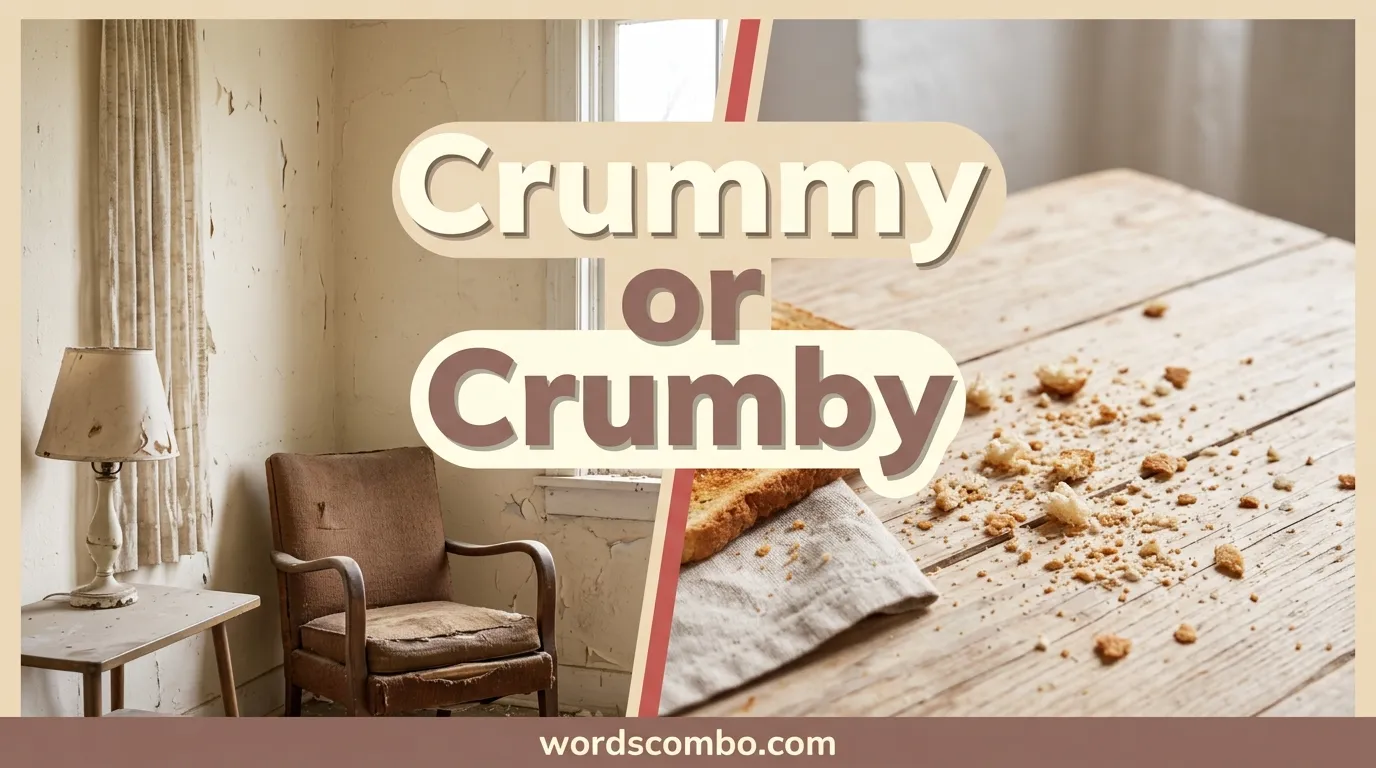
Crummy means bad, poor-quality, unpleasant, or inferior. Crumby usually means full of crumbs or like crumbs, although it can also be an accepted variant of crummy in some usage.
I caught this spelling once while editing a short piece about a bad hotel. The writer had called it a “crumby hotel.” At first glance, nothing looked wrong. The word sounded right, the sentence made sense, and even the spell-checker did not make the choice feel urgent. But the meaning gave it away. The writer meant that the hotel was bad, not that its rooms were covered in bread crumbs.
That small difference is why crummy or crumby can be tricky. Both forms are real words. Both are pronounced the same way. Yet they often point to very different ideas. Modern English usually favors crummy when you mean something poor, unpleasant, cheap, or low in quality. Crumby is the better choice when you are talking about crumbs.
The good news is that you do not need to memorize a long grammar rule. Once you connect each spelling with its meaning, the choice becomes much easier. Let’s break it down with simple examples so you can use the right word with confidence.
Crummy or Crumby: The Quick Answer
Use crummy when you mean bad, unpleasant, cheap, shabby, or poor in quality.
We had a crummy experience at the hotel.
Use crumby when something is full of crumbs or covered with crumbs.
The kitchen table was crumby after breakfast.
There is one extra detail worth knowing. Crumby can also appear as a variant spelling of crummy, especially in some British and American usage. Still, crummy is the safer choice when you mean “bad” or “poor-quality.”
The Story Behind Crummy and Crumby
The two words are closely connected.
Crumby comes naturally from crumb + -y. Its literal sense is easy to understand. Something that is crumby has crumbs in it, on it, or resembles crumbs. The word has been used for this sense for centuries.
Crummy developed as a variant spelling and later became strongly associated with the informal meaning bad, inferior, shabby, or unpleasant. The modern adjective is especially common in informal English.
This creates the spelling problem.
The words sound exactly alike, but the extra m in crummy often signals the figurative meaning people want:
- crumby = related to crumbs
- crummy = bad or poor-quality
Think of it as a meaning shortcut.
If you are talking about a messy plate after eating cookies, crumby makes sense.
If you are talking about a terrible plate, restaurant, service, or experience, crummy is usually the word you want.
Crummy and Crumby: What Is the Difference?
The easiest way to separate them is to focus on what you are describing.
| Term | Meaning | When to Use | Region/Context |
| crummy | Bad, poor, shabby, unpleasant, or inferior | When criticizing quality or an experience | Common in informal English, especially American English |
| crumby | Full of crumbs or resembling crumbs | When describing crumbs or a crumb-like texture | Literal food-related use; also a variant spelling in some English |
| crumby | Informally, bad or inferior | When used as a variant of crummy | Recognized in some American and British usage |
What does “crummy” mean?
Crummy is an informal adjective for something that is bad or below the quality you expected.
You might describe these things as crummy:
- a crummy hotel
- a crummy job
- a crummy movie
- a crummy car
- a crummy service
- a crummy day
For example:
The hotel looked great online, but the room was crummy.
Here, you are not talking about crumbs. You are saying the room was poor or unpleasant.
What does “crumby” mean?
Crumby has a literal connection to crumbs.
For example:
The children left the table crumby after eating cookies.
You could also use it for something with a crumb-like texture:
The bread had a soft, crumby center.
This literal meaning is the clearest reason to choose crumby.
Why can crumby sometimes mean bad?
Language changes over time. Some dictionaries recognize crumby as a variant of crummy, including the informal sense meaning bad or inferior.
That does not mean the two spellings are always interchangeable.
For modern American writing, crummy is the clearer choice when you mean “bad.” Crumby is much easier to understand as a word connected to crumbs.
Which One Should You Use?
If you are writing for a general audience, the safest rule is simple:
Use crummy for “bad.” Use crumby for “full of crumbs.”
For students
Choose crummy when describing something of poor quality.
That was a crummy test score.
Choose crumby when describing food or a surface covered with crumbs.
My notebook was on a crumby table.
For bloggers and content writers
Use crummy when the word describes a negative experience, product, place, or result.
Customers complained about the crummy service.
If you mean actual crumbs, use crumby.
The reviewer’s desk was still crumby after the photo shoot.
For professional writing
Be careful with both words.
Crummy is informal. It can sound too casual in a formal report, academic paper, or business document.
Instead of:
The company provided a crummy service.
A formal report might say:
The company provided poor-quality service.
Instead of:
We stayed in a crummy hotel.
You could write:
We stayed in a low-quality hotel.
For neutral international English
If clarity matters, avoid using crumby to mean “bad.” Use crummy for the informal meaning or choose a more neutral word such as poor, inferior, or low-quality.
That removes the possible confusion completely.
Common Mistakes With Crummy or Crumby
These mistakes usually happen because the words sound identical.
1. Using “crumby” for a bad experience
Wrong for the intended meaning:
We had a crumby experience.
Better:
We had a crummy experience.
Why? The writer means the experience was bad, not that it contained crumbs.
2. Using “crummy” for a surface covered in crumbs
Wrong for the literal meaning:
The kitchen counter was crummy after breakfast.
Better:
The kitchen counter was crumby after breakfast.
Here, the counter has crumbs on it.
3. Assuming crumby is always incorrect
That is not quite right.
Crumby is a real word. It has a literal meaning related to crumbs, and some dictionaries also recognize it as a variant of crummy.
So the issue is not simply “one is right and one is wrong.”
The real issue is meaning and context.
4. Using crummy in formal writing
Even though crummy is a standard word, it is informal.
For example:
The company has a crummy customer service system.
This sounds conversational.
A formal version would be:
The company has a poor customer service system.
5. Thinking the extra “m” changes pronunciation
It does not.
Both crummy and crumby are normally pronounced /ˈkrʌmi/.
The spelling difference is more useful than the sound.
Crummy or Crumby in Real World Examples
Seeing the words in normal situations makes the difference easier to remember.
Professional Email
Subject: Hotel Feedback
We were disappointed by the room. The furniture was damaged, and the overall condition was crummy.
Here, crummy means poor or unpleasant.
News Headline
Travelers Complain About Crummy Airport Service
The word is informal and gives the headline a direct, conversational tone.
Social Media Post
That was a crummy day, but at least the coffee was good.
Here, crummy means bad or unpleasant.
Formal Report
The inspection found poor-quality materials throughout the building.
A formal report would usually avoid crummy because it sounds casual.
Literal Food Example
After the birthday cake was served, the table was completely crumby.
Here, crumby clearly refers to crumbs.
Crummy or Crumby: Usage, Trends and Search Intent
The search behind crummy or crumby is mainly informational. People who search this pair usually want to know which spelling is correct, what each word means, and whether the two forms can be used interchangeably.
The strongest point of confusion is easy to explain:
Both words sound the same, but their common meanings differ.
Modern learner and reference sources consistently present crummy as an informal word meaning bad or poor-quality. They also recognize crumby in its literal crumb-related sense, while some references allow crumby as a variant of crummy.
For a USA audience, the practical rule is especially useful:
Bad = crummy
Covered with crumbs = crumby
This matters because spelling tools may accept both forms. A word being accepted by a spell-checker does not always tell you which meaning fits your sentence.
Crummy or Crumby: Comparison at a Glance
| Term/Variant | Meaning | Region/Context | Best Used When |
| Crummy | Bad, poor, shabby, unpleasant | Informal English, common in US English | You mean something is bad or low-quality |
| Crumby | Full of crumbs | General English | You mean something contains or is covered with crumbs |
| Crumby | A variant of crummy | Some British and American usage | The intended meaning is clearly “bad,” and the variant is acceptable in that context |
The easiest memory trick
Think about the word crumb.
If your sentence is about actual crumbs, crumby makes sense.
If your sentence is about something that is lousy or poor, use crummy.
A quick test is:
Can I replace the word with “bad”?
If yes, choose crummy.
We had a crummy vacation.
We had a bad vacation.
That works.
Now try:
The table is crumby.
You cannot replace it with “bad” without changing the meaning. The table is covered with crumbs.
FAQs About Crummy or Crumby
Q: Is it crummy or crumby?
A: Both are real words, but they are most often used for different meanings. Use crummy for something bad or poor-quality, and crumby for something full of crumbs.
Q: Is crummy the correct spelling for “bad”?
A: Yes. Crummy is the standard modern choice when you mean bad, inferior, shabby, or unpleasant. It is an informal word.
Q: Does crumby mean full of crumbs?
A: Yes. Crumby can mean full of or covered with crumbs. It can also describe something soft or crumb-like in some contexts.
Q: Is crumby a misspelling of crummy?
A: Not always. Crumby is a legitimate word with a literal crumb-related meaning. It is also recognized as a variant spelling of crummy in some usage. For clarity, however, crummy is the better choice when you mean “bad.”
Q: Can I say “a crumby hotel”?
A: You can find crumby used as a variant of crummy, but a crummy hotel is the clearer modern choice when you mean a bad or poor-quality hotel. If you want formal language, use a poor-quality hotel.
Q: Is crummy formal English?
A: Crummy is standard English, but it is informal. It works well in conversation, casual writing, reviews, and informal articles. In formal reports or academic writing, words such as poor, inferior, or substandard are usually better.
Q: How do you pronounce crummy and crumby?
A: They are normally pronounced the same way, roughly KRUM-ee. The spelling changes, but the pronunciation does not.
Q: What is the easiest way to remember crummy vs. crumby?
A: Remember this simple pair: crummy = bad and crumby = crumbs. If you are talking about poor quality, choose crummy. If you are talking about crumbs, choose crumby.
Final Thoughts on Crummy or Crumby
The crummy or crumby confusion looks harder than it really is.
The key is meaning, not pronunciation.
Use crummy when you mean bad, poor-quality, shabby, unpleasant, or inferior. It is an informal word, so it fits best in casual speech and relaxed writing. Use crumby when you mean full of crumbs, covered with crumbs, or related to crumbs. Some sources also recognize crumby as a variant of crummy, but that does not make the two spellings equally clear in every sentence.
When you are writing for a general USA audience, the safest rule is simple:
Bad = crummy.
Crumbs = crumby.
If you are writing formally, consider replacing crummy with a more precise word such as poor, inferior, or low-quality.
Now you know exactly when to use crummy or crumby. Bookmark this guide so you never have to stop and second-guess the spelling again.
Curious about another tricky word pair? Explore Flaky or Flakey: The Easy Spelling Guide.

I started writing about English word differences after years of teaching students who kept making the same mistakes. My focus is on making spelling rules feel simple and easy to remember. At WordsCombo, I turn confusing word pairs into clear comparisons.




1 thought on “Crummy or Crumby: The Easy Way to Get It Right”