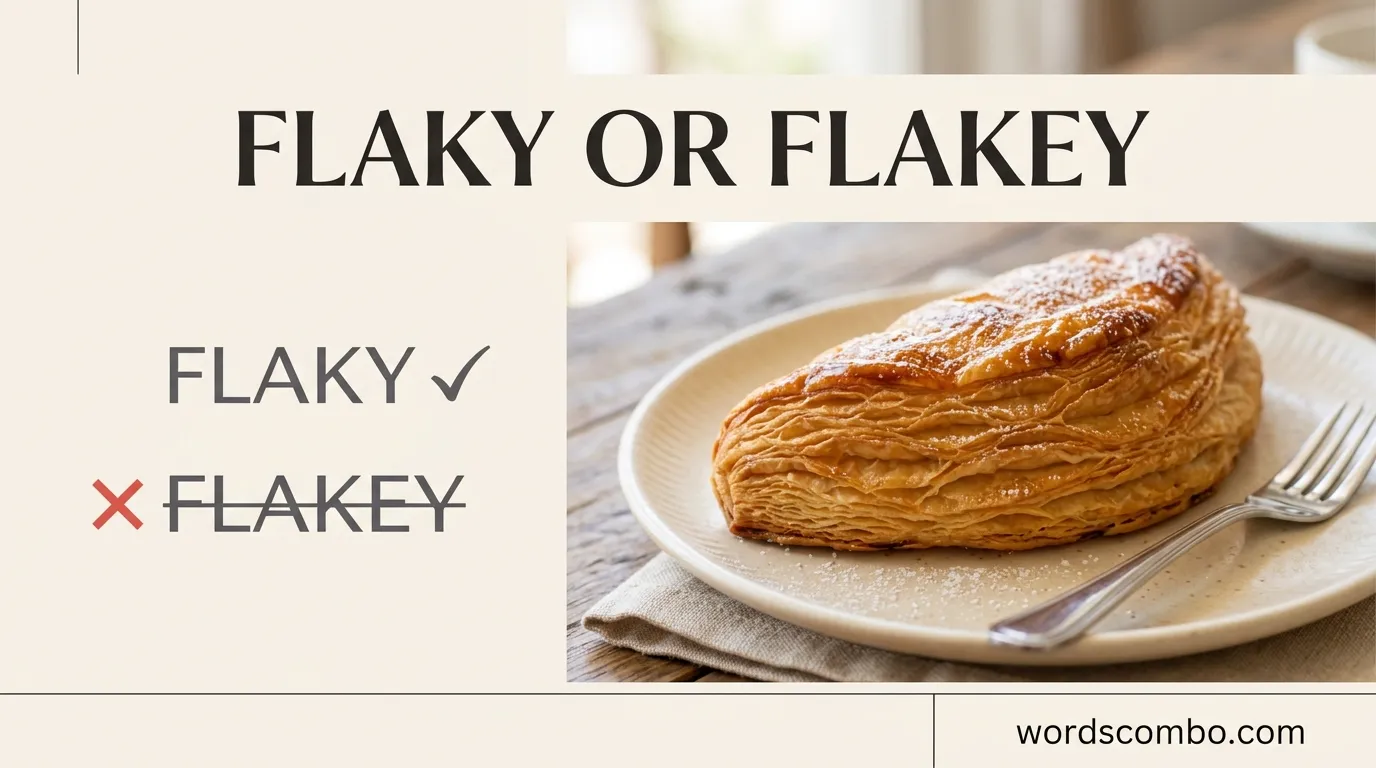
Flaky is the standard and preferred spelling. Flakey is also a recognized variant, but it is less common, so flaky is the safer choice for most writing.
I caught this one while editing a short food description on my laptop. The sentence read, “The pastry has a light and flakey crust.” Nothing looked strange at first. Then I stopped at flakey. The word sounded right, but the extra e suddenly looked suspicious.
That small spelling doubt can happen in many places. You may see flaky pastry, flaky skin, or someone described as flaky, then wonder why you sometimes see flakey too. If both forms appear in real writing, which one should you choose?
The answer is simpler than it seems. Flaky is the normal spelling and the one you should use by default. Flakey is not simply a made-up mistake. It is an accepted variant, but it is much less common.
This guide clears up the difference, explains where the word comes from, shows how to use it, and gives you an easy rule you can remember whenever you are unsure.
Flaky or Flakey: Quick Answer
Flaky is the preferred spelling in modern English, especially when you want the most familiar form.
Flakey is a real variant spelling. It can appear in dictionaries and published writing, but it is not usually the best first choice.
For example:
- Preferred: The pie has a flaky crust.
- Variant: The pie has a flakey crust.
Both sentences can be understood in the same way. The difference is mainly spelling preference and frequency, not meaning.
The Origin and Background of Flaky
The word flaky comes from flake, with the suffix -y added to form an adjective. The basic idea is something made of flakes or something that breaks, peels, or separates into flakes. The word has been used for centuries in this physical sense.
That gives us familiar phrases such as:
- flaky pastry
- flaky salt
- flaky paint
- flaky skin
- flaky snow
Over time, flaky also gained informal meanings connected with people and behavior. A person can be called flaky when they are unreliable, unpredictable, or unusual.
For example:
Jake said he would call at noon, but he forgot again. He can be pretty flaky.
The same idea can apply to things that do not work reliably:
My old internet connection was flaky all morning.
The spelling flakey developed as an alternative form. It does not represent a completely different word. Modern dictionaries recognize it as a variant of flaky.
So, if you have always thought flakey looked like a spelling mistake, there is an important correction: it is a recognized variant. However, that does not make it the better choice for everyday writing.
Flaky Explained: Meaning, Spelling, and Usage
The easiest way to understand the pair is to separate meaning from spelling.
The two forms can carry the same basic meanings. The main difference is that flaky is the standard form most readers expect.
| Term | Meaning | When to Use | Region/Context |
| flaky | Made of flakes, breaking into flakes, or informally unreliable | General writing and everyday use | Widely used in American and British English |
| flakey | Variant spelling of flaky | When preserving an existing variant or informal usage | Appears in both English varieties |
| flakier | Comparative form of flaky | When comparing two things or people | Standard |
| flakiest | Superlative form of flaky | When comparing three or more | Standard |
| flakiness | The quality of being flaky | When using the noun form | Standard |
When Flaky Means “Breaks Into Pieces”
This is one of the most common uses.
The biscuit has a flaky texture.
The old paint is flaky and needs repair.
She has flaky skin in winter.
Here, flaky describes something that breaks, peels, or separates into small layers or pieces.
When Flaky Describes a Person
In informal English, flaky can describe someone who is unreliable, forgetful, or unpredictable.
Tom is a little flaky about making plans.
This use can sound negative, so be careful in professional situations.
Calling a coworker flaky may sound rude. A softer word such as unreliable, inconsistent, or forgetful may be better.
When Flaky Describes Technology
You may also see flaky used for something that works inconsistently.
The website has been flaky all afternoon.
We have a flaky internet connection.
This use is especially common in informal technology discussions. Some English usage references also record this sense for unreliable systems or software.
Which Spelling Should You Use?
For most readers, the recommendation is simple:
Use flaky.
You do not need to choose flakey just because you have seen it before.
For Students
Use flaky in:
- School assignments
- Essays
- Exams
- Homework
- Vocabulary exercises
It is the safer and more familiar form.
For Professional Writers
Choose flaky in:
- Emails
- Reports
- Articles
- Business documents
- Product descriptions
- News writing
- Website content
It looks clean and standard.
For American English
Flaky is the best default choice for a broad American audience.
There is no need to treat flakey as the required American spelling. Both forms can be found in English, but flaky is the more useful form to learn and use consistently.
For British English
British English also uses flaky. Flakey can appear as a variant, but it is not a rule that British writers must use it.
For Global English
If your writing is intended for readers around the world, choose flaky.
It is short, familiar, and widely recognized.
Common Mistakes with Flaky or Flakey
The biggest mistakes usually come from treating the two spellings as if they had different meanings.
Mistake 1: Assuming Flakey Is Always Wrong
Mistake:
The pastry has a flakey crust.
Better default:
The pastry has a flaky crust.
Why: Flakey is recognized as a variant, so calling it completely wrong is too strong. Still, flaky is the preferred everyday spelling.
Mistake 2: Thinking the Extra E Changes the Meaning
Mistake:
Flaky means one thing, while flakey means something else.
Correction:
The two spellings generally have the same basic meanings.
Why: The difference is primarily spelling, not a separate definition.
Mistake 3: Using Flakey in Formal Writing Without a Reason
Less natural:
The report describes the system as flakey.
Better:
The report describes the system as flaky.
Why: Formal writing benefits from the more familiar standard form.
Mistake 4: Calling Someone Flaky in a Formal Email
Too casual:
John has been flaky about the project.
Better:
John has been inconsistent with the project.
Why: Flaky can sound informal or critical when used about a person.
Mistake 5: Writing Flakie or Flakeyy
Some spelling mistakes happen when writers try to guess the word from its pronunciation.
The standard form is:
F-L-A-K-Y
Not flakie, flakeyy, or another variation.
Flaky in Real World Examples
Seeing the word in context makes the spelling much easier to remember.
Professional Email
Subject: Pastry Sample Feedback
The new recipe creates a light, flaky crust and a rich buttery taste. I think it would work well for the next product test.
Here, flaky describes the texture of the pastry.
News Headline
Flaky weather conditions delay morning travel
In this type of headline, the word could describe conditions that are unstable or inconsistent, depending on the story.
Social Media Post
Just made homemade croissants. The layers turned out so flaky and crisp!
Social posts are usually casual, but flaky remains the natural spelling.
Formal Report
The inspection found flaky paint on several exterior surfaces.
Here, the word describes paint that is peeling or breaking away in small layers.
Technology Example
The test failed because of a flaky network connection.
In technical conversations, flaky can describe something that works sometimes but fails unpredictably.
Flaky: Data, Trends & Usage
The search intent behind “flaky or flakey” is strongly informational. People are usually not looking to buy something. They want to settle a spelling doubt before writing a sentence.
Current English reference results consistently put flaky first while also recognizing flakey as an alternative form.
The topic attracts several types of readers:
- Students checking spelling
- Writers editing articles
- Professionals preparing documents
- English learners comparing word forms
- Bloggers checking grammar and spelling
- General readers who have seen both versions
The word also has several strong search contexts. People may encounter it while looking up flaky pastry, flaky skin, flaky meaning, flaky person, flaky internet, or flaky vs flakey.
That matters because the word has more than one meaning. A reader may be asking about food in one search and reliability in another.
The most useful rule stays the same: use flaky unless you have a specific reason to preserve the alternative spelling.
Flaky or Flakey: Comparison at a Glance
| Term/Variant | Meaning | Region/Context | Best Used When |
| Flaky | Made of or breaking into flakes; also unreliable or unpredictable | General English | Almost all normal writing |
| Flakey | Alternative spelling of flaky | Informal or variant usage | When matching an existing spelling or quoted text |
| Flakier | More flaky | General English | Comparing two things |
| Flakiest | Most flaky | General English | Comparing three or more things |
| Flakiness | The quality of being flaky | General English | When a noun is needed |
The key takeaway is simple: flaky is your default spelling.
If you write, “The crust is flaky,” you are using the form most readers will expect.
FAQs About Flaky or Flakey
Q: Is it flaky or flakey?
A: Flaky is the preferred spelling. Flakey is also a recognized variant, but it is less common. For normal writing, choose flaky.
Q: Is flakey a real word?
A: Yes. Flakey is recognized as an alternative spelling of flaky. It is not simply an invented form, although flaky is the better default choice.
Q: What does flaky mean?
A: Flaky can mean made of flakes or likely to break into thin pieces. Informally, it can also describe a person or thing that is unreliable, unpredictable, or inconsistent.
Q: How do you spell flaky pastry?
A: The usual spelling is flaky pastry. For example: “The bakery makes buttery, flaky pastry every morning.”
Q: Is flaky acceptable in formal writing?
A: Yes, when the meaning fits. Flaky is a standard English adjective. However, when describing a person’s reliability, a more precise word such as unreliable may sound more professional.
Q: Is flakey American or British English?
A: Flakey is found in both varieties of English. It is not accurate to say that one country exclusively owns the spelling. Flaky is widely used in both American and British English.
Q: Do flaky and flakey have different meanings?
A: Usually, no. They are spelling variants rather than two completely different words. Flaky is the standard form to choose when you want the safest option.
Q: Can flaky describe a person?
A: Yes. In informal English, flaky can describe someone who is unreliable, forgetful, or unpredictable. Because it can sound critical, use it carefully in professional settings.
Q: Can you say that software is flaky?
A: Yes. Flaky can describe software, an internet connection, or another system that works inconsistently. This use is especially common in informal technical language.
Final Thoughts on Flaky or Flakey
When you are stuck between flaky or flakey, you do not need a complicated rule.
Choose flaky.
It is the standard spelling and the most useful form for everyday English. You can use it for pastry, skin, paint, snow, unreliable behavior, and systems that do not work consistently.
Flakey deserves one important distinction. It is not simply a spelling error. It is a recognized variant. You may see it in dictionaries, published material, or informal writing. Still, it is less common, so it usually makes sense to choose flaky instead.
Remember the easy rule:
Flaky = your normal choice.
Flakey = an accepted alternative.
That one rule will solve almost every spelling doubt you have about this pair.
Bookmark this guide so you never second-guess flaky again.
Looking for more word choices? See Shaky or Shakey: The Easy Spelling Guide.

I started writing about English word differences after years of teaching students who kept making the same mistakes. My focus is on making spelling rules feel simple and easy to remember. At WordsCombo, I turn confusing word pairs into clear comparisons.





1 thought on “Flaky or Flakey: The Easy Spelling Guide”