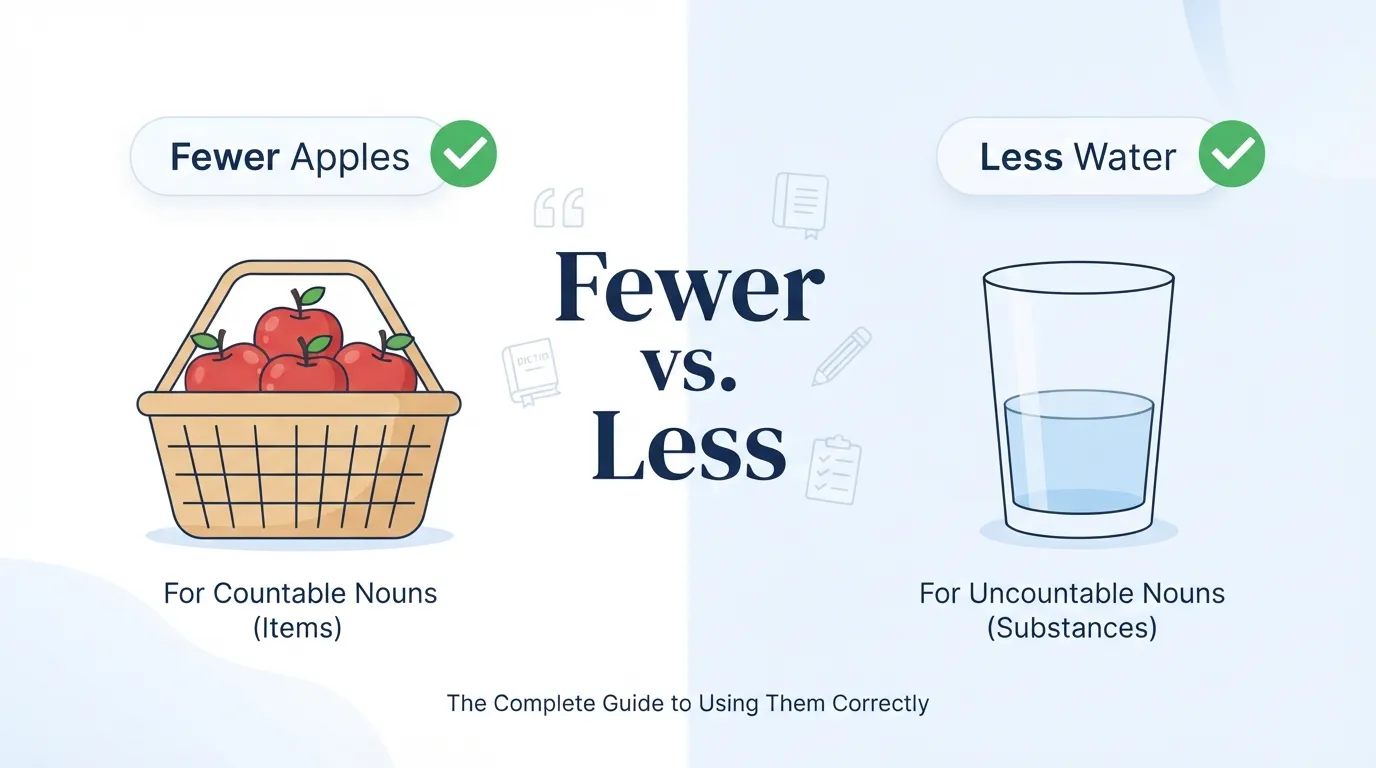
Fewer is used with things you can count, while less is used with things you cannot count. A simple trick is: if you can count the items one by one, use fewer. If you cannot, use less.
A few years ago, I was editing an article for a client when I spotted a sentence that read, “There were less mistakes this time.” It looked normal at first glance. Many people say it every day. Yet something felt wrong.
That tiny word choice changed the whole sentence.
I have spent more than ten years teaching English and editing writing. One grammar question appears again and again: Should I use fewer or less? Even native English speakers mix them up. You hear both on TV, read both online, and see both in stores. That makes the rule seem confusing.
The good news is that it is much easier than many people think.
By the end of this guide, you will know exactly when to use fewer and less. You will also learn the history behind the rule, common mistakes to avoid, real-life examples, and simple tips that help you remember the difference forever.
Let’s begin with the quick answer.
Fewer or Less: Quick Answer
Use fewer with countable nouns.
Use less with uncountable nouns.
Examples
- Fewer students came to class today.
- I drank less water yesterday.
- We need fewer meetings.
- She has less patience than before.
A simple memory trick is:
Count it? Use fewer. Measure it? Use less.
The Origin / Background of Fewer or Less
The words fewer and less have existed in English for hundreds of years.
Originally, people often used less with both countable and uncountable nouns. Writers such as Shakespeare even did this. Later, grammar experts suggested a clearer rule.
Around the late 1700s, grammarian Robert Baker recommended using:
- Fewer for things you count.
- Less for things you measure.
People liked this idea because it made writing more precise.
Today, this rule is taught in schools around the world. Still, everyday speech often breaks the rule. That is why phrases like “10 items or less” are still common, even though many editors prefer “10 items or fewer.”
Fewer or Less Explained: Key Differences
The biggest difference is whether the noun can be counted.
| Term | Meaning | When to Use | Region/Context |
| Fewer | Smaller number of countable things | Books, people, cars, apples | Standard English worldwide |
| Less | Smaller amount of something not counted | Water, money, sugar, time | Standard English worldwide |
Countable Nouns → Use Fewer
You can count them one by one.
Examples:
- fewer chairs
- fewer emails
- fewer children
- fewer mistakes
Uncountable Nouns → Use Less
These are measured rather than counted.
Examples:
- less water
- less milk
- less information
- less stress
Common Exceptions
English has a few exceptions.
We usually say:
- less than 10 minutes
- less than 20 miles
- less than $50
Even though minutes, miles, and dollars are countable, English treats measurements differently.
Which Version Should You Use?
Different situations call for different choices.
For Students
Use the grammar rule.
Choose fewer for countable nouns and less for uncountable nouns. This is what teachers and exams expect.
For Professional Writers
Always follow the standard rule.
Editors, publishers, and businesses prefer correct grammar because it sounds polished.
For Everyday Conversation
People often say less when they mean fewer.
Most listeners will understand you. However, using the correct word makes your English stronger.
For Global English
Follow the traditional grammar rule whenever possible.
It is accepted in American English, British English, Canadian English, Australian English, and many other varieties.
Common Mistakes with Fewer or Less
These mistakes appear everywhere.
| Mistake | Correct Version | Why |
| Less people | Fewer people | People can be counted. |
| Less books | Fewer books | Books are countable. |
| Fewer water | Less water | Water is uncountable. |
| Less apples | Fewer apples | Apples are counted individually. |
| Fewer patience | Less patience | Patience cannot be counted. |
Why Do People Make These Mistakes?
- They hear incorrect examples every day.
- Some signs and advertisements use less.
- Spoken English often ignores grammar rules.
- The words sound similar.
Remember the simple question:
Can I count it?
If yes, choose fewer.
If no, choose less.
Fewer or Less in Real World Examples
Professional Email
“We had fewer customer complaints this month than last month.”
News Headline
“City Reports Fewer Traffic Accidents During Holiday Weekend.”
Social Media Post
“I spend less time on my phone now, and I feel much happier.”
Formal Report
“The company used less electricity this year while producing fewer defective products.”
These examples show that both words often appear together because they describe different kinds of nouns.
Fewer or Less: Data, Trends & Usage
The phrase “fewer or less” is searched by thousands of English learners each month.
Who Searches for It?
- Students
- Teachers
- Job seekers
- Bloggers
- Content writers
- Business professionals
Search Intent
The search intent is mainly informational.
People want a simple grammar rule with examples they can trust.
Regions Where Interest Is High
- United States
- United Kingdom
- Canada
- Australia
- India
- Countries where English is taught as a second language
Why It Matters Today
More people write emails, social media posts, reports, and blog articles every day.
Using fewer and less correctly helps your writing look more professional and easier to trust.
Comparison Table
| Term/Variant | Meaning | Region/Context | Best Used When |
| Fewer | Smaller number | Formal and informal English | Countable nouns |
| Less | Smaller amount | Formal and informal English | Uncountable nouns |
| Less than 10 minutes | Measurement | Accepted exception | Time expressions |
| Less than $20 | Measurement | Accepted exception | Money amounts |
| 10 items or fewer | Countable items | Grammar guides | Shopping signs and writing |
Frequently Asked Questions
Q: What does fewer or less mean?
A: They both show a smaller amount. Fewer is for things you can count. Less is for things you cannot count.
Q: How do you use fewer and less correctly?
A: Ask yourself whether the noun is countable. If you can count it one by one, use fewer. If you measure it instead, use less.
Q: Fewer vs less: what is the difference?
A: Fewer describes numbers of countable things. Less describes amounts of uncountable things like water, sugar, or happiness.
Q: Is fewer or less acceptable in formal writing?
A: Yes. Both are correct when used properly. Formal writing follows the standard grammar rule very closely.
Q: Which version is correct: fewer or less?
A: Both are correct. The right choice depends on the noun that follows.
Q: Where does the rule come from?
A: Modern grammar books follow a rule suggested by grammarians in the eighteenth century. It became the standard taught in schools.
Q: Can fewer or less be used in business writing?
A: Absolutely. Professional emails, reports, presentations, and marketing content all benefit from using the correct word.
Conclusion
The difference between fewer and less is one of the easiest grammar rules once you know the trick.
Remember these key points:
- Use fewer for countable nouns.
- Use less for uncountable nouns.
- Measurements often use less, even when numbers appear.
- Following the rule makes your writing clearer and more professional.
Small grammar choices can make a big difference. They show readers that you care about clear communication.
The next time you stop before writing fewer or less, simply ask yourself one question:
Can I count it?
If the answer is yes, choose fewer. If not, choose less.
Now you know exactly how to use fewer or less. Bookmark this guide so you never second-guess these words again, and share it with someone who has struggled with this grammar rule.

I have been working with English language content for over six years. I specialize in word comparisons and spelling differences that most people overlook. At WordsCombo, I help readers choose the right word every time.




1 thought on “Fewer or Less: The Complete Guide to Using Them Correctly”