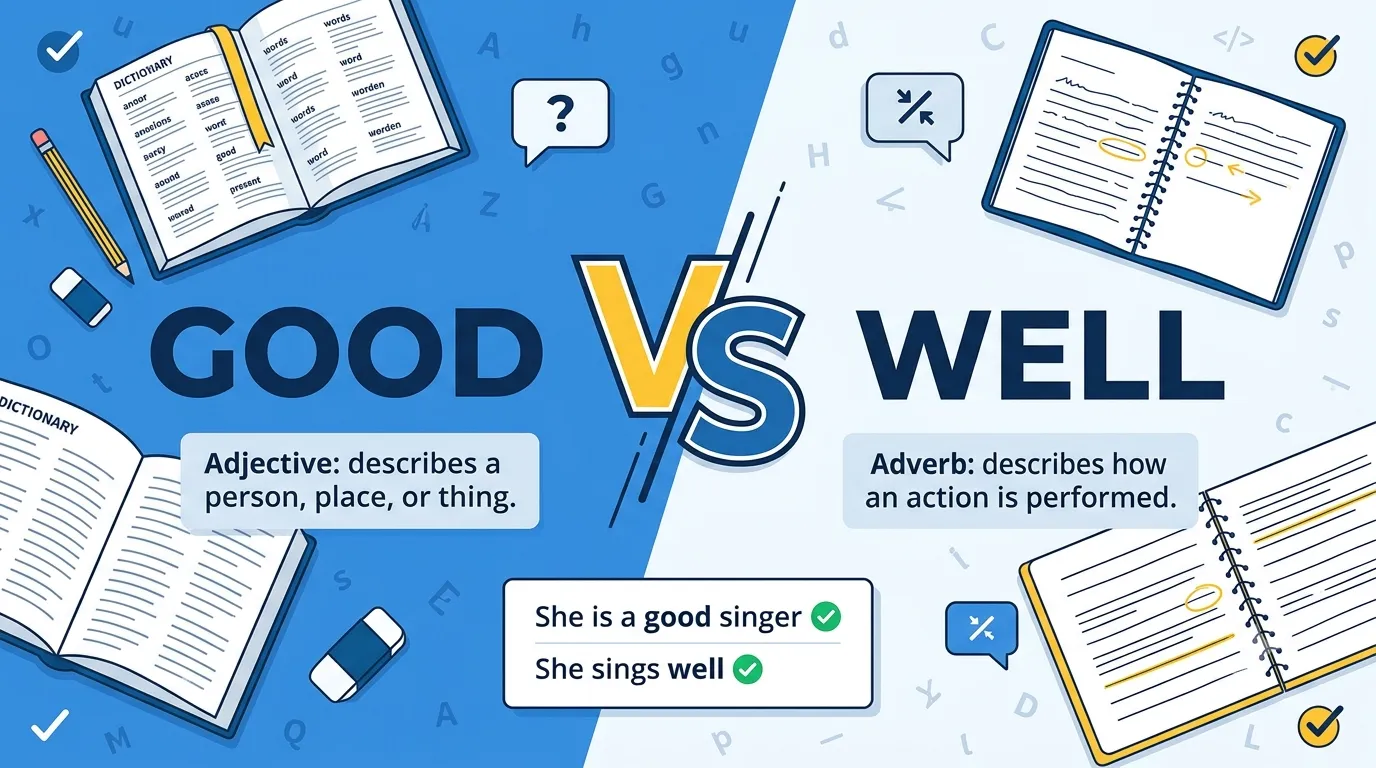
Good is an adjective that describes a noun, while well is usually an adverb that describes a verb. Use good for people, places, or things, and use well to explain how an action is done.
A few years ago, I was proofreading an email from a colleague when I spotted the sentence, “I hope you are doing good.” It looked natural because I had heard it countless times in everyday conversations. Still, something felt off.
That small mistake reminded me of one of the most common grammar questions in English: Should you say “good” or “well”?
If you’ve ever paused before writing, “I feel good,” or “I feel well,” you’re not alone. Native speakers mix them up too. The confusion comes from the fact that both words often relate to positive feelings or quality, yet they do different jobs in a sentence.
The good news is that the rule is much simpler than many grammar books make it seem.
By the end of this guide, you’ll know exactly when to use good and when to use well. You’ll also see easy examples, common mistakes, and practical tips you can use in everyday conversations, emails, school assignments, and professional writing.
Let’s start with the basic rule.
Good or Well: Quick Answer
The easiest way to remember the difference is this:
- Good describes a person, place, thing, or idea.
- Well describes how someone does an action.
Simple Examples
✅ The pizza tastes good.
✅ Sarah is a good teacher.
✅ He sings well.
✅ She completed the project well.
Think of it this way:
- If you’re describing what something is like, choose good.
- If you’re describing how something happens, choose well.
A Quick Memory Trick
Ask yourself this question:
Am I describing a thing or an action?
- Thing (noun) → Good
- Action (verb) → Well
This one question solves most grammar mistakes.
The Origin and Background of Good or Well
Although good and well seem closely related today, they come from different Old English words.
The word good comes from the Old English word gōd, which meant virtuous, suitable, beneficial, or of high quality. Over hundreds of years, its meaning stayed remarkably stable. Even today, we use good to describe quality, character, or value.
The word well comes from the Old English wel, meaning in a good way or properly. From the beginning, it described how something was done rather than what something was.
Because both words express something positive, English learners—and even native speakers—often use them interchangeably. Everyday speech also adds to the confusion. You may hear people say:
- “I’m doing good.”
- “She plays good.”
These phrases are common in casual conversation, but traditional grammar considers them incorrect in formal writing.
Another reason for the confusion is that well has two jobs in English.
Most of the time, it works as an adverb.
Example:
- She writes well.
- They worked well together.
Sometimes, however, well becomes an adjective that means healthy.
Example:
- I don’t feel well today.
- He looks well after his vacation.
This special use makes many people wonder whether they should say I am good or I am well.
The answer depends on what you mean.
- I am good usually means you’re happy, satisfied, or okay.
- I am well usually means you’re healthy.
Understanding this small difference makes your English much clearer.
Good or Well Explained: Key Differences
Although the words are similar, their grammar roles are different.
| Term | Meaning | When to Use | Context |
| Good | High quality, positive, satisfactory | Describing nouns or pronouns | Everyday English, academic writing, business writing |
| Well | In a good way | Describing verbs | Speaking, writing, presentations |
| Well (adjective) | Healthy | Talking about health | Everyday conversation and formal English |
When to Use Good
Use good before a noun or after linking verbs like is, looks, seems, feels, and tastes.
Examples:
- This is a good movie.
- The soup tastes good.
- She is a good leader.
- Your idea sounds good.
Here, good describes a person, object, or idea—not an action.
When to Use Well
Use well to explain how an action happens.
Examples:
- He drives well.
- The children behaved well.
- She speaks English well.
- They worked well as a team.
Notice that well answers the question How?
- How does she sing?
- She sings well.
The Special Case: “I Feel Good” vs. “I Feel Well”
This is one of the most searched grammar questions online.
I feel good.
This means you are happy, positive, or emotionally fine.
I feel well.
This means you are physically healthy or not sick.
In everyday conversation, many native speakers say I feel good even when talking about health. However, in formal English, I feel well is the more precise choice when referring to your physical condition.
Quick Comparison
| Sentence | Correct? | Why? |
| She is a good student. | ✅ | Describes a noun |
| She studies well. | ✅ | Describes a verb |
| The cake smells good. | ✅ | Linking verb + adjective |
| He swims well. | ✅ | Explains how he swims |
| She sings good. | ❌ | Should describe the verb with well |
By remembering one simple rule, good describes things, well describes actions, you’ll avoid the vast majority of mistakes.
Which Version Should You Use?
The right choice depends on what you want to say. Ask yourself one simple question:
Am I describing a person or thing, or am I describing an action?
If you are talking about a person, place, thing, or idea, use good.
Examples
- She is a good friend.
- This laptop is good.
- The weather looks good today.
If you are explaining how someone does something, use well.
Examples
- She writes well.
- They worked well together.
- He answered the question well.
Recommendations by Audience
| Audience | Best Choice | Why |
| Students | Follow the grammar rule carefully. | It helps in exams and assignments. |
| Professionals | Use good and well correctly in emails and reports. | It makes your writing look polished. |
| English learners | Learn the simple rule first. | You’ll avoid the most common mistake. |
| Casual conversation | You’ll hear both forms. | Native speakers often bend grammar in speech. |
| Formal writing | Stick to standard grammar. | It is clearer and more professional. |
A Simple Rule to Remember
- Good = describes a noun.
- Well = describes a verb.
If you’re unsure, this rule will guide you most of the time.
Common Mistakes with Good or Well
Even experienced English speakers make these mistakes. Here are the ones you’ll see most often.
| Mistake | Correct Version | Why |
| She sings good. | She sings well. | “Sings” is a verb. |
| He did good on the test. | He did well on the test. | You are describing how he performed. |
| I don’t feel good. (when talking about illness) | I don’t feel well. | “Well” means healthy. |
| They played good together. | They played well together. | The word describes the action. |
| She is well teacher. | She is a good teacher. | “Teacher” is a noun. |
Why These Mistakes Happen
Most errors happen because:
- Good and well both have positive meanings.
- Many people learn English through conversation before grammar.
- Informal speech often ignores grammar rules.
- Some expressions become common even if they aren’t technically correct.
When writing something important, always take a second look.
Good or Well in Real World Examples
Seeing the words in real situations makes the difference much easier to remember.
Professional Email
Thank you for your presentation. You explained the project well, and your ideas were good for the entire team.
Notice how:
- Well describes the action (explained).
- Good describes the noun (ideas).
News Headline
Local Hospital Receives Good Safety Rating After Independent Review
Here, good describes the rating.
Social Media Post
You played well today! Keep going—you’ll only get better.
The word well tells us how someone played.
Business Report
The marketing campaign performed well during the first quarter and produced good results.
Again:
- Performed well describes an action.
- Good results describes a noun.
Everyday Conversation
Person A: How was the movie?
Person B: It was really good.
Person A: How did you do on your driving test?
Person B: I did well.
These examples show the same grammar rule in everyday English.
Good or Well: Data, Trends & Usage
Searches for good or well stay high throughout the year because this is one of the most common English grammar questions.
People usually search for this topic when they are:
- Writing school assignments
- Preparing for English exams
- Learning English as a second language
- Writing business emails
- Improving professional communication
Search Intent
Primary Intent: Informational
Readers want a quick, reliable answer they can use immediately.
Who Searches the Most?
The topic is especially popular among:
- English learners
- Students
- Teachers
- Content writers
- Bloggers
- Job seekers
- Professionals who write in English
Why It Matters Today
Clear communication matters more than ever. Emails, social media, online meetings, and business messages all depend on good writing.
Using good and well correctly makes your English sound more natural. It also helps readers understand your meaning without confusion.
Good vs. Well: Comparison Table
| Term/Variant | Meaning | Region/Context | Best Used When |
| Good | High quality or positive | Standard English worldwide | Describing a noun or pronoun |
| Well (adverb) | In a good way | Standard English worldwide | Describing a verb |
| Well (adjective) | Healthy | Everyday and formal English | Talking about someone’s health |
| Doing well | Performing successfully | Global English | Work, school, sports, business |
| Doing good | Doing kind or charitable acts | Common in formal and informal English | Talking about helping others |
Quick Tip
One phrase often surprises learners.
I’m doing well. ✅
This means your life or work is going well.
I’m doing good. ✅ (in a different meaning)
This means you’re doing good deeds or helping other people.
Although many native speakers use I’m doing good to mean I’m doing well, careful writers still prefer I’m doing well in formal English.
Frequently Asked Questions (FAQs)
Q: What does “good” mean?
A: Good is an adjective that describes a noun or pronoun. It means something has high quality, is pleasant, or is suitable. For example, “She is a good friend.”
Q: What does “well” mean?
A: Well is usually an adverb that describes how an action is done. It can also be an adjective when talking about someone’s health. For example, “She sings well,” and “I am well today.”
Q: How do you use “good” and “well” correctly?
A: Use good to describe a person, place, thing, or idea. Use well to describe a verb or explain how an action happens. A simple rule is: good describes nouns, while well describes verbs.
Q: What is the difference between “good” and “well”?
A: The biggest difference is their grammar role. Good is an adjective, while well is usually an adverb. Although both express something positive, they cannot always replace each other.
Q: Is “good” or “well” correct in formal writing?
A: Both are correct when used properly. In formal writing, use good to describe nouns and well to describe verbs. Following this rule makes your writing clearer and more professional.
Q: Should I say “I feel good” or “I feel well”?
A: It depends on your meaning. I feel good usually means you feel happy or positive. I feel well means you are physically healthy. In everyday conversation, many people say I feel good for both situations, but I feel well is more precise when talking about health.
Q: Can “well” be an adjective?
A: Yes. While well is usually an adverb, it can also be an adjective meaning healthy. For example, “She is well again after being sick.”
Conclusion
The difference between good and well is much easier than it first appears. Once you understand their roles, you’ll make fewer grammar mistakes and write with more confidence.
Remember these key points:
- Good describes a person, place, thing, or idea.
- Well usually describes how an action is performed.
- Well can also mean healthy when used as an adjective.
- When you’re unsure, ask yourself whether you’re describing a thing or an action. That one question will guide you to the correct choice most of the time.
Like many English grammar rules, this one becomes natural with practice. The more you read, write, and speak, the easier it gets to choose the right word without thinking.
Now you know exactly how to use good and well in conversations, emails, reports, and everyday writing. Bookmark this guide so you never second-guess “good” or “well” again, and share it with anyone who has ever been confused by these two common words.
Read more: Mommies or Mommy’s: Which One Is Correct?

I have a background in academic writing and spent several years as a proofreader for digital publications. Spotting differences between easily confused words became second nature to me. At WordsCombo, I share that knowledge so readers can write with confidence.