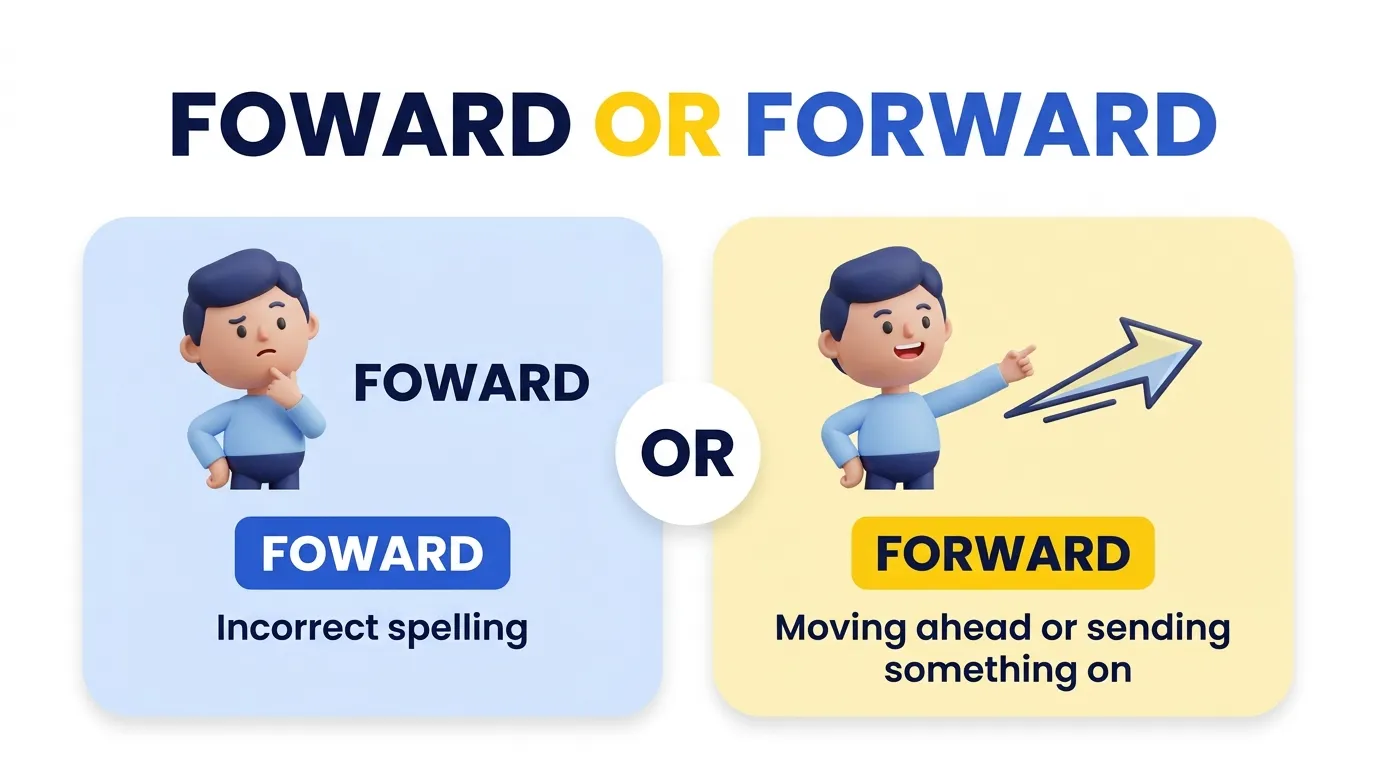
Quick Answer: Forward is the correct spelling. Foward is a misspelling. Use forward when you mean moving ahead, sending something on, or looking toward the future.
You are about to send an email that says, “I will foward your message to the team.” Then, a red line appears under foward. The correct spelling is forward, with an r after the first “fo.”
This mistake is easy to make because the word has several letters close together. However, once you learn the right spelling and a few simple examples, you can use forward with confidence in emails, schoolwork, and daily writing.
Foward or Forward: Quick Answer
Forward is the correct spelling in American English and British English. The spelling foward is incorrect in standard writing because it leaves out the letter r.
For example:
- Correct: Please forward the email to my teacher.
- Incorrect: Please foward the email to my teacher.
So, whenever you write about moving ahead or sending a message to someone else, choose forward.
The Origin of Forward
The word forward has a long history in English. It grew from old English words linked to moving ahead or being at the front.
Over time, the word came to mean more than physical movement. Today, you can use it to talk about progress, future plans, or sending a message to another person.
However, the spelling can cause confusion because people may leave out the second “r” when typing quickly. The shorter form, foward, may look close to the correct word, but it is not accepted as a standard spelling.
Foward or Forward Explained: Key Differences
The main difference is simple: forward has two letters “r” in the spelling, while foward leaves one out.
Forward can work as an adverb, adjective, verb, or noun in different contexts. For example, you can move forward, look forward to a trip, or forward an email.
By contrast, foward has no standard meaning in modern English. It is usually a typing or spelling mistake.
| Term | Meaning | When to Use | Region/Context |
| Forward | Moving ahead or sending something on | Emails, directions, plans, and everyday writing | American and British English |
| Foward | Misspelling of forward | Do not use in standard writing | Incorrect in standard English |
Examples of Forward in Sentences
- Please forward the report to the manager.
- We are moving forward with the new plan.
- I look forward to seeing you tomorrow.
In each example, forward is spelled with both “r” letters. Therefore, remember to include the letter after “fo” every time.
Which One Should You Use?
Choose forward whenever you need the correct spelling of this word. However, the best form can depend on how you use it and which English style you follow.
- For American English: Use forward in emails, essays, reports, and everyday writing.
- For British English: Use forward as an adjective or verb. As an adverb, forwards is also common.
- For formal writing: Choose forward when you want a clear, widely accepted form.
- For schoolwork and exams: Write forward, not foward, because the shorter spelling is incorrect.
In short, you do not need to change forward to foward for any country or writing style. The spelling stays the same in both American and British English.
Common Mistakes with Foward or Forward
Even good writers can make spelling mistakes when they type fast. Here are four errors to watch for.
1. Leaving Out the Letter R
- Incorrect: I will foward the email.
- Correct: I will forward the email.
This mistake happens when you leave out the second “r.” So, check that the word has all seven letters: f-o-r-w-a-r-d.
2. Writing Foreward Instead of Forward
- Incorrect: Please foreward the file.
- Correct: Please forward the file.
Although fore is a real word part, the correct spelling is forward, without an “e” after the “r.”
3. Confusing Forward with Foreword
- Incorrect: I read the forward at the start of the book.
- Correct: I read the foreword at the start of the book.
A foreword is a short text at the start of a book, often written by someone other than the author. By contrast, forward means moving ahead or sending something on.
4. Using Foward in a Work Email
- Incorrect: Can you foward this file to the client?
- Correct: Can you forward this file to the client?
In work emails, a small spelling error can make your message look less polished. Therefore, check the spelling before you press Send.
Foward or Forward in Real-World Examples
The word forward appears in many parts of daily life. These examples show how to use it in different settings.
Professional Email
“Could you please forward the meeting notes to the whole team?”
Here, forward means to send a message or file to other people.
News Headline
“Local Team Looks Forward to the Next Season”
In this headline, forward suggests hope and attention toward the future.
Social Media Post
“We are moving forward and working toward our goals!”
This sentence uses forward to describe progress. It can also help express a positive attitude about what comes next.
Formal Document
“The company plans to move forward with its new project in January.”
In this case, forward means to continue with a plan. The word fits formal reports, business letters, and work documents.
Everyday Conversation
“Please move forward so everyone can enter the room.”
Here, forward describes movement toward the front. As a result, the meaning is easy to understand from the situation.
Foward or Forward: Data, Trends and Usage
People search for foward or forward when they are unsure about the spelling of a common English word. The search usually shows a clear need: they want to know which form is correct and how to use it.
This spelling question matters in several settings:
- Students need the correct spelling for homework, essays, and tests.
- Office workers want to write clear emails and send files to the right people.
- English learners may spell the word as they hear it.
- Writers and editors need to catch small errors before sharing their work.
However, there is no need to guess which spelling is right. Forward is the standard spelling, while foward is a common error. Also, searches for this word can lead to a related question about forward versus forwards, which is a real difference in usage rather than the same spelling mistake.
Forward vs. Foward: Comparison at a Glance
| Term or Variant | Meaning | Region/Context | Best Used When |
| Forward | Ahead, onward, or send on | US and UK English | All standard writing |
| Foward | Incorrect spelling | Nonstandard | Never in standard writing |
| Forwards | Toward the front or future | Common in British English as an adverb | When it fits your sentence |
| Foreword | An introduction to a book | US and UK English | Talking about a book’s opening text |
Remember, forward and forwards can both be correct in some sentences. However, foward is not a correct alternative.
Frequently Asked Questions
Is it foward or forward?
Forward is the correct spelling, while foward is incorrect. Always include the letter “r” after “fo” when writing this word.
What does forward mean?
Forward means moving ahead, facing the front, or making progress. It can also mean sending an email or message to another person.
Why do people spell forward as foward?
People often leave out the second “r” when typing quickly or spelling the word from memory. However, remembering the letter pattern for-ward can help you avoid this mistake.
Is forward correct in American and British English?
Yes, forward is correct in both American and British English. British writers also commonly use forwards as an adverb, while American writers often prefer forward.
Is foward acceptable in formal writing?
No, foward is a spelling mistake in standard formal English. Use forward in work emails, school assignments, reports, and other professional documents.
What is the difference between forward and foreword?
Forward means moving ahead or sending something on, while foreword is a short introduction at the start of a book. Therefore, use foreword when talking about a book’s opening section.
How do you remember the correct spelling of forward?
Break the word into two parts: for + ward. Since the first part contains the letter “r,” remember to keep it when writing the full word.
Final Thoughts on Foward or Forward
The correct spelling is forward, not foward. This small spelling difference matters when you write emails, finish schoolwork, or share professional documents. Therefore, take a moment to check the word before sending your message.
Remember these three points: forward is the correct spelling, foward is a mistake, and foreword has a different meaning. Also, both American and British writers use forward, although forwards is common in British English when the word acts as an adverb.
Now you can write with more confidence. Keep the letter “r” in mind, and use forward whenever you mean moving ahead or sending something on. Practice it in a sentence today to help the correct spelling stick.
Want to avoid more common spelling mistakes? Check out [ANCHOR TEXT] for more simple English spelling guides.
SEO & Image Metadata
SEO Meta Title: Foward or Forward? Correct Spelling Explained
SEO Meta Description: Foward or forward: Find the correct spelling, learn what forward means, compare common mistakes, and write the word correctly in emails and schoolwork.

I started writing about English word differences after years of teaching students who kept making the same mistakes. My focus is on making spelling rules feel simple and easy to remember. At WordsCombo, I turn confusing word pairs into clear comparisons.