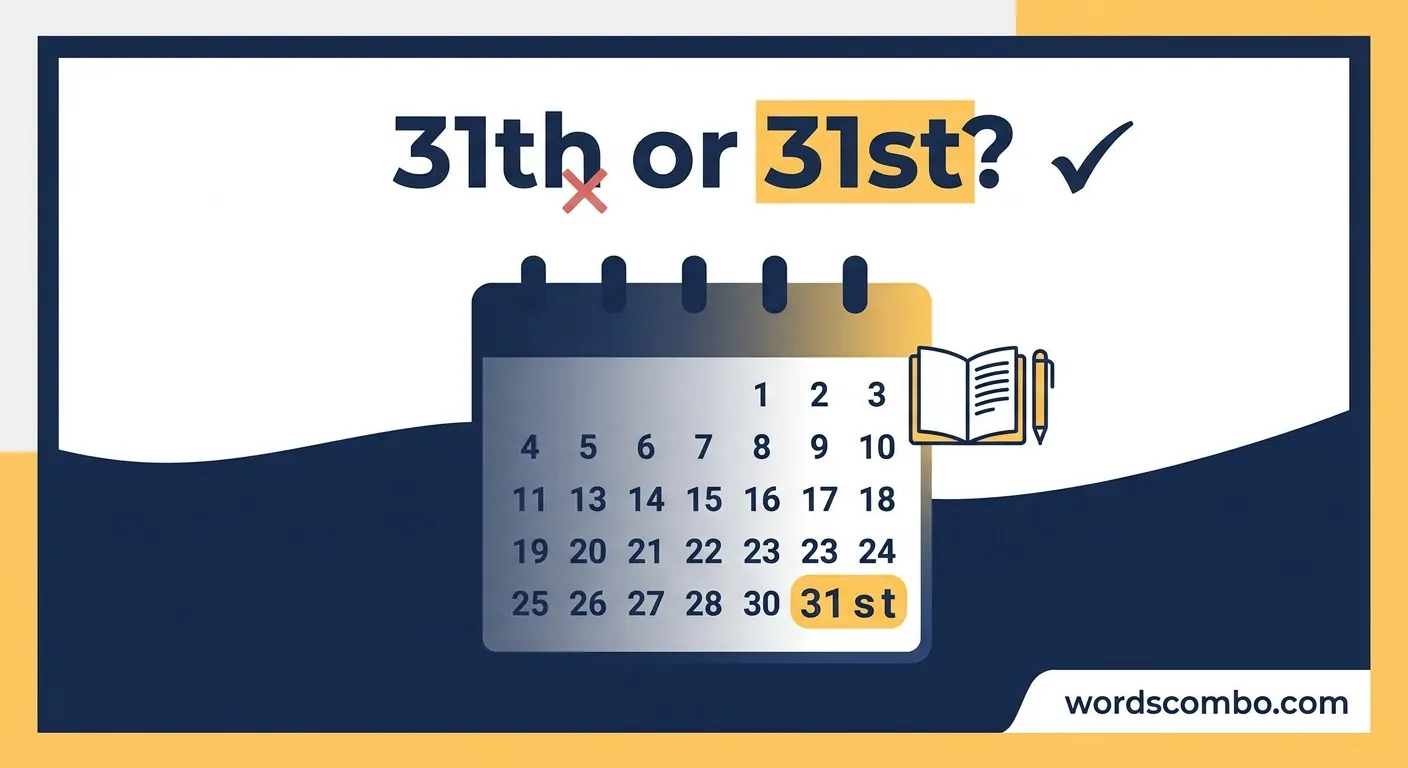
31st is the correct ordinal form of 31, while 31th is incorrect. The full form is thirty-first.
I caught this mistake once while checking a date in a document just before it was sent out. The sentence looked fine at first glance: “The deadline is December 31th.” Then I stopped. That tiny ending suddenly looked very wrong.
It is an easy mistake to make. Most ordinal numbers use -th, so your brain may automatically turn 31 into 31th. But English changes the ending for certain numbers. That is why we write 1st, 21st, and 31st, not 1th, 21th, or 31th.
The good news is that you do not need to memorize a long list. Once you understand the pattern behind 31st, the answer becomes almost automatic. You will also know how to handle dates, birthdays, rankings, reports, invitations, and other formal writing.
So, if you are stuck between 31th or 31st, you can settle the question right now.
31th or 31st: The Quick Answer
31st is correct. 31th is incorrect in standard English.
The number 31 is an ordinal number when it shows position or order. Its full written form is thirty-first, so the shortened form is 31st.
Examples:
- Correct: My birthday is on August 31st.
- Incorrect: My birthday is on August 31th.
- Correct: She finished in 31st place.
- Incorrect: She finished in 31th place.
The simplest rule is this: 31 ends in 1, so it takes -st.
The Background Behind 31st
The confusion comes from the way English forms ordinal numbers.
A cardinal number tells you how many:
- one
- two
- thirty-one
An ordinal number tells you where something comes in an order:
- first
- second
- thirty-first
When ordinal numbers are written with digits, their endings reflect the written ordinal form. First becomes 1st, second becomes 2nd, and third becomes 3rd. Therefore, thirty-first becomes 31st.
That is why 31th does not work. There is no English ordinal called “thirty-th.”
The mistake is usually caused by overusing -th. Forms such as 4th, 5th, 6th, 10th, and 30th make the -th ending feel like the normal choice. But numbers ending in 1, 2, or 3 often use different endings.
There is one important exception group: 11th, 12th, and 13th.
So the pattern is not simply “look at the final digit.” You also need to watch those three exceptions.
31st Explained: The Rule You Need
The easiest way to understand 31st is to look at the final part of the number.
| Term | Meaning | When to Use | Region/Context |
| 31st | Thirty-first | Dates, rankings, order, sequences | Standard English worldwide |
| 31th | No standard ordinal meaning | Do not use | Incorrect |
| thirty-first | Full written form of 31st | Formal or fully written text | Standard English |
When do you use 31st?
Use 31st when 31 shows an order or position.
For example:
- The meeting is on the 31st.
- She came 31st in the competition.
- This is our 31st annual event.
- He celebrated his 31st birthday.
- The 31st chapter contains the answer.
When do you use 31?
Do not use 31st when you simply mean the quantity or age.
For example:
- She is 31 years old. ✅
- She is 31st years old. ❌
But:
- She is celebrating her 31st birthday. ✅
The difference is simple. 31 tells you the amount or age. 31st tells you the position in an order.
Which Form Should You Use?
For almost every normal writing situation, the answer is easy:
Use 31st. Never use 31th in standard English.
For students
Use 31st in homework, tests, essays, and assignments. It is the standard ordinal form.
For professional writers
Use 31st in emails, reports, announcements, schedules, and business documents when an ordinal form is appropriate.
For dates
Use 31st when your chosen date style includes ordinal suffixes.
For example:
- August 31st
- 31st August
The spelling does not change between American and British English. The usual difference is the order of the date, not the ending of 31.
For formal documents
There is another useful point. Many formal date styles simply write:
August 31, 2026
rather than:
August 31st, 2026
So 31st is correct when you choose an ordinal date style, but a formal document may prefer a style without the suffix.
Common Mistakes with 31st
1. Writing 31th
❌ The event is on December 31th.
✅ The event is on December 31st.
This happens because writers remember that many ordinal numbers use -th.
2. Confusing 31 with 31st
❌ He is 31st years old.
✅ He is 31 years old.
Use 31st for an ordinal idea, such as 31st birthday.
3. Writing 31nd
❌ She finished 31nd in the race.
✅ She finished 31st in the race.
The -nd ending belongs to numbers such as 2nd and 22nd, not 31.
4. Writing 31rd
❌ This is the 31rd edition.
✅ This is the 31st edition.
The -rd ending is used with numbers such as 3rd and 23rd.
5. Adding a space
❌ 31 st
✅ 31st
The suffix attaches directly to the number.
31st in Real World Examples
The correct form appears in many everyday situations.
Professional email
Please send your final documents by August 31st.
This works when the writer uses an ordinal date style.
News headline
Company Announces New Policy Ahead of 31st Anniversary
Here, 31st describes the order of the anniversary.
Social media post
Our store turns 31 this month! Join us for our 31st anniversary celebration.
Notice the difference between 31 and 31st. The company is 31 years old, but the anniversary is the 31st one.
Formal report
The committee met for its 31st annual review.
Here, 31st tells the reader which annual review it is.
31st: Data, Trends & Usage
The search intent behind “31th or 31st” is strongly informational. People are usually not looking for a product or service. They want a quick spelling and grammar answer.
Search results for this exact confusion consistently center on questions such as:
- Is 31th correct?
- How do you write 31st?
- Why is it 31st?
- How do you say 31st?
- What is the ordinal form of 31?
- Is the rule different in American and British English?
The topic also connects to common situations such as dates, birthdays, rankings, anniversaries, lists, and formal documents.
This matters because a tiny two-letter ending can create doubt in otherwise polished writing. For English learners, the best solution is not to memorize 31st alone. Learn the larger ordinal-number pattern, then the answer becomes easier to recall.
31st or 31th: Comparison at a Glance
| Term/Variant | Meaning | Region/Context | Best Used When |
| 31st | Thirty-first | Standard English | Showing position, order, dates, rankings |
| 31th | Incorrect form | No standard English context | Never use it |
| thirty-first | Full written ordinal | Standard English | When writing the number in words |
| 31 | Cardinal number | Standard English | Showing quantity or age |
The key distinction is simple:
31 = quantity
31st = position or order
thirty-first = the full written ordinal
FAQs About 31th or 31st
Q: Is 31th correct or 31st?
A: 31st is correct. The form 31th is not used in standard English. The full form is thirty-first.
Q: How do you write 31 in ordinal form?
A: Write it as 31st. In words, it is thirty-first.
Q: Why is 31st correct instead of 31th?
A: The number 31 is read as thirty-first. Since the ordinal word ends in first, its abbreviated form ends in st.
Q: Is 31st used in American English?
A: Yes. 31st is standard in American English. British English uses the same ordinal form. The main difference in dates is often the order of the day and month.
Q: Can I write 31st for someone’s age?
A: No. Say 31 years old, not 31st years old. You can say 31st birthday because that describes the order of the birthday.
Q: How do you pronounce 31st?
A: 31st is pronounced “thirty-first.”
Q: Is 31st correct in formal writing?
A: Yes, when an ordinal is needed. However, some formal date styles omit ordinal endings, so you may see August 31, 2026 instead of August 31st, 2026.
Q: What is the rule for 21st, 31st, and 41st?
A: Numbers ending in 1 usually take -st, so we write 21st, 31st, and 41st. The major exception is 11th, which uses -th.
Final Thoughts on 31th or 31st
If you only remember one thing, remember this:
31st is correct. 31th is incorrect.
The full ordinal form is thirty-first, and the shortened form is 31st. That makes the ending easier to understand.
You can use 31st for a position, ranking, anniversary, birthday, chapter, event, or ordinal date. Use 31 when you mean the number itself, such as someone’s age.
There is also a useful larger pattern. Numbers ending in 1 often use st, numbers ending in 2 use nd, and numbers ending in 3 use rd. But remember the special 11th, 12th, and 13th group.
So the next time your fingers type 31th, stop for one second. Say the number in full: thirty-first. The correct ending becomes much easier to see.
Bookmark this guide so you never second-guess 31st again.
Curious about similar number endings? Explore Fourteen or Forteen: The Complete Spelling Guide.

I started writing about English word differences after years of teaching students who kept making the same mistakes. My focus is on making spelling rules feel simple and easy to remember. At WordsCombo, I turn confusing word pairs into clear comparisons.









1 thought on “31th or 31st: The Complete Easy Guide”