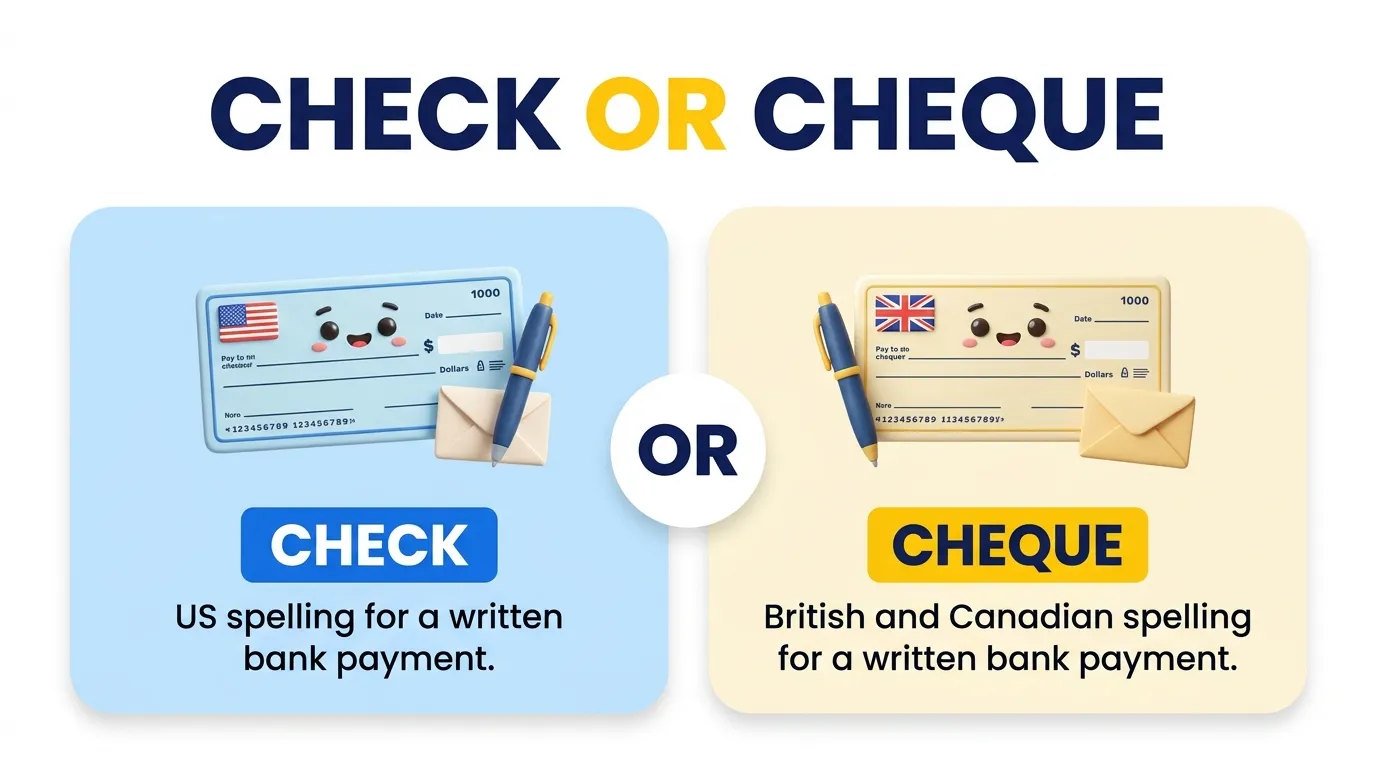
Check or cheque means two different things depending on where you live and how you use the word. In American English, check is the correct spelling for a bank payment. In British English and many other countries, cheque is used for a written bank payment. The word check can also mean to look at, test, or make sure something is right.
A bank email can make you pause when you type, “I will send the check tomorrow.” You may wonder if cheque looks more correct or more formal. The answer depends on your audience and the meaning you want to share. Both spellings are correct, but they are not used in the same places. Once you know the simple rule, you can write emails, letters, and bank notes with confidence.
Check or Cheque: Quick Answer
Both check and cheque are correct spellings for a written bank payment. However, the right choice depends on your reader’s country.
- Check: Use this spelling in the United States. For example, “I paid the bill by check.”
- Cheque: Use this spelling in British English and Canadian English for a bank payment. For example, “She sent the money by cheque.”
Remember, check also means to look at something or make sure it is right. You cannot use cheque for that meaning.
The Story Behind Check and Cheque
The word check has a long history. It came into English through French and was first linked to the game of chess. Over time, its meaning grew to include stopping something, testing something, and making sure things were correct.
Later, the word gained a banking meaning. A check became a written order that tells a bank to pay money from an account. The spelling cheque grew as a separate form for this banking use.
Today, American English favors check for bank payments. British English often uses cheque for the same thing. Both words sound alike, so it is easy to mix them up when writing.
Check or Cheque Explained: Key Differences
The main difference is the spelling used for a bank payment. The meaning stays the same, but the preferred form changes by region.
Here is a simple guide to help you choose the right word.
| Term | Meaning | When to Use | Region or Context |
| Check | A written bank payment | When writing about a bank check | United States |
| Cheque | A written bank payment | When writing about a bank cheque | United Kingdom and Canada |
| Check | To look at or test something | When checking facts, work, or details | All major English varieties |
| Check mark | A mark that shows a choice or task is complete | When marking a list or form | All major English varieties |
| Paycheck | Money paid by an employer | When talking about wages | United States |
| Paycheque | Money paid by an employer | When following Canadian or British spelling styles | Canada and some British-style contexts |
For example, an American writer may say, “Please mail the check today.” A British writer may use, “Please mail the cheque today.”
However, both writers would say, “Please check the address before mailing it.” The verb check keeps the same spelling in both places.
Which One Should You Use?
Your audience is the best guide. Choose the spelling that your readers expect, and keep it the same throughout your writing.
- For American readers: Use check for a bank payment because it is the standard US spelling. Write “I deposited the check yesterday.”
- For British readers: Use cheque when you mean a bank payment. However, keep check when you mean to inspect or test something.
- For Canadian readers: Use cheque for a bank payment in line with common Canadian spelling. Use check for checking facts or marking a list.
- For international readers: Follow the spelling style used by your company, school, or client. If there is no set style, match the reader’s country.
- For school assignments: Follow your teacher’s requested form of English. Consistency matters more than mixing styles.
If you are writing for a US website, choose check. On a Canadian banking page, cheque is usually the better choice. Either way, your reader can understand both forms.
Common Mistakes with Check or Cheque
These words are easy to confuse because they sound the same. Still, a few simple rules can help you avoid common errors.
Using cheque for every meaning of check
Mistake: Please cheque my homework.
Correction: Please check my homework.
Why does this happen? Some writers learn that cheque is the British spelling and apply it to every use of the word. In fact, cheque is used for a bank payment, not for the act of checking work.
Using check in a Canadian bank letter without checking the style
Mistake: I sent you a check for the payment.
Better for Canadian English: I sent you a cheque for the payment.
The first sentence is clear, but the second usually fits Canadian spelling better. Therefore, check your company or bank’s style guide before sending a formal letter.
Mixing both spellings in one document
Mistake: The first page says check, while the next page says cheque for the same kind of payment.
Correction: Choose one spelling based on your audience and use it throughout.
Mixing forms can make your writing look careless. Instead, set your spelling choice before you begin.
Writing paycheque for an American audience
Mistake: I received my paycheque on Friday.
Correction: I received my paycheck on Friday.
American English uses paycheck. Canadian English commonly uses paycheque. So, the best spelling depends on where your readers live.
Treating cheque and check as different payment types
Mistake: A cheque and a check are two different kinds of bank payment.
Correction: They are two regional spellings for the same basic type of payment.
The spelling does not change what the bank document does. However, the rules for using it depend on the country and the bank.
Check or Cheque in Real-World Examples
Real examples make the difference easier to remember. Notice how the spelling changes with the audience and meaning.
In a professional email
American English:
Subject: Payment Confirmation
Hello Mark,
I mailed the check this morning. Please let me know when you receive it.
Best regards, Alex
British or Canadian English:
Subject: Payment Confirmation
Hello Mark,
I mailed the cheque this morning. Please let me know when you receive it.
Best regards, Alex
Both emails are clear. The choice depends on the spelling style used by the sender and reader.
In a news headline
- US style: Local Business Pays Workers by Check
- British style: Local Business Pays Workers by Cheque
Headlines often use short, direct words. Therefore, the spelling should match the publication’s usual style.
In a social media post
- US style: I finally deposited my check today!
- Canadian style: I finally deposited my cheque today!
A casual post can use either form when it fits the audience. However, using the local spelling helps the message feel natural.
In a formal document
- US style: The payment was made by check on October 15.
- British style: The payment was made by cheque on October 15.
Formal writing should be clear and consistent. For that reason, use the spelling preferred by the organization or country named in the document.
When you mean to review something
- Please check the report before the meeting.
- Please check the spelling of your name.
- Please check the box beside your answer.
In each example, check means to review, confirm, or mark something. The spelling stays the same in American and British English.
Check or Cheque: Usage Trends and Search Intent
People search for check or cheque when they want to know which spelling is right. The question often comes up while writing a bank email, filling out a form, or learning English.
The search has a few common goals:
- Spelling help: Readers want to know whether check or cheque is correct.
- Regional English: Students and writers want to understand the difference between American, British, and Canadian English.
- Work and banking: People need the right spelling for payment notes, letters, and bank forms.
- English learning: Learners want simple examples that show how each word works.
Meanwhile, online payments have made bank terms part of many digital tasks. People may still need to write about a paper check or cheque, even when they pay bills online. That is why this spelling question remains useful for students, workers, and anyone who writes for an international audience.
There is no single spelling that fits every country. Instead, the best choice depends on the meaning and the reader. For a US audience, check is the safe choice for a bank payment. For a British or Canadian audience, cheque is often preferred.
Check or Cheque: Comparison at a Glance
Use this table when you need a quick answer. It covers the main differences without extra rules to remember.
| Term or Variant | Meaning | Region or Context | Best Used When |
| Check | Written order to pay money | American English | Writing about a US bank payment |
| Cheque | Written order to pay money | British and Canadian English | Writing about a bank payment in these styles |
| Check | To review or confirm | All English varieties | Checking work, facts, or details |
| Check mark | A mark showing a choice or task is complete | General English | Completing a list or form |
| Paycheck | Wages paid by an employer | American English | Writing about pay in the US |
| Paycheque | Wages paid by an employer | Common Canadian English | Writing about pay in Canada |
The key rule is simple: use check for the act of checking in every region, but choose check or cheque for a bank payment based on your audience.
FAQs About Check or Cheque
Is it check or cheque?
Both spellings are correct when you mean a written bank payment. However, American English uses check, while British English and Canadian English commonly use cheque.
What is the difference between a check and a cheque?
There is no basic difference in the payment document itself. The main difference is regional spelling, so choose the form that fits your reader.
Is cheque British or American English?
Cheque is mainly linked to British English and is also common in Canadian English. In the United States, the usual spelling for a bank payment is check.
Is check or cheque correct in formal writing?
Both are correct in formal writing when you follow the right regional style. For example, use check in a US business letter and cheque in a British or Canadian business letter.
Should I write paycheck or paycheque?
Use paycheck for American English and paycheque for Canadian English. In either case, the word means money an employer pays a worker.
Where did the word cheque come from?
The spelling cheque developed from the word check, which has roots in older French and the language of chess. Later, the word gained a banking meaning and different English-speaking regions settled on different spellings.
Should I use check or cheque on a bank form?
Use the spelling shown on the form or the one preferred by your bank. If you are filling out a US form, check is the usual spelling, while a British or Canadian form may use cheque.
Final Thoughts on Check or Cheque
Choosing between check or cheque is easy once you know who will read your writing. Both words can mean a written bank payment, but the preferred spelling changes by country. American English uses check, while British and Canadian English commonly use cheque. However, the word check also means to review, test, or confirm something, and that spelling stays the same across these regions.
Before you send an email, write a report, or fill out a bank form, think about your audience. Then choose the right spelling and use it consistently. For US readers, choose check. For British or Canadian readers, choose cheque for bank payments. Ready to improve your English? Explore more word guides and build your vocabulary today.
Curious about more confusing words? Explore Realised or Realized.

I studied English literature and have spent years editing content for blogs and digital platforms. I noticed most people struggle with choosing between two similar words. At WordsCombo, I make that choice simple and clear.