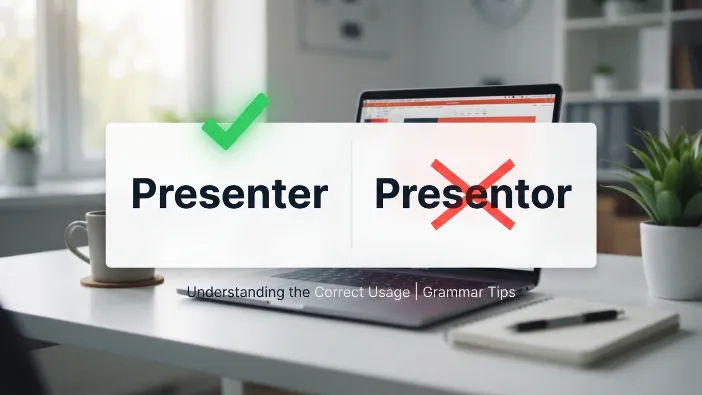
Presenter is the standard and preferred spelling. Presentor exists as a variant spelling, but it is dated and uncommon, so use presenter in modern English.
Have you ever typed a sentence, looked at the word presentor, and thought, “That doesn’t look quite right”? I have seen this small spelling doubt many times when reviewing presentations, reports, and other professional writing.
The confusion is easy to understand. Words such as actor, editor, and director end in -or, so presentor may seem natural. Yet English does not always follow one simple spelling pattern.
The standard word today is presenter. It means a person who presents something, gives a talk, hosts a program, or introduces a show. Oxford lists presenter for people who speak to an audience and for radio and television roles.
But there is one interesting detail: presentor is not simply a made-up word. Merriam-Webster lists it as a variant spelling of presenter. It is also described elsewhere as a dated form.
So, which one should you use? The answer becomes much easier once you understand where these two forms come from.
Presenter or Presentor : Quick Answer
Presenter is the correct choice for normal modern English.
Use it when you mean a person who:
- Gives a presentation
- Hosts a TV or radio program
- Speaks at a conference
- Introduces an event
- Gives an award
- Explains a topic to an audience
Simple examples
- Correct: Maria is the presenter at today’s conference.
- Correct: The TV presenter interviewed the actor.
- Preferred: James will be the presenter of the award.
Presentor may appear in older or unusual sources, but it is not the form you should normally choose today. Merriam-Webster calls it a variant spelling of presenter.
For school work, business writing, websites, reports, and professional communication, stick with presenter.
The Origin and Background of Presenter
The word presenter comes from the verb present plus the agent suffix -er.
An agent noun is simply a noun for someone who does an action.
For example:
- teach → teacher
- write → writer
- sing → singer
- present → presenter
The history of present goes back through Middle English and Old French to Latin. The Latin praesentare meant roughly “to show,” “to place before,” or “to present.”
The noun presenter has a long history too. Dictionary.com dates its first recorded use to the 1530s–1540s, while Merriam-Webster gives its first known use as the 15th century.
Interestingly, the word was not always linked to television.
The meaning changed over time. Today, when people hear presenter, they may picture someone standing in front of a camera or speaking at a conference. The television and radio sense developed much later. Etymonline notes that the meaning “host of a radio or television program” dates from the 20th century.
So the word has moved with the way people communicate.
Presenter Explained: Meaning and Uses
A presenter is someone who presents, introduces, or explains something.
The exact meaning depends on the setting.
1. TV or radio presenter
In British English, presenter is very common for someone who hosts a television or radio program.
Example:
She works as a television presenter.
In North American English, host is often more common for this role.
2. Conference presenter
A person who gives a talk at a conference can also be called a presenter.
Example:
The conference presenter explained the new research.
3. Award presenter
A person who gives an award is an award presenter.
Example:
The famous actor was the presenter of the award.
4. Business presenter
Someone who explains a plan, report, or idea to a group can also be a presenter.
Example:
The presenter explained the sales figures.
5. Online presenter
The word also works for webinars, online classes, and digital events.
Example:
The webinar presenter answered questions from the audience.
The meaning stays simple: a presenter is a person who presents something.
Presenter vs Presentor: What’s the Difference?
The biggest difference is not meaning. It is modern usage and spelling preference.
| Term | Meaning | When to Use | Region/Context |
|---|---|---|---|
| Presenter | A person who presents | Normal modern writing | UK, US, and international English |
| Presentor | Variant of presenter | Mainly older or unusual usage | Rare/dated contexts |
Merriam-Webster directly lists presentor as a variant spelling of presenter.
That means calling presentor completely impossible would be too strong. However, it is still not the best choice for everyday writing.
If you want your writing to look natural and current, choose presenter.
Why does presentor look tempting?
The spelling probably feels natural because English has many words ending in -or.
Consider:
- actor
- editor
- director
- instructor
- translator
It is easy to assume that present should follow the same pattern.
But English word formation is not always perfectly predictable. Presenter became the standard form, and that is the spelling modern readers expect.
Which Version Should You Use?
For almost every modern writing situation, use presenter.
For students
Use presenter in essays, assignments, presentations, and school projects.
Example:
Ali was the main presenter during the school event.
For professionals
Use presenter in emails, reports, conference programs, and business documents.
Example:
The keynote presenter will speak at 10 a.m.
For journalists and media writers
Use presenter for television and radio professionals.
Example:
The news presenter introduced the evening report.
For international readers
Presenter is the safest choice because it is widely understood in both British and American English.
In British English, presenter is especially common for television and radio roles. In American English, host may be preferred in some broadcasting contexts.
The simple rule
When in doubt, write presenter.
You do not need to change your spelling based on whether your reader is British or American.
Common Mistakes With Presenter
Small spelling mistakes can make otherwise good writing look less polished. Here are the most common ones.
1. Writing presentor instead of presenter
Mistake:
She is the event presentor.
Better:
She is the event presenter.
Presentor can be found as a variant, but presenter is the normal modern form.
2. Adding an extra letter
Mistake:
He is the presentter.
Correct:
He is the presenter.
The word has only one t.
3. Confusing presenter with present
Mistake:
She is the person who will presenter the report.
Correct:
She is the person who will present the report.
Presenter is a noun. Present is the verb.
4. Using presentor in formal work
You may find presentor in some dictionaries or older sources. Still, using it in a formal paper can make your spelling look unusual.
Better choice:
The presenter discussed the findings.
5. Confusing presenter with host
These words can overlap, especially in broadcasting.
A presenter presents or introduces a program. A host can lead or run a show. The exact choice depends on the type of program and the variety of English.
Presenter in Real-World Examples
Knowing the spelling is useful. Knowing how people actually use the word is even better.
Professional email
Subject: Conference Presenter Details
Please send the presenter information before Friday.
Here, presenter refers to the person giving a talk.
News article
The television presenter interviewed several experts about the issue.
This is a common British English use.
Social media post
Excited to be today’s presenter at our annual student conference!
The word sounds natural in a casual post too.
Formal report
The presenter explained the results and answered questions from the audience.
This works well in reports, minutes, and event documents.
Award ceremony
The actor returned to the stage as the award presenter.
Here, the presenter is the person giving the award.
Presenter or Presentor : Data, Trends & Usage
Searches for “presenter or presentor”, “presentor spelling”, and “is presentor a word?” are mainly informational. People are usually not looking for a product or service. They want a quick spelling decision.
The search itself makes sense because presentor looks believable. It follows a spelling pattern that appears in many English nouns.
Modern dictionary evidence points toward presenter as the normal form. Oxford, Cambridge, Dictionary.com, and other major references list presenter as the established noun.
At the same time, Merriam-Webster’s entry for presentor shows why the question is not completely black and white: it records presentor as a variant spelling of presenter.
This is useful for writers because it explains why you may occasionally see presentor in older material or unusual sources.
The practical lesson is simple:
Dictionary existence does not always mean equal modern usage.
A word can exist as a historical or variant form while another spelling remains the clear everyday choice.
For current writing, presenter is the safer and more natural option.
Presenter vs Presentor: Comparison at a Glance
| Term/Variant | Meaning | Region/Context | Best Used When |
|---|---|---|---|
| Presenter | Person who presents | Modern English; UK and US | Almost all normal writing |
| Presentor | Variant of presenter | Rare, dated, or unusual use | Only when preserving a source’s wording |
| TV presenter | Person who hosts or introduces a TV program | Especially British English | British media contexts |
| Radio presenter | Person who presents a radio program | Especially British English | Radio and broadcasting |
| Conference presenter | Person giving a conference talk | International English | Academic and professional events |
| Award presenter | Person giving an award | UK, US, international | Ceremonies and events |
| Host | Person leading a program or event | Especially North American English | Shows, events, and broadcasts |
The key point is that presenter is the standard spelling you should reach for first.
Frequently Asked Questions
Q: What does presenter mean?
A: A presenter is a person who presents, explains, or introduces something. The word can describe a TV or radio presenter, conference speaker, event presenter, or award presenter.
Q: Is presenter the correct spelling?
A: Yes. Presenter is the standard modern spelling. It is widely used in British, American, and international English.
Q: Is presentor a word?
A: Yes, but with an important qualification. Merriam-Webster lists presentor as a variant spelling of presenter, while other references describe it as dated. It is much less common than presenter.
Q: Which is correct, presenter or presentor?
A: Presenter is the preferred choice in modern English. Use it in school, business, academic, professional, and online writing.
Q: Is presenter formal enough for professional writing?
A: Yes. Presenter is completely suitable for formal writing. You can use it in reports, conference programs, business documents, academic work, and news writing.
Q: Where does the word presenter come from?
A: Presenter comes from present + -er. The verb present has roots in Middle English, Old French, and Latin. The noun has been used for centuries.
Q: Is presenter used in British and American English?
A: Yes. Both varieties use presenter. British English uses it very often for TV and radio roles, while American English may use host more often for some broadcasting jobs.
Q: Can I use presenter for someone giving a presentation?
A: Absolutely. A person giving a talk at a meeting, conference, class, or webinar can be called a presenter. For example, “The presenter explained the new plan.”
Final Verdict: Presenter or Presentor?
When two spellings look almost identical, it is easy to hesitate. Presenter and presentor are a good example.
The answer is clear for modern writing: use presenter.
A presenter can host a TV or radio program, give a conference talk, explain a business plan, introduce an event, or give someone an award. The word is established across major English varieties and has a long history.
Presentor is more complicated. It is not simply an invented spelling. Merriam-Webster records it as a variant of presenter, and historical sources show that the form has existed. However, it is rare and dated compared with the standard modern form.
So if you are writing an email, essay, article, report, presentation, or professional document, there is no need to take a risk.
Choose presenter.
Remember the easy pattern:
present → presenter
Now you know exactly which spelling to use. Bookmark this guide if you often second-guess tricky English words, and share it with someone who still writes presentor.
Read more: Calendar or Calender: Which Spelling Is Correct?

I started writing about English word differences after years of teaching students who kept making the same mistakes. My focus is on making spelling rules feel simple and easy to remember. At WordsCombo, I turn confusing word pairs into clear comparisons.