Are you unsure whether the correct spelling is forest or forrest? You are not alone. These two spellings look very similar, but they are generally used for different purposes.
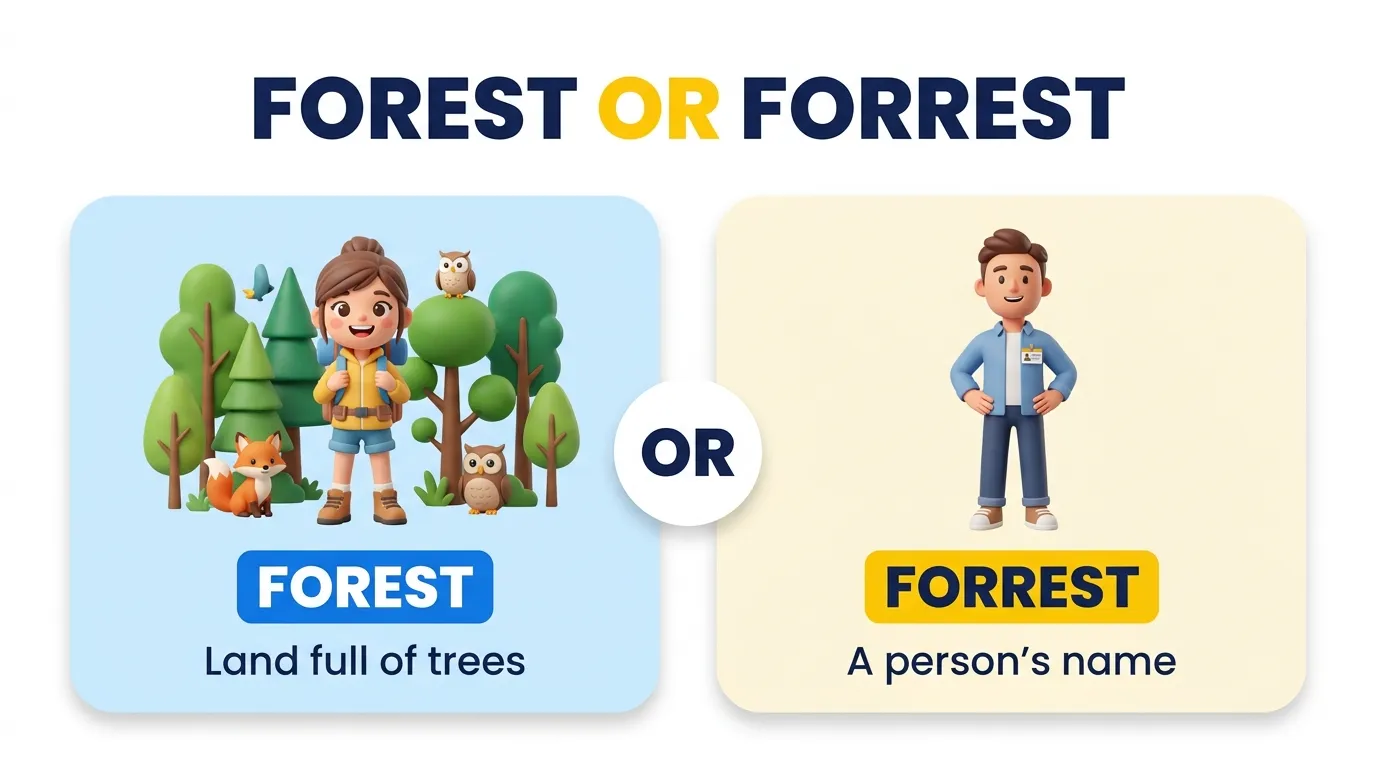
Forest is the correct spelling when you mean a large area covered with trees and plants. Forrest is generally used as a person’s first or last name. If you are writing about trees, woodland, or a wooded area, use forest.
Forest or Forrest: What’s the Difference?
| Word | Meaning | Typical Use | Example |
|---|---|---|---|
| Forest | A large area covered with trees and plants | Common noun | We walked through the forest. |
| Forrest | Usually a person’s name | Proper noun | Forrest is my neighbor’s name. |
The easiest way to remember the difference is:
Forest = trees and woodland
Forrest = usually a person’s name
Cambridge Dictionary defines forest as a large area of land covered with trees and plants, or the trees and plants themselves.
What Does Forest Mean?
Forest is a noun used for a large area where trees and other plants grow. It can refer to the land itself or, depending on context, the trees and vegetation growing there.
Examples of forest
- We went for a walk through the forest.
- The birds live deep in the forest.
- A large forest surrounds the village.
- The hikers became lost in the forest.
- The government is working to protect the forest.
The word is used in both British and American English. The pronunciation differs slightly between the two varieties, but the spelling remains forest.
What Does Forrest Mean?
Forrest is most commonly encountered as a personal name. It can be used as a first name or surname.
For example:
- Forrest is my brother’s first name.
- Mr. Forrest joined the meeting.
- Forrest moved to another city last year.
Because Forrest looks almost identical to forest, it is sometimes accidentally used when someone means the wooded area. In ordinary English writing, however, the word for an area of trees is forest.
Forest vs. Forrest: Key Difference
The main difference is meaning and grammatical use.
Forest is a common noun:
We explored the forest during our vacation.
Forrest is generally a proper noun:
Forrest visited us last weekend.
A common noun names a general person, place, thing, or idea. A proper noun identifies a particular person, place, or other specific entity and is normally capitalized.
Forest
- Refers to an area of trees.
- Usually written in lowercase unless it begins a sentence or forms part of a proper name.
- Used as a common noun.
Forrest
- Usually refers to a person’s name.
- Normally begins with a capital letter when used as a name.
- Used as a proper noun.
Is Forrest a Misspelling of Forest?
Not necessarily. If someone writes Forrest as a person’s name, it is not a misspelling. It is a legitimate spelling used in names.
However, if you are referring to an area covered with trees, forest is the standard spelling.
For example:
Correct:
We spent the afternoon walking through the forest.
Incorrect for the intended meaning:
We spent the afternoon walking through the forrest.
The second sentence would normally be corrected to forest.
When Should You Use Forest?
Choosing the right word is important in formal writing, just as it is when deciding between practice and practise.
Use forest when you are talking about trees, woodland, or a large area of land covered by trees and vegetation.
Examples
The forest was quiet in the early morning.
Many animals live in the forest.
They drove through a dense forest.
The forest contains several species of birds.
We explored the forest during our camping trip.
You may also see forest in compounds and expressions such as:
- forest fire
- forest floor
- forest ranger
- forest management
- tropical forest
- rain forest or rainforest
- forest cover
These all refer to forests or things associated with forests. Cambridge Dictionary also lists terms such as forest fire, forest floor, and forest ranger among common uses of the word.
When Should You Use Forrest?
Use Forrest when it is someone’s name.
For example:
Forrest called me yesterday.
I met Forrest at the conference.
Forrest is studying English.
Because names are proper nouns, Forrest is normally capitalized.
If you are not talking about a person but about an area of trees, use forest instead.
Forest or Forrest in Example Sentences
Seeing the two words side by side can make the difference easier to remember.
Examples with Forest
The children played near the edge of the forest.
A narrow road runs through the forest.
The hikers entered the forest before sunrise.
The region is surrounded by a dense forest.
Several animals depend on the forest for food and shelter.
Examples with Forrest
Forrest is coming to dinner tonight.
I sent the document to Forrest.
Forrest introduced himself to the new team.
My friend’s last name is Forrest.
The context makes the distinction clear: forest describes a wooded area, while Forrest generally identifies a person.
Why Do People Confuse Forest and Forrest?
People often confuse forest and Forrest because they look very similar, just as readers can confuse other similar-looking words such as compliment and complement.
The extra r in Forrest can make it look like an alternative spelling of forest. However, the two forms have different typical uses.
Another reason for the confusion is that people may encounter Forrest as a name and assume it is simply another spelling of the common noun.
A simple memory trick is:
Forest has one “r” after the “fo.”
Forrest has two “r” letters.
Think:
Forest → trees
Forrest → name
Is “Forrest” Ever Correct for Trees?
No, not as the standard spelling of the common noun. When you mean an area covered with trees, use forest.
For example:
We walked through the forest.
not:
We walked through the forrest.
Forrest can be correct when it is someone’s name, but it should not normally replace forest when describing woodland.
Is Forest Spelled Differently in British English?
Similar differences between British and American English can be seen in words such as spelt and spelled.
No. The standard spelling is forest in both British and American English.
The pronunciation can differ between British and American English, but the spelling does not change. Cambridge Dictionary gives UK and US pronunciations for forest while retaining the same spelling.
So you should write:
British English: forest
American English: forest
Where Does the Word Forest Come From?
Forest is an established English word referring to a wooded area. Its history is connected with words used in French and Latin for wooded or outdoor areas.
For a modern English sentence, however, the important point is simple: forest is the standard English noun for a large area of trees.
Common Mistakes With Forest and Forrest
Spelling mistakes are common in English, especially when two words look or sound similar.
Here are some common errors to watch for.
Mistake 1: Using Forrest for trees
❌ We walked through the forrest.
✅ We walked through the forest.
Mistake 2: Treating Forrest as the standard noun
❌ The Forrest was full of trees.
✅ The forest was full of trees.
Mistake 3: Forgetting that names are capitalized
If Forrest is someone’s name, capitalize it:
✅ Forrest lives nearby.
Not:
❌ forrest lives nearby.
Mistake 4: Assuming the extra “r” makes a different spelling of forest
The extra r does not create a standard alternative spelling for the common noun forest.
How to Remember Forest vs. Forrest
Use this simple rule:
Forest = trees.
Forrest = usually a person.
If you can replace the word with woodland or an area of trees, you almost certainly need forest.
For example:
We walked through the forest.
You could also say:
We walked through the woodland.
But if the sentence is about someone’s name:
Forrest called me.
you are dealing with a proper name.
Forest or Forrest: Quick Examples
| Sentence | Correct Word |
|---|---|
| We walked through the ___ yesterday. | forest |
| The ___ was full of tall trees. | forest |
| ___ is my friend’s name. | Forrest |
| I spoke with Mr. ___. | Forrest |
| Many animals live in the ___. | forest |
| ___ joined the team last year. | Forrest |
Frequently Asked Questions
Is “forrest” ever a correct spelling for trees?
No. Forest is the standard spelling when referring to an area covered with trees. Forrest is generally used as a personal name.
Why do people confuse forest and forrest?
The words look and sound similar, but forest is the standard common noun for a wooded area, while Forrest is generally used as a name.
Is Forrest a first name or a last name?
Forrest can be used as a first name or surname. When it is used as a person’s name, it is normally capitalized.
Which spelling is correct in formal writing?
For an area of trees, use forest. If you are writing someone’s name and their name is Forrest, retain the spelling Forrest.
Does British English spell forest differently?
No. Forest is the standard spelling in both British and American English. The pronunciation may vary between the two varieties.
Can forrest ever work as a normal word in a sentence?
Forrest can appear in a sentence when it is a person’s name. It is not normally used as the common noun meaning an area of trees.
Is “forest” a noun?
Yes. Forest is commonly used as a noun for a large area covered with trees and plants.
What is the easiest way to remember forest and Forrest?
Remember: forest = trees, while Forrest = usually a name.
Forest or Forrest: Final Answer
The correct spelling depends on what you mean.
Use “forest” when you mean an area of trees or woodland.
Use “Forrest” when it is a person’s name or another proper name that is officially spelled that way.
So if you are writing about trees, the answer is simple:
Forest is correct.
Sources
- Cambridge Dictionary : forest
- Cambridge Dictionary : forest pronunciation
Related Spelling Guides
- Compliment or Complement
- Spelt or Spelled
- Practice or Practise
- Loosing or Losing
- Judgment or Judgement

I started writing about English word differences after years of teaching students who kept making the same mistakes. My focus is on making spelling rules feel simple and easy to remember. At WordsCombo, I turn confusing word pairs into clear comparisons.