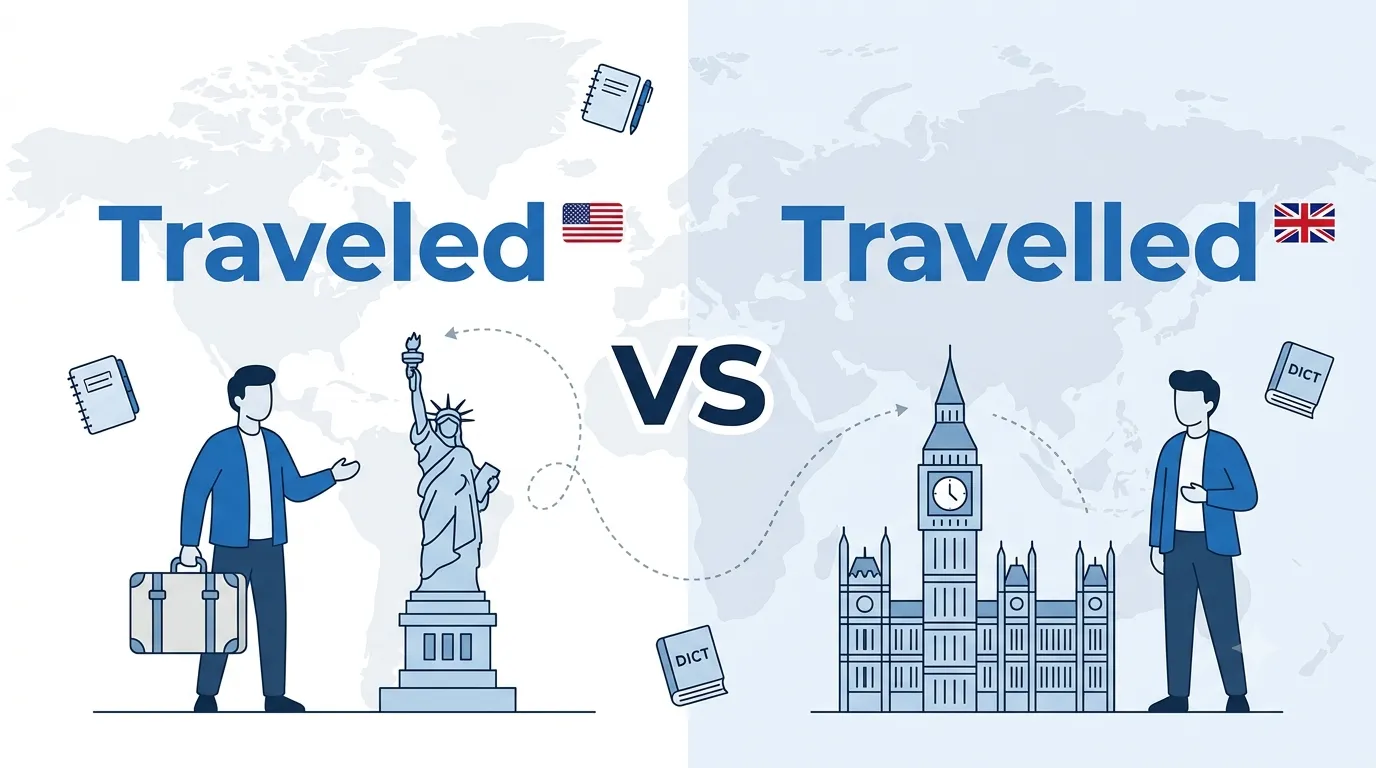
Both traveled and travelled are correct. The only difference is spelling. Traveled is the preferred spelling in American English, while travelled is the standard spelling in British English and many other English speaking countries.
A few years ago, I was editing a travel blog before it went live. Everything looked great until I noticed something strange. Half the article used “traveled,” while the other half used “travelled.” At first, I thought one of them had to be wrong.
After checking several trusted dictionaries and style guides, I discovered the truth. Both spellings are correct. The real difference is where you use them.
Many writers, students, bloggers, and business professionals face the same confusion. You may wonder which spelling is right for an essay, a website, an email, or even a social media post. Choosing the wrong version for your audience can make your writing look inconsistent.
The good news is that the answer is simple once you know the rule.
In this guide, you’ll learn why both spellings exist, where each one is used, how to avoid common mistakes, and which version fits your audience best.
Traveled or Travelled: Quick Answer
Both traveled and travelled are the past tense and past participle of the verb travel.
The spelling depends on the type of English you are using:
- Traveled → American English (US)
- Travelled → British English (UK), Canadian English, Australian English, New Zealand English, and most Commonwealth countries
Real World Examples
American English
- I traveled to New York last summer.
- She has traveled across the United States.
British English
- I travelled across Europe by train.
- They have travelled around the world together.
The meaning never changes. Only the spelling does.
The Origin and Background of Traveled or Travelled
The word travel has been part of English for hundreds of years. It comes from the Old French word travail, which originally meant hard work or to struggle. Long ago, traveling was slow, difficult, and often dangerous, so the connection made sense.
As English spread around the world, spelling rules began to develop in different ways.
In the United States, dictionary writer Noah Webster promoted simpler spellings in the early 1800s. His goal was to make American English easier and more consistent.
That is why many American words use a single L, such as:
- traveled
- traveled
- traveling
- canceled
- modeled
Meanwhile, British English kept the traditional rule of doubling the final L before adding endings like ed or ing.
So British English uses:
- travelled
- travelling
- cancelled
- modelling
Neither spelling is newer or better. They simply follow different spelling traditions.
Traveled or Travelled Explained: Key Differences
The biggest difference is not meaning. It is regional spelling.
If you write for readers in the United States, use traveled.
If your audience is in the United Kingdom or most Commonwealth countries, use travelled.
Comparison Table
| Term | Meaning | When to Use | Region/Context |
|---|---|---|---|
| Traveled | Past tense of travel | American English writing | United States |
| Travelled | Past tense of travel | British English writing | UK, Australia, New Zealand, South Africa, India, and many Commonwealth countries |
Side by Side Examples
| American English | British English |
|---|---|
| We traveled by plane. | We travelled by plane. |
| She traveled for work. | She travelled for work. |
| They have traveled a lot. | They have travelled a lot. |
The Simple Rule
Think of it this way:
- 🇺🇸 United States → Traveled
- 🇬🇧 United Kingdom → Travelled
The same rule applies to other words ending in l, such as:
| American English | British English |
|---|---|
| Traveled | Travelled |
| Traveling | Travelling |
| Canceled | Cancelled |
| Counseling | Counselling |
| Modeled | Modelled |
Keeping your spelling style consistent is more important than choosing one version over the other. Mixing both spellings in the same document can confuse readers and make your writing appear less polished.
Which Version Should You Use?
Choosing between traveled and travelled is easy once you know who will read your writing.
There is no right or wrong spelling for everyone. The best choice depends on your audience.
For Students
Use the spelling your school or teacher expects.
- American schools → traveled
- British schools → travelled
Always follow the style guide for your class.
For Bloggers
Think about where most of your readers live.
- Writing for a US audience? Use traveled.
- Writing for a UK audience? Use travelled.
A consistent spelling style helps build trust with your readers.
For Businesses
Companies should match the language used by their customers.
For example:
- A US travel agency should write traveled.
- A UK tourism company should write travelled.
Using local spelling makes your content feel natural.
For Academic Writing
Many universities have their own style rules.
Check whether your institution follows:
- American English
- British English
Then use that spelling throughout your paper.
For Global Audiences
If your readers come from many countries, choose one style and stick with it.
Consistency matters more than the spelling itself.
Quick Recommendations
- American audience → Traveled
- British audience → Travelled
- Australian audience → Travelled
- Canadian audience → Usually Travelled (though American spelling is becoming more common in some contexts)
- International audience → Pick one style and use it consistently
Common Mistakes with Traveled or Travelled
Many people know both spellings exist. The real problem is using them the wrong way.
Here are the most common mistakes.
| Mistake | Correct | Why It Happens |
|---|---|---|
| I travelled across Texas for my US newspaper. | I traveled across Texas for my US newspaper. | American publications prefer American spelling. |
| She traveled around London in a UK report. | She travelled around London in a UK report. | British publications use British spelling. |
| We traveled yesterday and are travelling today. | Use one spelling style throughout. | Mixing spelling styles looks inconsistent. |
| He has travel to France. | He has traveled/travelled to France. | The past participle is needed after has. |
| They travel last year. | They traveled/travelled last year. | The sentence needs the past tense. |
Tips to Avoid These Mistakes
- Decide on American or British English before you begin writing.
- Don’t switch spellings halfway through your article.
- Use your spell checker with the correct language setting.
- Follow your company’s or school’s style guide.
A few seconds of checking can save a lot of editing later.
Traveled or Travelled in Real World Examples
Seeing the word in context makes it much easier to remember.
Professional Email
Dear Sarah,
I traveled to our Chicago office last week to meet the new team. The visit was productive, and I look forward to sharing my notes.
Best regards,
Alex
(American English)
News Headline
Thousands of tourists travelled across Scotland during the holiday weekend.
(British English)
Social Media Post
Finally checked another country off my bucket list! I traveled over 3,000 miles for this adventure, and every moment was worth it. 🌍✈️
Formal Report
During the past financial year, company representatives travelled to six countries to strengthen international partnerships.
(British English business report)
These examples show that the meaning stays the same. Only the regional spelling changes.
Traveled or Travelled: Data, Trends & Usage
Both spellings are searched online every day because many people are unsure which one is correct.
Where Is This Topic Most Popular?
People often search for traveled or travelled in countries such as:
- United States
- United Kingdom
- Canada
- Australia
- India
- New Zealand
These countries use different English spelling rules, which creates confusion.
Who Searches for It?
This topic is popular among:
- Students
- English learners
- Bloggers
- Copywriters
- Teachers
- Editors
- Business professionals
- Content marketers
Anyone who writes in English may need the answer.
Search Intent
The search intent is mainly informational.
Readers want to know:
- Which spelling is correct.
- Which spelling fits their audience.
- Whether both versions are accepted.
- How to avoid mistakes.
Why This Matters Today
More people write for a global audience than ever before.
A blog written in the United States may be read in Australia. A UK company may have customers in America.
Using the right spelling for your audience helps your writing look more professional. It also creates a better reading experience and builds trust with your readers.
Standalone Comparison Table
| Term/Variant | Meaning | Region/Context | Best Used When |
|---|---|---|---|
| Traveled | Past tense and past participle of travel | American English | Writing for US readers, businesses, schools, and publications |
| Travelled | Past tense and past participle of travel | British English and Commonwealth English | Writing for UK, Australia, New Zealand, India, South Africa, and similar audiences |
| Traveling | Present participle of travel | American English | US articles, emails, websites, and reports |
| Travelling | Present participle of travel | British English | UK publications, academic writing, and official documents |
| Traveler | A person who travels | American English | American books, blogs, and media |
| Traveller | A person who travels | British English | British newspapers, websites, and formal writing |
Frequently Asked Questions (FAQs)
Q: What does traveled or travelled mean?
Both traveled and travelled are the past tense and past participle of the verb travel. They mean that someone went from one place to another. The only difference is the spelling, not the meaning.
Q: How do you use traveled or travelled correctly?
Choose the spelling that matches your audience.
- Use traveled if you are writing in American English.
- Use travelled if you are writing in British English or most Commonwealth English.
Once you choose one style, use it throughout your writing.
Q: Traveled vs. travelled: what’s the difference?
There is no difference in meaning. Both words describe the same action.
The only difference is regional spelling:
- Traveled → American English
- Travelled → British English
Q: Is traveled acceptable in formal writing?
Yes. Traveled is completely correct in formal writing when you are using American English. It appears in business reports, academic papers, newspapers, books, and official documents across the United States.
Q: Which version is correct: traveled or travelled?
Both are correct.
The best choice depends on the English style you follow.
- Writing for the United States? Use traveled.
- Writing for the United Kingdom, Australia, or similar countries? Use travelled.
Neither spelling is more correct than the other.
Q: Where do these spellings come from?
The word travel comes from the Old French word travail, which meant hard work or struggle.
Over time, American English adopted simpler spelling rules, while British English kept the traditional double L pattern. That is why both spellings exist today.
Q: Can I use traveled or travelled in business, academic, and online writing?
Yes. Both spellings are widely accepted.
The key is to match the spelling with your audience and stay consistent throughout your document, website, email, or social media content.
Conclusion
If you have ever paused while typing traveled or travelled, you are not alone. It is one of the most common spelling questions in English, and the answer is refreshingly simple.
Remember these key points:
- Both spellings are correct.
- Traveled is the standard choice in American English.
- Travelled is preferred in British English and many Commonwealth countries.
- Consistency matters most. Pick one style based on your audience and use it throughout your writing.
Whether you are writing an email, a school assignment, a blog post, or a business report, choosing the right spelling helps your work look polished and professional. Your readers will notice the consistency, even if they do not realize why it feels natural.
The next time you wonder which spelling to use, think about who you are writing for. That simple step will help you make the right choice every time.
Now you know exactly how to use traveled and travelled—bookmark this guide so you never second guess the spelling again. If you found it helpful, share it with someone who has asked the same question.

I studied English literature and have spent years editing content for blogs and digital platforms. I noticed most people struggle with choosing between two similar words. At WordsCombo, I make that choice simple and clear.