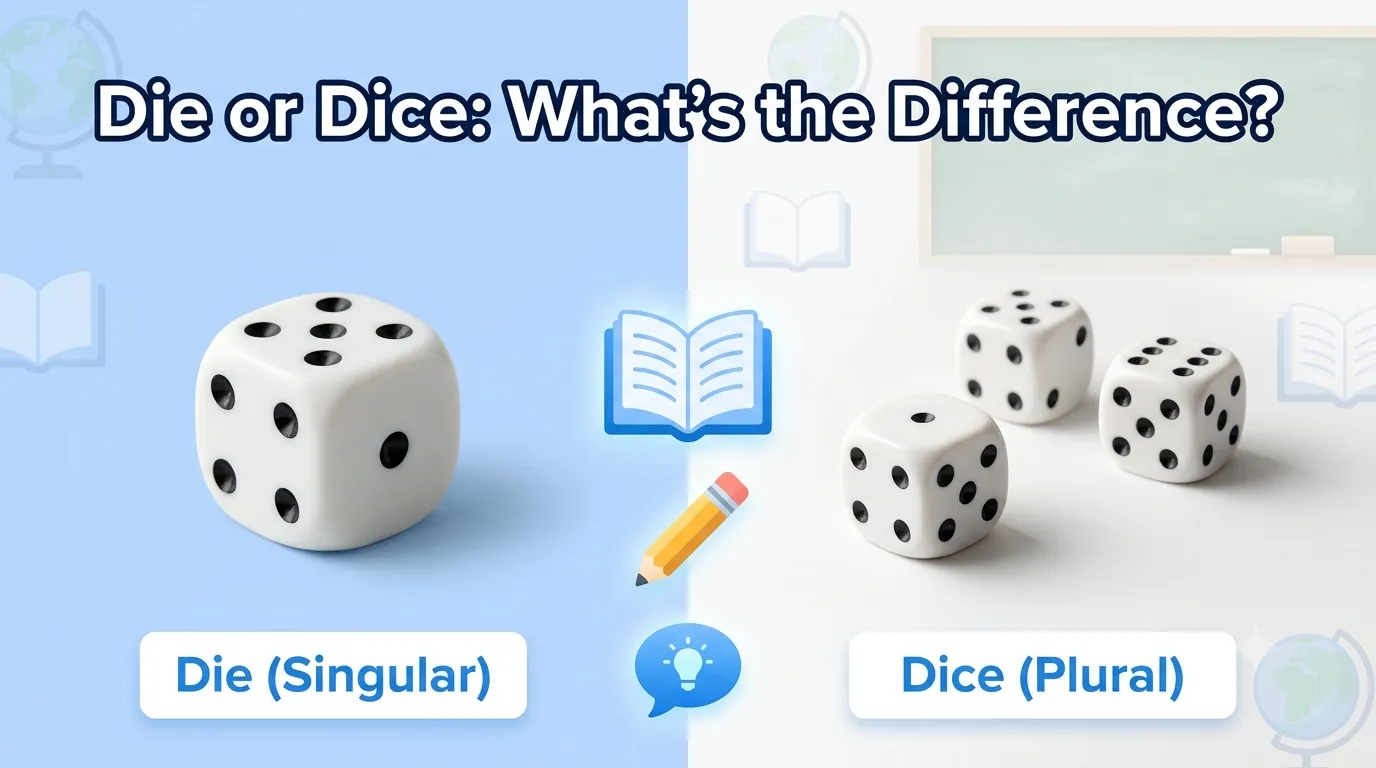
Die is the singular form, and dice is the plural form. If you are talking about one gaming cube, use die. If you are talking about two or more, use dice.
A few years ago, I was helping a student edit an article about board games. Everything looked great until one sentence stopped us both:
“Roll the dice.”
That was fine. But the next line said:
“Take one dice and place it on the board.”
The student asked, “Is dice correct here too?” It sounded natural because many people say it that way in everyday conversation. Yet traditional English grammar tells a different story.
This small question confuses writers, students, gamers, teachers, and even native English speakers. Search online, and you’ll find different answers. Some dictionaries accept dice as both singular and plural in casual English, while style guides still recommend die for one cube and dice for more than one.
So which version should you use?
You’ll find the answer here. We’ll explain the difference, show real examples, discuss the history behind both words, point out common mistakes, and help you choose the right form with confidence.
Die or Dice: Quick Answer
The basic rule is simple:
- Die = one cube used in games.
- Dice = two or more cubes.
Examples
- ✅ Roll a die.
- ✅ Roll two dice.
- ✅ The die landed on six.
- ✅ The dice are on the table.
In casual speech, many people also use dice for one cube, especially in American English. However, die remains the preferred choice in formal writing.
The Origin and Background of Die or Dice
The word die comes from Old French dé, which itself comes from Latin datum, meaning “something given” or “something played.”
Originally:
- One gaming cube = die
- More than one = dice
Over hundreds of years, everyday speech changed. People began saying dice even when talking about just one cube.
Today:
- Traditional grammar still teaches die as singular.
- Casual conversation often accepts dice as singular.
- Professional writing usually keeps the traditional rule.
This explains why different sources sometimes give different answers.
Die or Dice Explained: Key Differences
The biggest difference is simply the number of gaming cubes being discussed.
| Term | Meaning | When to Use | Region/Context |
|---|---|---|---|
| Die | One gaming cube | Formal writing, education, manuals | Worldwide |
| Dice | Two or more gaming cubes | Standard English | Worldwide |
| Dice (singular) | One gaming cube | Informal speech | Mostly North America |
Example Using “Die”
“I lost one die from my board game.”
Example Using “Dice”
“The dice rolled across the table.”
Informal Example
“Pass me that dice.”
Many people say this casually, but editors usually change it to:
“Pass me that die.”
Which Version Should You Use?
The best choice depends on your audience.
For Students
Use die for one.
Teachers and exams usually expect the traditional rule.
For Professional Writers
Always use:
- die (singular)
- dice (plural)
This avoids confusion and follows most style guides.
For Gamers
Many gamers say dice whether they mean one or many.
People will understand you, but written game rules often use die for a single piece.
For Global Readers
Stick with:
- die = one
- dice = many
It works everywhere.
Common Mistakes with Die or Dice
Here are mistakes people often make.
| Mistake | Correct Form | Why? |
|---|---|---|
| One dice | One die | Singular noun |
| This dice is blue | This die is blue | One object |
| These die are old | These dice are old | Plural noun |
| Roll a dice | Roll a die | Formal grammar |
| Two die | Two dice | Plural needed |
Why These Mistakes Happen
- Everyday speech influences writing.
- Movies and games often use dice for both forms.
- Many people never learn the traditional singular.
Die or Dice in Real World Examples
Professional Email
Please bring one die and two dice sets for tomorrow’s classroom activity.
News Headline
Casino Introduces New Security Features for Every Die Used at the Tables
Social Media Post
I rolled the dice three times and still couldn’t win!
Formal Report
Each participant received one numbered die before the experiment began.
These examples show how the words fit naturally into different types of writing.
Die or Dice: Data, Trends & Usage
People search for die or dice because they are unsure which word is correct.
Most Common Search Intent
Informational
People want to know:
- Which spelling is correct?
- Is dice singular?
- Can dice mean one?
- What’s the grammar rule?
Popular Audiences
- Students
- Teachers
- Board game players
- Casino enthusiasts
- English learners
- Writers and editors
Regions Where Confusion Is Common
- United States
- United Kingdom
- Canada
- Australia
- India
Why This Matters Today
Board games, tabletop RPGs, online gaming, and educational content are more popular than ever. As people write reviews, guides, and game rules, they naturally wonder whether to use die or dice.
Standalone Comparison Table
| Term/Variant | Meaning | Region/Context | Best Used When |
|---|---|---|---|
| Die | One gaming cube | Formal English | Writing about one cube |
| Dice | More than one cube | Standard English | Talking about multiple cubes |
| Dice (singular) | One cube | Informal speech | Casual conversation only |
| Die (mathematics/manufacturing) | Tool or mold | Technical fields | Engineering and manufacturing |
Frequently Asked Questions
Q: What does die mean?
A: Die is the singular form of dice. It usually refers to one small cube used in games.
Q: How do you use die correctly?
A: Use die whenever you are talking about one gaming cube. For example: “The die landed on four.”
Q: Die vs dice what’s the difference?
A: Die refers to one cube. Dice refers to two or more cubes. In informal speech, some people also use dice for one cube.
Q: Is die acceptable in formal writing?
A: Yes. In fact, it is the preferred choice for formal writing, academic papers, manuals, and professional documents.
Q: Which version is correct die or dice?
A: Both are correct, but they mean different things. Use die for one and dice for more than one.
Q: Where does the word die come from?
A: It comes from Old French dé, which later became the English word die. The plural eventually became dice.
Q: Can dice be used as a singular noun?
A: Yes, many people use dice as singular in casual conversation. However, die is still the recommended form in formal English.
Conclusion
The difference between die and dice is easier than it first appears. Remember three simple points.
First, die is the traditional singular form. Second, dice is the plural form. Third, while casual speech often uses dice for one cube, formal writing still favors die.
If you’re writing an essay, article, report, or professional document, follow the traditional rule. It looks polished and avoids confusion. If you’re chatting with friends during a board game, hearing dice used for one cube is common and widely understood.
Language changes over time, but knowing the standard rule helps you write with confidence. Once you understand the difference, you’ll never need to second guess yourself again.
Now you know exactly how to use die and dice. Bookmark this guide for future reference, and share it with anyone who’s ever wondered which word is correct.

I have been working with English language content for over six years. I specialize in word comparisons and spelling differences that most people overlook. At WordsCombo, I help readers choose the right word every time.