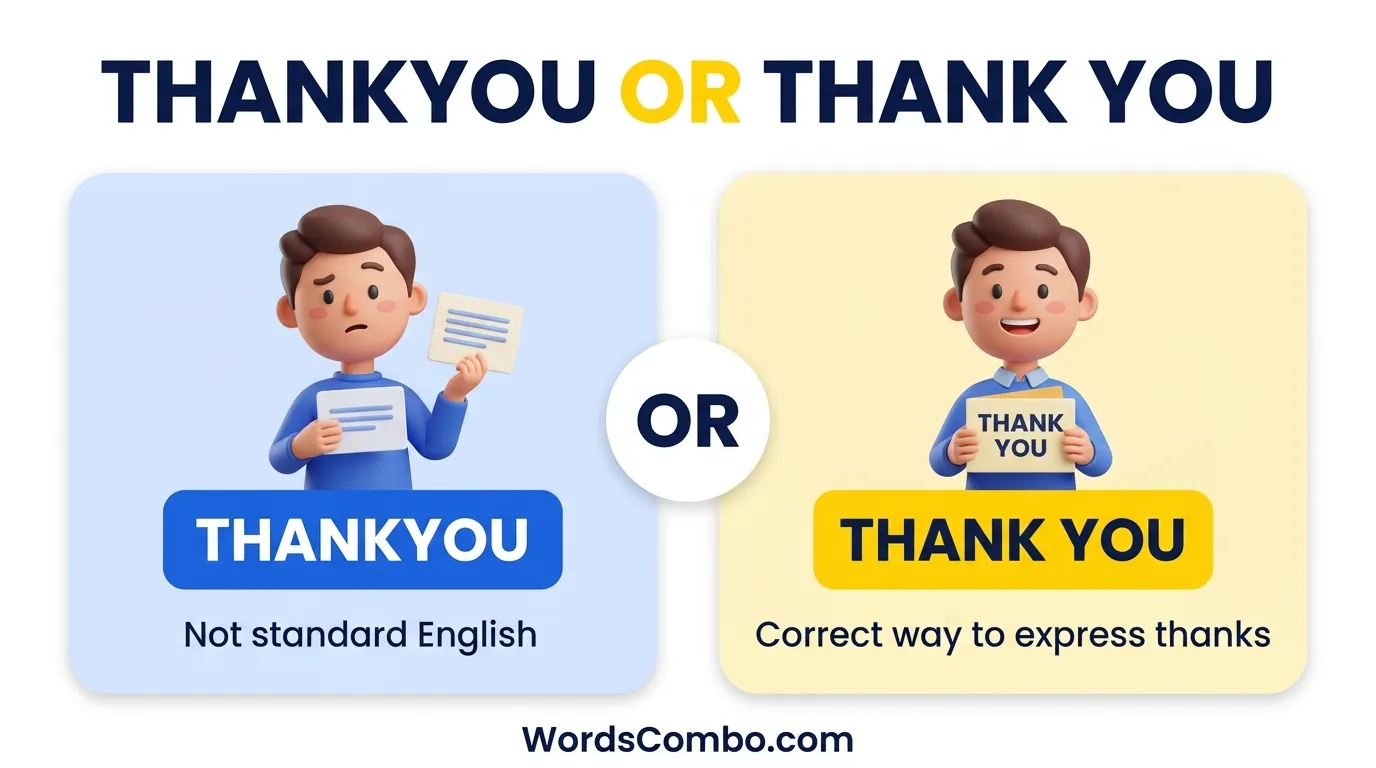
Thank you is the correct spelling when you want to show gratitude. Thankyou is not correct as a standard English phrase. Write the two words separately.
When you finish an email to your teacher, thank a client, or reply to a kind message, you may pause over the spelling. Is it thank you or thankyou? The answer is simple: thank you is always written as two words when you express thanks. The closed form, thankyou, is not standard English. However, thank-you with a hyphen is correct in some cases, such as in a thank-you note. This guide explains when to use each form, with easy examples.
Thank You or Thankyou: Quick Answer
Thank you is the correct phrase for showing that you feel grateful. Always write it as two separate words in a message, email, or conversation.
For example:
- Correct: Thank you for your help.
- Incorrect: Thankyou for your help.
However, when the phrase describes a noun, a hyphen may be needed. For example, She sent me a thank-you card.
The Origin of Thank You and Thankyou
The phrase thank you comes from the older English word thank, which relates to gratitude and appreciation. The word you tells us who receives that thanks.
Over time, people began using the phrase in letters, books, and everyday speech. Because both words are often spoken together, some people think they should be joined in writing.
However, saying two words together does not mean they become one word. English has many phrases that sound like a single unit but still need a space. That is why thank you remains the standard form.
The hyphenated form, thank-you, developed as a way to use the phrase before a noun or as a noun itself. For example, a thank-you message and a short thank-you are both correct.
Thank You vs. Thankyou: Key Differences
The main difference is simple: thank you is the standard phrase, while thankyou is a spelling mistake in normal English writing. The hyphenated form has a different job.
Here is how to tell them apart.
- Thank you: Use it to express gratitude. Example: Thank you for calling.
- Thankyou: Avoid it in standard English. Example: Thankyou for calling is incorrect.
- Thank-you: Use it in certain noun forms or before another noun. Example: I wrote a thank-you note.
The space or hyphen changes how the words work in a sentence. So, choosing the right form helps your writing look clear and professional.
| Term | Meaning | When to Use | Region/Context |
| Thank you | A phrase that expresses gratitude | Thanking someone directly | Standard English worldwide |
| Thankyou | A nonstandard closed spelling | Avoid in normal writing | Generally incorrect |
| Thank-you | A noun or describing form linked to thanks | Before a noun or as a noun | Standard English usage |
Which One Should You Use?
In almost every message where you want to thank someone, write thank you as two words. The choice is easy once you know what the phrase is doing.
- For students: Write thank you in schoolwork because it is the standard spelling.
- For professionals: Use thank you in emails to clients, managers, and coworkers because it looks clear and polite.
- For social media users: Write thank you in comments, captions, and replies. Even short posts benefit from correct spelling.
- For formal writing: Use thank you when expressing gratitude, but use thank-you in phrases such as a thank-you letter.
- For neutral, everyday writing: Choose thank you whenever you are unsure.
Remember, you do not need to join the words to sound friendly or natural. A simple Thank you! works well in almost any setting.
Common Mistakes with Thank You
Even good writers can mix up these forms. However, a few simple rules can help you avoid the most common errors.
– Mistake: Thankyou for your time. Correction: Thank you for your time. Why: The phrase needs a space when you thank someone directly.
– Mistake: Thank-you for your help. Correction: Thank you for your help. Why: A hyphen is not needed when you express gratitude directly.
– Mistake: I sent a thankyou card. Correction: I sent a thank-you card. Why: The hyphen helps join the words when they describe a card.
– Mistake: I want to say a thankyou. Correction: I want to say thank you. Why: The standard phrase does not need to be joined into one word.
– Mistake: Thank you note is the only correct form. Correction: A thank-you note is a clear, standard choice. Why: The hyphen shows that the phrase describes the type of note.
Thank You in Real-World Examples
The right form depends on how you use it. Here are examples from everyday life, school, and work.
Professional email
Thank you for taking the time to review my application. I look forward to hearing from you.
News headline
Local School Thanks Volunteers for Their Help
Here, thanks is a verb that tells readers what the school did.
Social media post
Thank you all for your kind wishes and support!
Formal document
I would like to thank you for your time and support during the project.
Personal message
Thank you for the lovely birthday gift. It made my day!
Thank-you card
I wrote a thank-you note to my teacher because she helped me prepare for my exam.
Notice how the spelling changes with its role. When you thank a person, use thank you. When you describe a note or card, use thank-you.
Thank You: Data, Trends & Usage
People search for thankyou or thank you because the two words often sound like one when spoken. In texts and quick online messages, writers may also leave out spaces or punctuation.
However, this spelling question matters beyond casual chat. Students need the right form for schoolwork, while job seekers and workers need clear writing in emails and letters.
The search intent is mainly informational. People want a quick answer, examples, and a rule they can remember. Related questions about thank-you notes, thank-you messages, and formal writing also show that readers need help with the hyphenated form.
The key lesson is that thank you is the standard expression of gratitude, while thank-you is used as a noun or describing word. Learning this small rule can help you write with more confidence.
Thank You or Thankyou: Comparison at a Glance
| Term/Variant | Meaning | Region/Context | Best Used When |
| Thank you | Expresses gratitude | Standard English | Thanking someone directly |
| Thankyou | Nonstandard closed spelling | Informal spelling error | Avoid in standard writing |
| Thank-you | A noun or describing word | Standard English | Writing a thank-you note or card |
Frequently Asked Questions
Is thank you one word or two?
Thank you is two words when you express gratitude. For example, write, “Thank you for your help,” rather than “Thankyou for your help.”
Is thankyou ever correct?
In standard English, thankyou written as one word is not the recommended form for expressing thanks. Although you may see it in casual messages or on signs, use thank you in schoolwork and professional writing.
What is the difference between thank you and thank-you?
Thank you is the phrase you use to thank someone directly. By contrast, thank-you is used as a noun or describing word, as in a thank-you card.
Is thank you acceptable in formal writing?
Yes, thank you is correct in formal emails, letters, reports, and other professional writing. For example, “Thank you for your time and consideration” is polite and clear.
Which is correct, thank you or thankyou?
Thank you is the standard spelling when expressing gratitude. Therefore, write the words separately instead of joining them into thankyou.
Why is thank you written as two words?
The phrase combines thank and you to express gratitude to another person. Even though the words are often spoken together, they remain separate in standard writing.
Should I write thank you note or thank-you note?
Thank-you note is the recommended form because the phrase describes the type of note. For example, “I sent my teacher a thank-you note after the school year ended.”
Final Thoughts on Thank You or Thankyou
The correct spelling is thank you, with a space between the two words. Use it whenever you thank a friend, teacher, coworker, client, or family member. It is simple, polite, and correct in both formal and casual writing.
Remember, thankyou is not the standard form, so avoid it in emails, essays, and work documents. However, thank-you is correct when the phrase works as a noun or describes another word, such as in thank-you card or thank-you message.
Now you can choose the right form with confidence. Keep this easy rule in mind, and your writing will be clearer every time you express gratitude. Practice using these forms in your next message, and make every thank-you count!
Curious about similar spelling questions? Explore Speech or Speach.

I started writing about English word differences after years of teaching students who kept making the same mistakes. My focus is on making spelling rules feel simple and easy to remember. At WordsCombo, I turn confusing word pairs into clear comparisons.