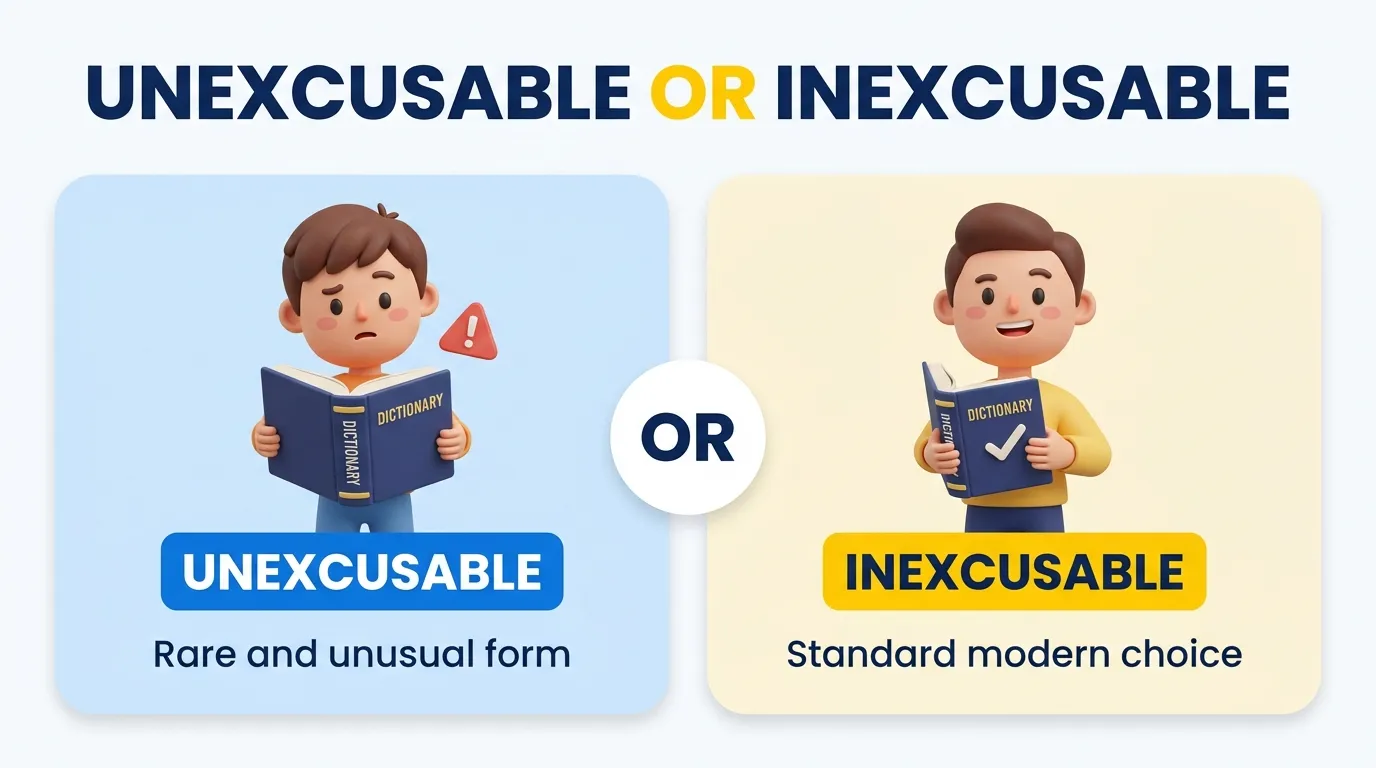
Unexcusable or inexcusable means something that cannot be excused, forgiven, or justified. Inexcusable is the standard choice for modern English.
A client message sits on your screen, and you are ready to send it. Then a red squiggly line makes you stop at unexcusable or inexcusable. Both forms look logical, so the choice can feel tricky. The answer is simple: inexcusable is the usual form. Unexcusable exists, but it is rare and may look like a spelling mistake. So, if you want clear writing, choose inexcusable.
Unexcusable or Inexcusable: Quick Answer
Inexcusable is the word you should normally use. It describes something that cannot reasonably be excused, forgiven, or justified.
For example:
- The delay was inexcusable.
- His rude behavior was inexcusable.
Unexcusable has the same basic meaning, but it is much less common. Therefore, most writers should choose inexcusable.
The Origin of Unexcusable and Inexcusable
The confusion comes from the way English uses negative prefixes. Un- often means “not,” while in- can also mean “not.”
The word excusable means something can be forgiven or accepted with a good reason. However, English settled on inexcusable as the usual opposite.
Historically, unexcusable also appeared in English. Still, inexcusable became the familiar form used in normal modern writing.
The spelling can therefore feel unfairly tricky. Both forms make sense when you look at their parts, but only one is the clear everyday choice.
Unexcusable or Inexcusable Explained
The main difference is not the basic meaning. Instead, the difference is how familiar and natural each form feels to modern readers.
Inexcusable means impossible to excuse or justify. It works well in casual speech, workplace writing, school work, and formal documents.
Unexcusable carries the same idea. However, it is uncommon, so some readers may think it is simply a spelling error.
Consider these examples:
- Inexcusable: The manager called the mistake inexcusable.
- Unexcusable: The manager called the mistake unexcusable.
Both sentences are understandable. However, the first one is the safer choice for polished English.
Inexcusable or Unexcusable: Comparison at a Glance
| Term/Variant | Meaning | Region/Context | Best Used When |
| Inexcusable | Cannot be excused or justified | Modern standard English | Almost any normal writing |
| Unexcusable | Cannot be excused or justified | Rare or unusual usage | Usually better replaced with inexcusable |
| Excusable | Can be excused or justified | Modern standard English | When a valid reason exists |
Which One Should You Use?
For students, use inexcusable because it is the familiar standard form.
For work emails, choose inexcusable because it sounds natural and polished.
For formal reports, use inexcusable because readers are more likely to expect this form.
For everyday conversation, inexcusable is also the natural choice.
If you are unsure, remember one simple rule: choose inexcusable. That choice will fit almost every normal English situation.
Common Mistakes with Unexcusable or Inexcusable
Using “Unexcusable” in Formal Writing
Because unexcusable looks logical, writers may choose it without checking the usual form.
Write inexcusable instead. This makes the sentence look familiar and clear to most readers.
Adding an Extra “E”
A common spelling mistake is inexcuseable.
The correct form is inexcusable. So, keep the ending as -cusable, not -cuseable.
Writing “Inexcusible”
Some writers drop the a before the ending. However, inexcusible is not the normal spelling.
Use inexcusable when you mean something cannot be excused.
Using the Adjective as an Adverb
The sentence “She acted inexcusable” is not correct standard usage.
Instead, write, “She acted inexcusably.” The adverb inexcusably describes how someone acted.
Using the Word for Every Small Error
Calling every tiny mistake inexcusable can sound too strong.
For example, a small typing error may simply be careless or minor. In contrast, serious misconduct may be described as inexcusable.
Unexcusable or Inexcusable in Real-World Examples
Professional Email
A manager may write:
The missed deadline was inexcusable, especially after the agreed date was confirmed.
Here, inexcusable shows strong criticism. However, the word may sound harsh, so use it when the situation truly calls for strong language.
News Headline
A headline might say:
Officials Call the Service Failure Inexcusable
The word works well because it clearly shows that the failure is viewed as impossible to justify.
Social Post
Someone might write:
Treating people that way is inexcusable.
This use is common in strong personal comments. Still, the word carries a serious tone.
Formal Document
A report might say:
The repeated failure to follow the safety rule was inexcusable.
In this setting, the word clearly communicates that the action had no reasonable excuse.
Unexcusable or Inexcusable: Data, Trends & Usage
People who search unexcusable or inexcusable are usually trying to solve a spelling or word-choice problem. They often want a quick answer before writing an email, assignment, report, or public post.
The search also has a strong comparison intent. Readers are not only asking what the word means. They want to know which form looks correct and which one sounds natural.
Because unexcusable looks like a logical formation, the confusion can continue even for strong English learners. That is why a simple comparison helps.
In short, inexcusable is the form worth remembering. It gives readers the word they expect and avoids an unnecessary spelling doubt.
FAQs About Unexcusable or Inexcusable
Is inexcusable the correct spelling?
Yes, inexcusable is the standard spelling used in modern English. It means something cannot reasonably be excused, forgiven, or justified.
Is unexcusable a real word?
Unexcusable has been used in English and carries the same basic meaning as inexcusable. However, it is rare, so inexcusable is the better default for normal writing.
What is the difference between inexcusable and unexcusable?
The two forms have essentially the same meaning. However, inexcusable is much more familiar and natural to most modern English readers.
Can I use inexcusable in formal writing?
Yes, inexcusable works well in formal writing. For example, you can use it in a report, business email, school assignment, or official statement when the situation truly cannot be justified.
Which is correct, unexcusable or inexcusable?
Inexcusable is the form you should normally choose. Although unexcusable can be found in English, it is uncommon and may look like an error.
Where does the word inexcusable come from?
Inexcusable is built around excusable, with in- giving it a negative meaning. The older word unexcusable also existed, but inexcusable became the usual modern form.
Can I say “this is inexcusable” in an email?
Yes, you can. However, the phrase is strong, so use it when you truly mean that the action or problem cannot be accepted or justified.
Final Thoughts on Unexcusable or Inexcusable
The key point is simple: inexcusable is the normal choice. It means something cannot reasonably be excused, forgiven, or justified. Meanwhile, unexcusable has the same basic sense but is far less common.
For school work, business emails, reports, and other polished writing, choose inexcusable. Also, remember the spelling in-ex-cus-a-ble and avoid forms such as inexcuseable or inexcusible.
When you are unsure, go with inexcusable. That small choice can make your writing feel cleaner and more natural. Keep this rule handy, and use inexcusable with confidence whenever the situation calls for it.
Curious about similar words? Explore Firey or Fiery.

I started writing about English word differences after years of teaching students who kept making the same mistakes. My focus is on making spelling rules feel simple and easy to remember. At WordsCombo, I turn confusing word pairs into clear comparisons.









1 thought on “Unexcusable or Inexcusable: The Clear Answer”