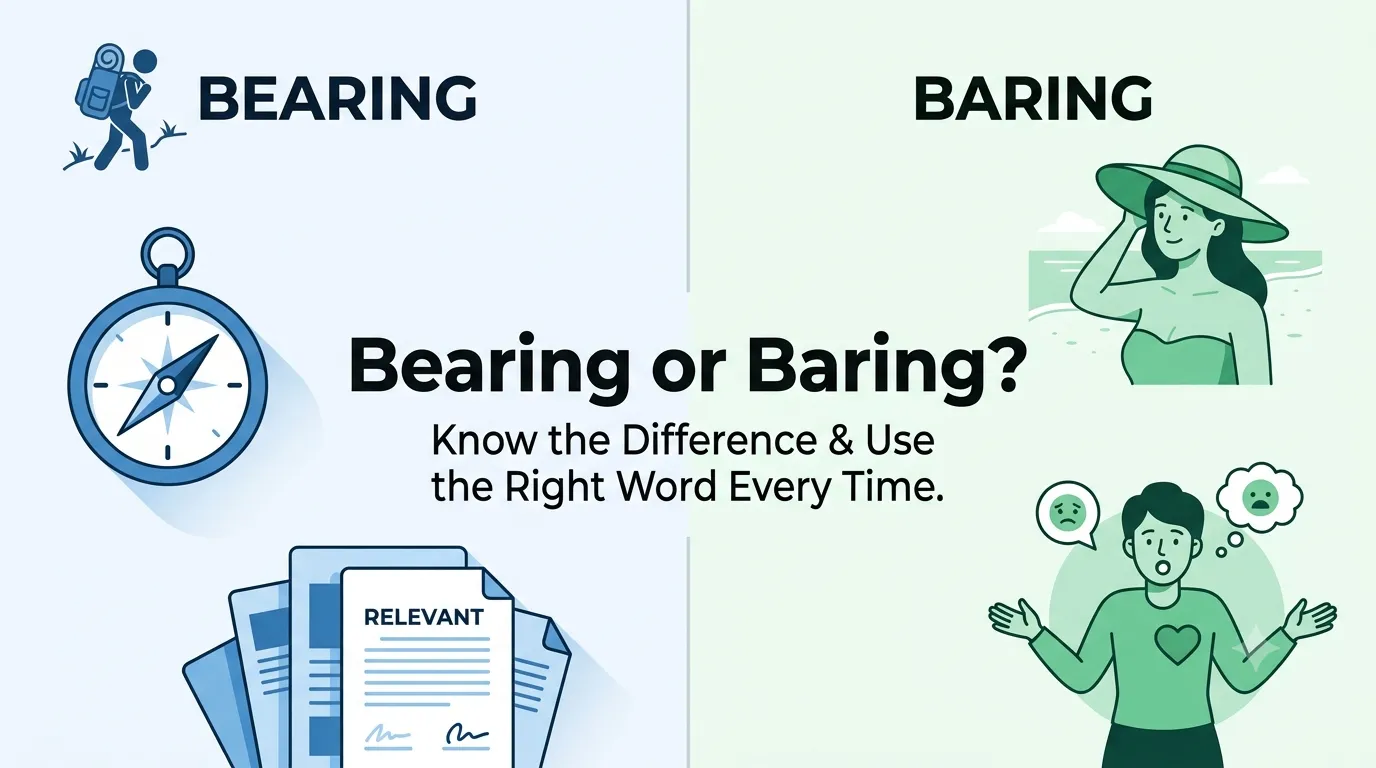
Bearing usually means carrying, supporting, relating to, or direction. Baring means uncovering or revealing something. Although they sound the same, they have very different meanings.
A few years ago, I proofread a business email that said, “This issue has no baring on the final decision.” At first glance, nothing looked wrong. The sentence sounded fine because bearing and baring are pronounced the same.
But one small spelling mistake completely changed the meaning.
This is one of the most common English mistakes. Students, professionals, and even experienced writers mix these words up because they are homophones—words that sound alike but have different meanings.
The good news is that the difference is actually very simple once you understand it.
By the end of this guide, you’ll know exactly when to use bearing and when to use baring. You’ll also see easy examples, common mistakes, comparison tables, memory tricks, and real-world usage so you never hesitate again.
Let’s clear up the confusion once and for all.
Bearing or Baring: Quick Answer
The easiest way to remember the difference is this:
- Bearing = carrying, supporting, relating to, direction, or behavior.
- Baring = uncovering, exposing, or revealing.
Examples
✅ Your experience has a bearing on this job.
✅ She is baring her shoulders in the summer dress.
If you can replace the word with revealing, choose baring.
If not, you almost always need bearing.
The Origin / Background of Bearing or Baring
Although these words sound identical, they come from different verbs.
Bearing
Bearing comes from the Old English verb bear, meaning:
- carry
- support
- endure
- produce
- hold up
Over hundreds of years, the word gained several meanings, including:
- carrying weight
- direction
- influence
- posture
- patience
That’s why bearing has many different uses today.
Baring
Baring comes from the verb bare, meaning:
- uncover
- expose
- reveal
Its meaning has stayed almost the same for centuries.
Because both words sound alike, many writers accidentally spell one when they mean the other.
Bearing or Baring Explained: Key Differences
The biggest difference is simple.
| Term | Meaning | When to Use | Region/Context |
|---|---|---|---|
| Bearing | Carrying, influence, direction, posture | Professional, academic, everyday English | Worldwide |
| Baring | Revealing or exposing | Clothing, emotions, body parts | Worldwide |
Bearing Examples
- The report has bearing on our decision.
- Please take a compass bearing.
- His calm bearing impressed everyone.
- She is bearing the heavy box.
Baring Examples
- She is baring her feet on the beach.
- He was baring his feelings.
- The tree was baring its roots after the storm.
Notice how baring always involves exposing something.
Different Meanings of Bearing
Many learners think bearing has only one meaning.
Actually, it has several.
1. Influence
This is the most common use.
Example:
- Your grades have a bearing on your scholarship.
Meaning:
Your grades affect the decision.
2. Direction
Used in navigation.
Example:
- The captain checked the ship’s bearing.
Meaning:
Direction or angle.
3. Carrying
From the verb “bear.”
Example:
- She was bearing a heavy backpack.
Meaning:
Carrying.
4. Behavior
Example:
- His professional bearing impressed the client.
Meaning:
The way someone presents themselves.
5. Enduring
Example:
- She is bearing the pain bravely.
Meaning:
Putting up with something difficult.
Different Meanings of Baring
Baring has one main idea.
It always means exposing something.
Physical Exposure
- baring your teeth
- baring your arms
- baring your shoulders
Emotional Exposure
- baring your heart
- baring your soul
- baring your emotions
Think of baring as revealing something hidden.
Which Version Should You Use?
Here is a quick guide.
For Students
Use bearing when writing essays about influence or relevance.
Example:
“The evidence has bearing on the argument.”
For Professionals
Most workplace emails require bearing.
Examples:
- has bearing on
- direct bearing
- bearing responsibility
For Creative Writers
Use baring when describing people or emotions.
Example:
“She stood in the rain, baring her face to the wind.”
For Global English
Both American and British English use:
- bearing
- baring
The spelling does not change by region.
Common Mistakes with Bearing or Baring
These mistakes appear every day.
| Incorrect | Correct | Why |
|---|---|---|
| No baring on the decision | No bearing on the decision | Means influence |
| Compass baring | Compass bearing | Means direction |
| Bearing your shoulders | Baring your shoulders | Means exposing |
| She is bearing her teeth | She is baring her teeth | Teeth are exposed |
| This has little baring | This has little bearing | Means relevance |
Why People Make These Mistakes
- The words sound identical.
- Spellcheck sometimes misses them.
- Many people know the pronunciation but not the meanings.
Easy Memory Trick
Here’s the trick I teach new writers.
Bearing = Carrying
Both have the idea of support.
Think:
Bear = Carry
If you’re talking about influence, support, direction, or carrying, choose bearing.
Baring = Bare
Think:
Bare = Naked
If something becomes uncovered, choose baring.
This simple trick works almost every time.
Bearing or Baring in Real-World Examples
Professional Email
“Your previous experience has bearing on this promotion decision.”
News Headline
“New Evidence Has Bearing on Court Investigation.”
Social Media Post
“Summer means baring your feet at the beach!”
Formal Report
“The financial data has direct bearing on future planning.”
Casual Conversation
“She’s baring her feelings for the first time.”
Bearing or Baring: Data, Trends & Usage
People search for bearing or baring because English learners often hear the words before they see them written.
Most Common Search Intent
Informational
Readers usually want to know:
- Which spelling is correct?
- What’s the difference?
- Which one fits my sentence?
Who Searches Most?
- Students
- ESL learners
- Content writers
- Editors
- Business professionals
- Job applicants
Why It Matters Today
Writing is more public than ever.
Emails, social media posts, reports, resumes, and online articles all require clear spelling. Using bearing instead of baring, or vice versa, makes your writing look more polished and professional.
Standalone Comparison Table
| Term/Variant | Meaning | Region/Context | Best Used When |
|---|---|---|---|
| Bearing | Carrying, influence, direction, posture | Worldwide | Discussing relevance, support, navigation, or behavior |
| Baring | Revealing, exposing | Worldwide | Talking about uncovering body parts, emotions, or hidden things |
Quick Practice
Choose the correct word.
- The results have no ______ on the final decision.
- She was ______ her shoulders in the sun.
- His calm ______ impressed the interviewers.
- The hikers checked their compass ______.
- He was ______ his heart during the speech.
Answers
- bearing
- baring
- bearing
- bearing
- baring
FAQs
Q: What does bearing mean?
A: Bearing usually means influence, direction, carrying something, or the way someone behaves. The correct meaning depends on the sentence.
Q: What does baring mean?
A: Baring means exposing or uncovering something. It often refers to body parts, emotions, or anything being revealed.
Q: How do you use bearing correctly?
A: Use bearing when talking about relevance, responsibility, direction, posture, or carrying something. For example, “This information has no bearing on the case.”
Q: Bearing vs. bariwhat’s the difference?
A: Bearing relates to carrying, influence, or direction. Baring means revealing or exposing. They sound alike but have different meanings and uses.
Q: Is bearing acceptable in formal writing?
A: Yes. Bearing is very common in formal writing, business communication, legal documents, and academic work.
Q: Which version is correct: bearing or baring?
A: It depends on your meaning. Use bearing for influence, direction, or carrying. Use baring when you mean revealing or exposing something.
Q: Where do bearing and baring come from?
A: Bearing comes from the verb bear, meaning to carry or support. Baring comes from bare, meaning to uncover or reveal.
Q: Can baring be used in professional writing?
A: Yes, but only when you truly mean revealing or exposing something. In business writing, bearing is much more common because it often refers to relevance or importance.
Conclusion
Now you know that bearing and baring may sound the same, but they serve very different purposes. Bearing is the right choice when you’re talking about carrying something, influence, direction, responsibility, or someone’s manner. Baring, on the other hand, is used when something is uncovered, exposed, or revealed, whether it’s a person’s shoulders, teeth, or emotions.
A simple memory trick can save you from future mistakes: bear = carry = bearing, while bare = uncover = baring. When you pause for just a second to think about the meaning, choosing the correct spelling becomes much easier.
Clear writing builds confidence and credibility. Whether you’re sending an email, writing an essay, or publishing online, using the right word helps your message stay accurate and professional.
Now you know exactly how to use bearing and baring—try the memory trick in your next piece of writing, bookmark this guide for future reference, and share it with someone who’s mixed these words up before.

I have been writing about English spelling and word usage for the past five years. My goal is to give readers a clear answer without overwhelming them with complicated rules. At WordsCombo, I focus on making everyday English easier for everyone.