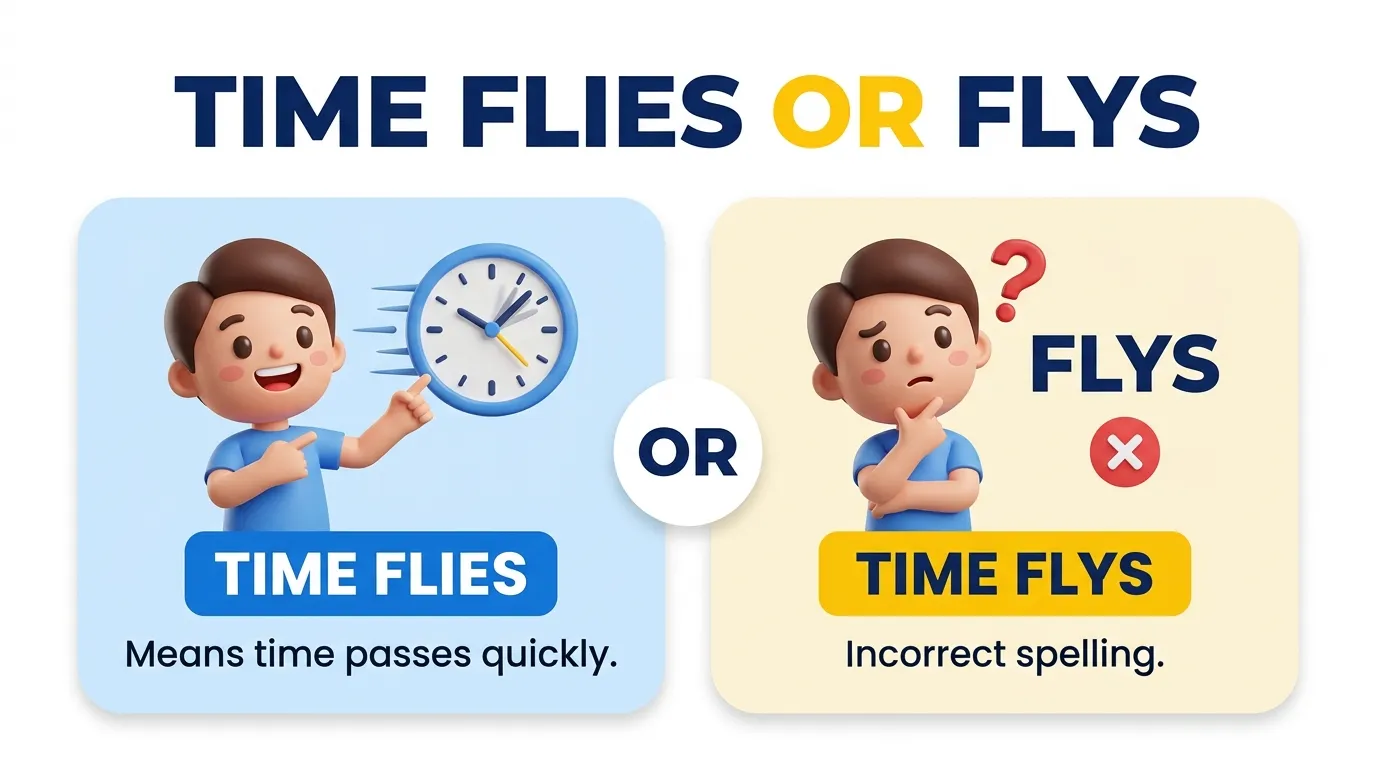
Time flies means time passes quickly. Time flys is a common spelling mistake and is not correct.
Writing a work email can come with small doubts. You type “time flies,” then pause when the red spell-check line makes you question the word. Should it be flies or flys?
The answer is simple. Time flies is the correct phrase in American English and other forms of English. It means that time seems to pass very fast. Once you know the rule, you can use this phrase with ease in emails, schoolwork, social posts, and daily talk.
Time Flies or Flys: The Quick Answer
The correct phrase is time flies, not “time flys.” It means that time passes quickly, often when you are busy or having fun.
For example:
- “Time flies when you are having fun.”
- “I can’t believe summer is over. Time flies!”
So, if you are writing a note to a friend or a report at work, choose time flies.
The Origin of Time Flies
The phrase time flies comes from an old idea. People have long used the image of flight to show how fast time seems to move. Like a bird in the sky, time cannot be held still.
The phrase is also linked to the Latin saying tempus fugit, which means “time flees.” Over time, the English phrase became a common way to talk about how quickly life moves.
But why do people write “flys”? The answer lies in English spelling. Many verbs that end in a consonant plus y change the y to ies when used with he, she, or it. For example, try becomes tries, and fly becomes flies.
Time Flies Explained: Key Differences
The main difference is simple. Flies is the right spelling in this phrase, while flys is not the correct form of the verb fly in standard English.
| Term | Meaning | When to Use | Region/Context |
| Time flies | Time passes quickly | In everyday talk and formal writing | Common in the U.S. and worldwide |
| Time flys | Incorrect spelling | Do not use it as the phrase | A spelling mistake |
| Time fly | Not the standard phrase for this meaning | Use only in a different, valid sentence structure | Depends on context |
For example, you can say, “Time flies when you are busy.” However, you should not write, “Time flys when you are busy.”
The Simple Spelling Rule
When a verb ends in a consonant followed by y, change the y to ies for he, she, or it in the present tense.
- I fly, but she flies.
- They try, but he tries.
- We cry, but the baby cries.
So, because we say “time flies” as if time is moving quickly, the correct spelling is flies.
Which One Should You Use?
Use time flies in almost every situation where you mean that time passes quickly.
- For everyday talk, use “time flies” because it sounds natural and is correct.
- For formal writing, use “time flies” in reports, letters, and work emails because it follows standard English rules.
- For social media, use “time flies” in captions about birthdays, trips, and special events.
- For schoolwork, use “time flies” because teachers expect the correct spelling.
- For a neutral tone, choose “time flies” because it works in both casual and professional settings.
In short, there is no need to choose between the two spellings. Time flies is the correct choice.
Common Mistakes with Time Flies
Even simple phrases can cause spelling errors. However, a few easy checks can help you write time flies the right way.
- Mistake: Writing “time flys.” Correction: Write “time flies” because the verb changes from fly to flies.
- Mistake: Using “time fly’s.” Correction: Write “time flies” without an apostrophe because the phrase does not show ownership.
- Mistake: Writing “time flew” for a general fact. Correction: Use “time flies” for a general idea, but use “time flew” when talking about the past.
- Mistake: Thinking “flies” always means insects. Correction: In this phrase, “flies” is a verb that means time passes quickly.
- Mistake: Avoiding the phrase in work emails. Correction: You can use “time flies” in friendly work messages because it is a normal English phrase.
These errors often happen because English has many spelling rules. Still, remembering fly → flies makes this choice easy.
Time Flies in Real-World Examples
The phrase works in many settings because it shares a simple feeling. Here are some ways to use it naturally.
In a professional email
It is hard to believe we have worked together for five years. Time flies! Thank you for being such a great part of the team.
In a news headline
Time Flies as Local Students Get Ready for Graduation
This headline uses the phrase to show how quickly the school year has passed.
In a social media post
Five years of great memories, and it feels like yesterday. Time flies! 💛
In a formal document
As we look back on the past year, we are reminded that time flies and that each day brings a chance to grow.
Although the phrase is friendly, it can fit a formal message when the tone allows it.
Time Flies: Data, Trends and Usage
The search phrase “time flies or flys” shows that people want a quick spelling answer. They often need help while writing an email, school task, caption, or work message.
Here is what this search tells us about readers:
- Search interest: People want to know which spelling is correct.
- Main audience: Students, English learners, office workers, bloggers, and editors.
- Search intent: Mainly informational, with a clear need for a correct spelling and examples.
- Related searches: “Time flies meaning,” “time flies in a sentence,” and “time flies when you’re having fun.”
- Why it matters: Clear spelling helps people write with more confidence, especially when a short message needs to look polished.
The key point is that people do not need a long grammar lesson to solve this problem. Instead, they need a clear answer, a simple rule, and examples they can use right away.
Time Flies: Comparison at a Glance
| Term/Variant | Meaning | Region/Context | Best Used When |
| Time flies | Time passes quickly | Standard English worldwide | Talking about how fast time seems to pass |
| Time flies by | Time passes quickly | Casual and general writing | Adding a natural, conversational feel |
| Time flew | Time passed quickly | Past tense | Talking about a finished event |
| Time has flown | Time has passed quickly | Reflective writing and speech | Looking back at a period that has ended or nearly ended |
| Time flys | Incorrect spelling for this phrase | Nonstandard usage | Never use it to mean time passes quickly |
Notice that the verb can change with the tense. However, time flies remains the correct choice when you describe a general feeling in the present.
Frequently Asked Questions
What does time flies mean?
Time flies means that time seems to pass very quickly. For example, you might say it after a fun weekend because the days seemed to end sooner than expected.
Is it time flies or time flys?
The correct phrase is time flies. Since time is a singular subject, the verb fly changes to flies in the present tense.
Why is it flies and not flys?
English spelling rules change many verbs that end in a consonant followed by y. For example, fly becomes flies, just as try becomes tries.
Is time flies acceptable in formal writing?
Yes, time flies is correct in both casual and formal writing. However, a very technical report may use a more direct phrase, such as “time passes quickly.”
Is time flies correct in American English?
Yes, time flies is correct in American English and British English. The spelling does not change by region.
Where does the phrase time flies come from?
The phrase reflects the old idea that time moves swiftly and cannot be held back. It is also linked to the Latin saying tempus fugit, which means “time flees.”
Can I write time flies when you’re having fun?
Yes, “Time flies when you’re having fun” is a common and correct expression. It means that enjoyable moments often seem to pass faster than expected.
Final Thoughts on Time Flies
The choice between time flies and time flys is easy once you know the rule. Use flies when you mean that time passes quickly, and avoid flys in standard writing. The same spelling rule applies to words such as tries and cries.
Whether you are writing a school essay, a work email, or a birthday post, the right phrase helps your message look clear and polished. You can also use time flew when talking about the past or time has flown when looking back on the years.
Next time you pause over this phrase, remember fly becomes flies. Save this simple rule, share it with a friend, and write with confidence!
Curious about other tricky word pairs? Explore Buses or Busses.

I have been writing about English spelling and word usage for the past five years. My goal is to give readers a clear answer without overwhelming them with complicated rules. At WordsCombo, I focus on making everyday English easier for everyone.