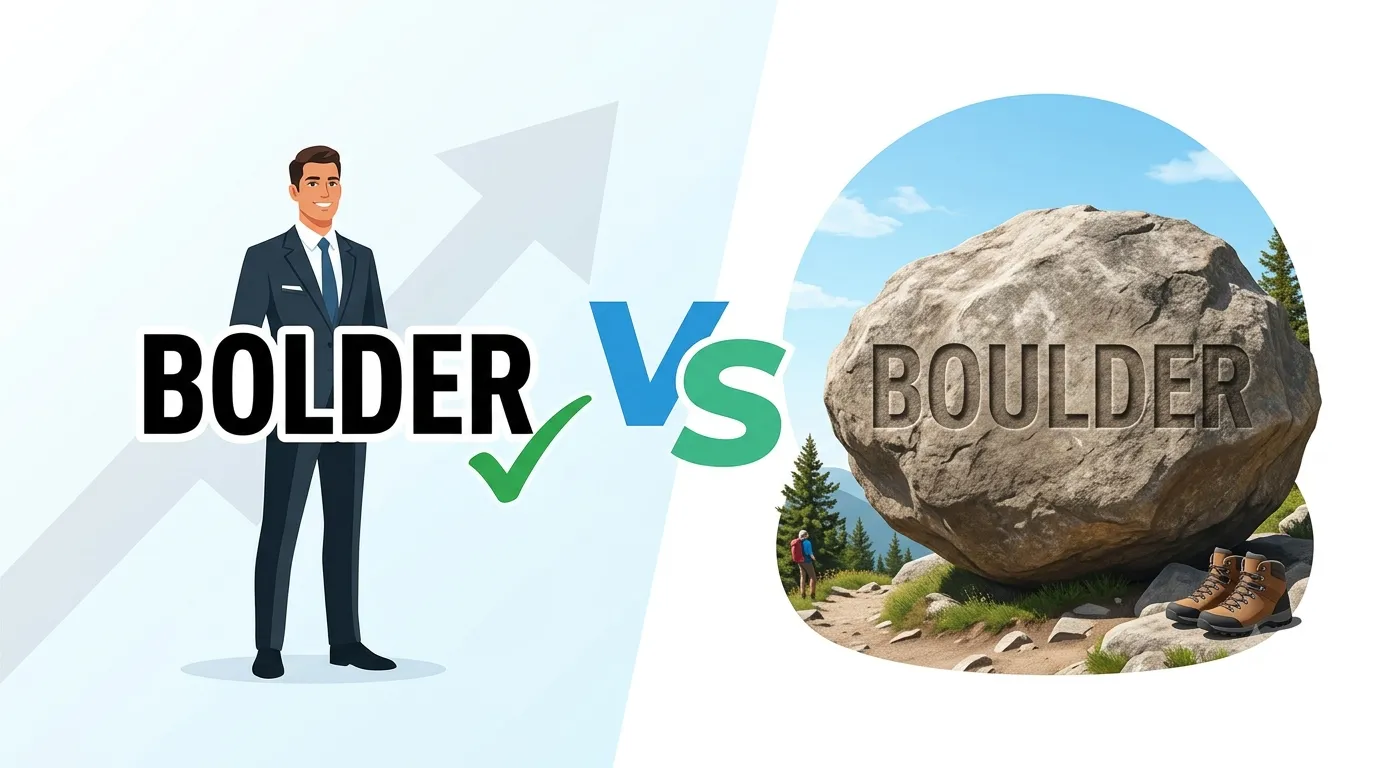
Bolder is the comparative form of bold, meaning more confident, stronger, or darker in appearance. Boulder refers to a large rock. Although they sound alike, they have completely different meanings and should never be used interchangeably.
A few years ago, I was proofreading a blog post when I came across this sentence: “The company made a boulder decision this year.” At first, I smiled because I knew exactly what had happened. The writer meant bolder, but spellcheck didn’t catch the mistake because boulder is also a real word.
This mix-up happens more often than you might think. Since both words sound almost the same, many students, writers, and even native English speakers type the wrong one without noticing. One small spelling mistake can completely change the meaning of a sentence.
If you’ve ever wondered whether to use bolder or boulder, you’re in the right place. By the end of this guide, you’ll know what each word means, when to use it, how to remember the difference, and how to avoid one of the most common spelling mistakes in English.
Let’s clear up the confusion once and for all.
Bolder or Boulder: Quick Answer
The difference is simple.
- Bolder means more bold. It describes someone or something that is more confident, daring, stronger, or darker.
- Boulder means a very large rock, usually found in nature.
Examples
✅ She made a bolder choice in her career.
✅ The hikers climbed over a huge boulder.
❌ He made a boulder statement. (Incorrect)
❌ We moved a bolder down the hill. (Incorrect)
The Origin of Bolder and Boulder
Although these words sound alike, they come from different origins.
Bolder
Bolder is the comparative form of bold.
The word bold comes from Old English and has been used for centuries to describe courage, confidence, and strength. Over time, English speakers naturally formed bolder to compare two people or things.
Examples:
- A bolder plan
- A bolder colour
- A bolder personality
Boulder
Boulder comes from words related to large rounded stones. It has always referred to a massive rock shaped by nature, often found in mountains, rivers, or forests.
Examples:
- A giant boulder blocked the road.
- Children climbed onto the boulder.
Because the two words developed separately, they have completely different meanings despite their similar pronunciation.
Bolder vs Boulder Explained
The easiest way to remember the difference is to think about what each word describes.
| Word | Meaning | When to Use | Context |
|---|---|---|---|
| Bolder | More bold, more confident, stronger | Comparing confidence, design, colours, or decisions | Writing, business, education |
| Boulder | A large natural rock | Talking about landscapes, hiking, geology, or nature | Outdoors, science |
Think of it this way
If you’re talking about people, choices, fonts, colours, or ideas, you almost always need bolder.
If you’re talking about rocks or mountains, use boulder.
Which Version Should You Use?
Choosing the right word depends on your sentence.
For students
Use bolder when writing essays about confidence, opinions, or writing style.
Example:
Her argument became bolder after more research.
For business professionals
Use bolder when discussing marketing, branding, leadership, or decision-making.
Example:
The company adopted a bolder strategy.
For travellers and hikers
Use boulder when describing nature.
Example:
We rested beside a large boulder.
For everyone
Ask yourself one simple question:
Am I talking about confidence or a rock?
- Confidence → Bolder
- Rock → Boulder
That quick check solves almost every mistake.
Common Mistakes with Bolder and Boulder
These errors appear in emails, blogs, social media posts, and even school assignments.
| Incorrect | Correct |
|---|---|
| The CEO made a boulder decision. | The CEO made a bolder decision. |
| We climbed over a bolder. | We climbed over a boulder. |
| Use a boulder font. | Use a bolder font. |
| The bolder blocked the road. | The boulder blocked the road. |
Why do people confuse them?
- They sound nearly identical.
- Spellcheck often misses the mistake.
- Many people type quickly without checking context.
Always read your sentence one more time before publishing.
Bolder and Boulder in Real-World Examples
Professional Email
We recommend taking a bolder marketing approach next quarter.
News Headline
Massive boulder closes mountain highway after heavy rain.
Social Media Post
Sometimes the bolder choice leads to the biggest success.
Business Report
The company introduced a bolder branding strategy to attract younger customers.
Travel Blog
A huge boulder overlooked the beautiful valley below.
These examples show how different the meanings really are.
Bolder or Boulder: Usage Trends
Searches for bolder or boulder continue to grow because English learners often hear the words before they see them written.
Most common search intent
Informational
People usually want to know:
- Which spelling is correct
- What each word means
- Which word fits their sentence
- Why the words sound the same
Who searches most?
- Students
- Bloggers
- Copywriters
- Teachers
- English learners
- Content editors
Why this matters today
With AI writing tools, texting, and fast typing becoming common, spelling mistakes can spread quickly. Knowing the difference helps your writing look more professional and trustworthy.
Quick Comparison Table
| Term | Meaning | Region/Context | Best Used When |
|---|---|---|---|
| Bolder | More confident, daring, or darker | Standard English worldwide | Comparing boldness, style, or confidence |
| Boulder | Large natural rock | Nature, hiking, geology | Referring to rocks and landscapes |
Frequently Asked Questions
Q: What does bolder mean?
A: Bolder means more bold. It describes someone or something that is more confident, daring, stronger, or darker than another.
Q: What does boulder mean?
A: A boulder is a very large rock found in nature. It has nothing to do with confidence or writing.
Q: Which is correct: bolder or boulder?
A: Both are correct words. The right choice depends on your meaning. Use bolder for confidence or comparison and boulder for a large rock.
Q: Is bolder acceptable in formal writing?
A: Yes. Bolder is perfectly correct in academic, business, and professional writing whenever you are comparing boldness or strength.
Q: Why are bolder and boulder confused?
A: They are confused because they sound almost the same. This makes them homophones for many speakers, even though they have different meanings.
Q: Can I use boulder to describe a brave person?
A: No. Boulder only refers to a large rock. To describe someone as more courageous or confident, use bolder.
Q: How can I remember the difference?
A: Think of the extra “u” in boulder as making the word heavier, just like a giant rock. Bolder comes from bold, so it always relates to courage, confidence, or stronger appearance.
Conclusion
The difference between bolder and boulder is easy once you know what each word means. Bolder is the comparative form of bold, so it describes greater confidence, stronger design, or darker text. Boulder, on the other hand, is simply a large natural rock.
Whenever you’re unsure, ask yourself one question: Am I talking about confidence or a rock? If it’s confidence, ideas, colours, or decisions, choose bolder. If it’s something you might find on a mountain trail, choose boulder.
A single letter can completely change your sentence, but now you know exactly how to avoid that mistake. Keep this guide handy whenever you’re writing, editing, or proofreading.
Bookmark this page so you never second-guess “bolder” or “boulder” again, and share it with anyone who has ever mixed them up.

I have been writing about English spelling and word usage for the past five years. My goal is to give readers a clear answer without overwhelming them with complicated rules. At WordsCombo, I focus on making everyday English easier for everyone.