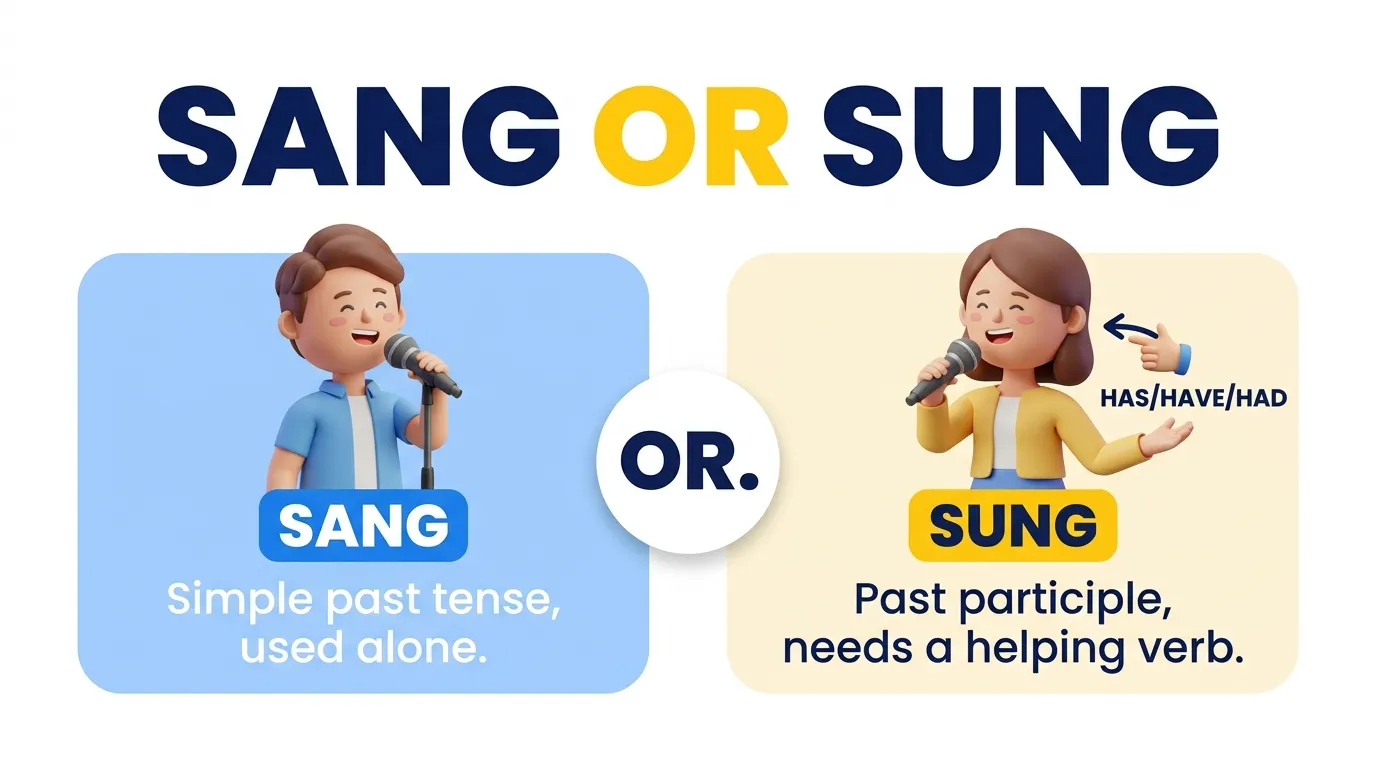
Use sang for the simple past tense (“She sang a song”). Use sung with a helping verb like has, have, or had (“She has sung this song before”).
You typed a sentence, then paused. Was it “she sang” or “she has sung”? This mix-up trips up even confident writers, because both words come from the same verb: sing. The good news is that once you learn one simple rule, you will never second-guess it again.
In this guide, you will find clear examples, common mistakes, and a quick table you can check anytime you write.
Sang or Sung: Quick Answer
Sang is the simple past tense of sing. Use it alone, without any helping word. For example: “The choir sang beautifully last night.”
Sung is the past participle. It always needs a helping verb such as has, have, had, or was. For example: “The song has been sung by many artists.”
Origin and Background
English verbs like sing are called irregular verbs, which is why they do not just add -ed like walked or talked. Instead, sing changes its middle vowel three times: sing, sang, sung. This pattern comes from Old English and shows up in similar verbs like ring, rang, rung and drink, drank, drunk. Since these verbs do not follow the usual pattern, people often guess wrong. That is exactly why this mix-up is so common today.
Meaning and Key Differences
Both words point to the same action, singing, but they are used in different grammar spots. Here is a simple table to make it clear.
| Term | Meaning | When to Use | Region/Context |
| Sang | Simple past tense of sing | Alone, with no helping verb | Standard in American and British English |
| Sung | Past participle of sing | With has, have, had, or was/were | Standard in American and British English |
For example, you would say “He sang at the wedding,” but “He has sung at many weddings.” Both sentences are correct. The difference is just the grammar structure around them.
Which One Should You Use?
For American English: The rule is the same as everywhere else. Use sang alone and sung with a helping verb.
For British English: The same rule applies, so there is no regional difference here.
For formal writing: Always check for a helping verb nearby. If you see has, have, or had, you need sung, not sang.
For school or work: Teachers and editors often flag this exact mistake, so it is worth double-checking before you submit anything.
For general readers: If you are unsure, try this trick: say the sentence without any helping word. If it still sounds complete, use sang.
Common Mistakes
Mistake: “She has sang the anthem before.”
Correction: “She has sung the anthem before.”
Why it happens: The helping verb has needs sung, not sang, but many speakers use sang out of habit.
Mistake: “He sung the song at the party.”
Correction: “He sang the song at the party.”
Why it happens: There is no helping verb here, so sang is correct, though sung often slips in by mistake.
Mistake: “They had sang together for years.”
Correction: “They had sung together for years.”
Why it happens: The word had is a helping verb, which means sung is required, not sang.
Mistake: “The bird sung early this morning.”
Correction: “The bird sang early this morning.”
Why it happens: Since there is no helper word, only sang fits, even though sung can sound similar in casual speech.
Real-World Examples
Professional Email
“Thank you for the opportunity. Our choir has sung at several corporate events this year.”
News Headline
“Local Teen Sang National Anthem Before Championship Game”
Social Media Post
“Just sung my heart out at karaoke night! Best time ever.”
Formal Document
“The national anthem was sung by the school choir during the opening ceremony.”
Search Intent and Usage Patterns
People search for “sang or sung” mostly while writing something, an email, an essay, or a caption, and they pause because the two words sound close but are not interchangeable. Students often search this while doing grammar homework, while writers and professionals search it while proofreading. The confusion mainly comes from the fact that both words describe the same action, singing, just at different points in a sentence’s structure. Once you spot the helping verb rule, the confusion usually clears up for good.
Sang or Sung: Comparison at a Glance
| Term/Variant | Meaning | Region/Context | Best Used When |
| Sang | Simple past tense | American and British English | No helping verb is present |
| Sung | Past participle | American and British English | A helping verb like has, have, had, or was is present |
Frequently Asked Questions
Is it “sang” or “sung” after “has”?
Always use sung after has, since has is a helping verb. For instance, “She has sung in three languages.” Using sang here would be grammatically incorrect.
What is the past tense of sing?
The simple past tense of sing is sang. You use it alone, such as in “They sang together at the concert.”
What is the past participle of sing?
The past participle is sung, and it always appears with a helping verb such as has, have, or had.
Which is correct, “I sang” or “I sung”?
“I sang” is correct when there is no helping verb nearby. “I sung” would only be correct if paired with a helper, like “I have sung.”
Does British English use sang and sung differently?
No, British English follows the exact same rule as American English. The difference between sang and sung is about grammar, not region.
Can “sung” ever stand alone in a sentence?
No, sung always needs a helping verb before it. If you see it standing alone, it is likely a mistake and should be sang instead.
Why do people confuse sang and sung so often?
Since sing is an irregular verb, it does not follow the usual -ed pattern, which makes the past tense and past participle forms easy to mix up, especially in casual speech.
Final Thoughts on Sang or Sung
The rule behind sang and sung is simpler than it feels at first. Use sang on its own, and use sung only when a helping verb like has, have, or had comes before it. Once this pattern clicks, you will catch yourself before making the mistake again.
Next time you write a sentence with sing, pause for just a second and check for a helping verb nearby. That one habit will keep your writing clear and correct, whether you are sending an email, writing an essay, or posting online. With a little practice, choosing between sang and sung will feel automatic.
Curious about similar words? Explore This or That

I have been writing about English spelling and word usage for the past five years. My goal is to give readers a clear answer without overwhelming them with complicated rules. At WordsCombo, I focus on making everyday English easier for everyone.