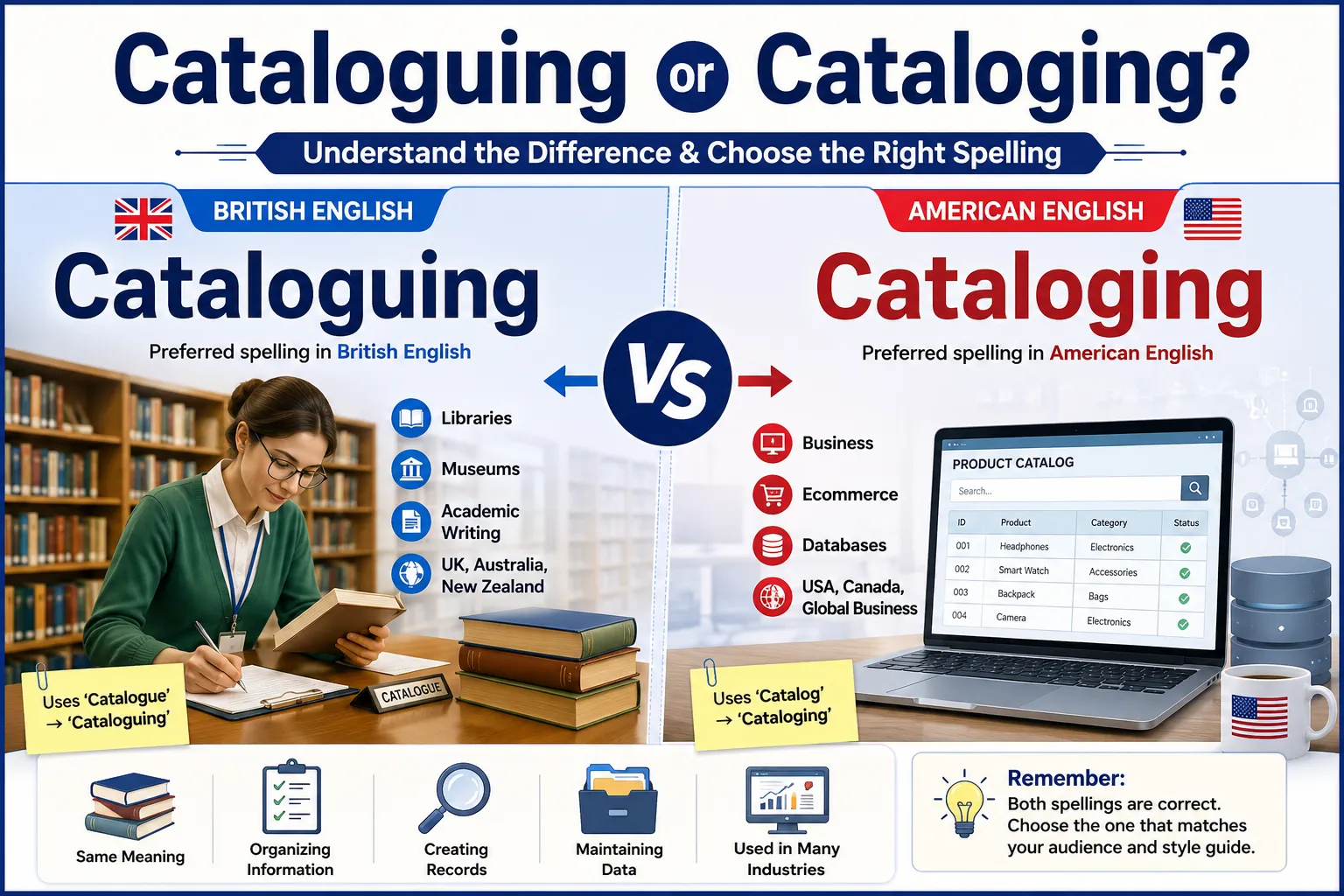
Cataloguing and cataloging mean the same thing. The only difference is spelling. Cataloguing is the preferred British English spelling, while cataloging is the standard American English spelling.
A few years ago, I was helping a client edit a library training guide. Half the document used cataloguing, while the other half used cataloging. At first, it looked like a mistake. After checking the style guide, I realized both spellings were correct. The only difference was the audience.
Many writers, students, librarians, and business professionals face the same question. Should you write cataloguing or cataloging? A quick search online often brings mixed answers. Some websites say one spelling is wrong. Others simply list both without explaining when to use each.
The good news is that the answer is simple once you know the rule. The choice depends on the type of English you are using. Understanding this small difference helps your writing look polished and consistent.
In this guide, you’ll learn the meaning of both spellings, why they exist, where each one is used, and how to choose the right version with confidence.
Cataloguing or Cataloging: Quick Answer
Both cataloguing and cataloging describe the process of creating, organizing, and maintaining a catalog or catalogue of items. These items may include books, products, artworks, files, records, or digital content.
The spelling changes based on the variety of English you use.
- Cataloguing = British English
- Cataloging = American English
Real world examples
- A librarian spends the morning cataloguing new books in a university library. (UK English)
- An online retailer is cataloging thousands of new products for its website. (US English)
The meaning never changes. Only the spelling does.
The Origin and Background of Cataloguing or Cataloging
The word comes from the Greek word katalogos, meaning a list or register. It later passed through Latin and French before entering English as catalogue.
For centuries, British English kept the French style spelling catalogue. When adding ing, it became cataloguing.
American English gradually simplified many spellings during the 19th century. Influenced by language reformers like Noah Webster, words ending in ogue were often shortened.
For example:
- Catalogue → Catalog
- Dialogue → Dialog (less common in general writing)
- Monologue → Monolog (used in some American publications)
Because Americans commonly use catalog, the verb naturally became cataloging.
This difference follows the same pattern as many other British and American spelling variations.
| British English | American English |
|---|---|
| Catalogue | Catalog |
| Catalogueing/Cataloguing* | Cataloging |
| Organise | Organize |
| Centre | Center |
| Travelling | Traveling |
Note: The accepted British spelling is cataloguing, not catalogueing. The extra e is dropped before adding ing.
Although the spellings differ, readers understand both versions without confusion.
Cataloguing or Cataloging Explained: Key Differences
The biggest difference between cataloguing and cataloging is regional spelling, not meaning.
Both words refer to organizing information into a structured list. Whether you are working in a library, museum, warehouse, online store, or database, the action remains exactly the same.
Comparison Table
| Term | Meaning | When to Use | Region/Context |
|---|---|---|---|
| Cataloguing | Organizing items into a catalogue | British English writing | UK, Australia, New Zealand, many Commonwealth countries |
| Cataloging | Organizing items into a catalog | American English writing | United States |
| Catalogue | A list of items | British English noun | Books, libraries, retail, museums |
| Catalog | A list of items | American English noun | Retail, business, technology, libraries |
Example using British English
The museum finished cataloguing its historical artifacts before opening the new exhibition.
Example using American English
The company is cataloging every product before launching its online store.
Does one spelling look more professional?
No.
Both spellings are fully correct.
Professional writing depends on consistency. If your document follows British English, use catalogue and cataloguing throughout. If it follows American English, use catalog and cataloging consistently.
Mixing both spellings in the same document can make your work appear less polished, even though each spelling is correct on its own.
Key Takeaways So Far
- Cataloguing and cataloging have exactly the same meaning.
- The difference is British English vs. American English.
- Cataloguing pairs with catalogue.
- Cataloging pairs with catalog.
- Always stay consistent with the English style you choose.
Which Version Should You Use?
Choosing between cataloguing and cataloging is easy once you know your audience. The meaning stays the same. Your readers simply expect the spelling that matches their version of English.
Use cataloguing if:
- You write for readers in the United Kingdom
- Your audience is in Australia
- You publish in New Zealand
- You follow British English style guides
- Your school, university, or organization uses British English
Example:
The library staff spent the afternoon cataloguing rare books.
Use cataloging if:
- You write for readers in the United States
- Your company follows American English
- You create content for a U.S. website or business
- Your publication uses American style guides like APA, MLA, or Chicago
Example:
The team is cataloging customer records before the software launch.
For a Global Audience
If your audience comes from different countries, the best choice depends on your style guide.
- Choose British English → use cataloguing
- Choose American English → use cataloging
The most important rule is simple:
Be consistent from start to finish.
Switching between the two spellings in the same document can confuse readers and make your writing look unedited.
Common Mistakes with Cataloguing or Cataloging
Many people know both spellings exist, but they still make small mistakes. Here are the most common ones and how to fix them.
| Mistake | Correct Version | Why It Happens |
|---|---|---|
| cataloguing books in an American report | cataloging books | American English drops the ue. |
| cataloging books in a British report | cataloguing books | British English keeps the catalogue form. |
| catalogueing | cataloguing | The extra e is removed before adding ing. |
| Using both spellings in one article | Pick one spelling | Mixing styles reduces consistency. |
| Thinking one spelling is incorrect | Both are correct | The difference is regional, not grammatical. |
Easy Tips to Remember
- UK = catalogue → cataloguing
- US = catalog → cataloging
- Never write “catalogueing.”
- Choose one style and stick with it.
These small changes make your writing look more professional and easier to read.
Cataloguing or Cataloging in Real World Examples
Seeing the word in real situations makes the difference much clearer.
Professional Email
British English
Dear Team,
We will begin cataloguing the new archive next Monday. Please follow the updated filing procedure.
American English
Dear Team,
We will begin cataloging the new inventory next Monday. Please use the updated classification system.
News Headline
British English
National Museum Begins Cataloguing Ancient Artifacts
American English
University Starts Cataloging Historic Documents
Social Media Post
British English
We have finished cataloguing over 10,000 historical photographs. More collections will be available soon.
American English
We’re cataloging thousands of vintage records so everyone can search them online.
Formal Report
British English
The project focused on cataloguing historical manuscripts to improve long term preservation and public access.
American English
The research team completed cataloging digital records before the migration to the new database.
Library Example
The librarian spent several days cataloguing newly donated books before placing them on the shelves.
Business Example
The warehouse staff is cataloging every product with a barcode for faster inventory management.
Museum Example
Experts are cataloguing paintings to create a complete digital archive of the collection.
Cataloguing or Cataloging: Data, Trends & Usage
Interest in cataloguing and cataloging continues to grow because more people work with digital information than ever before.
Libraries, museums, online stores, schools, and software companies all rely on accurate catalog systems.
Where Is Each Spelling Most Popular?
| Region | Preferred Spelling |
|---|---|
| United Kingdom | Cataloguing |
| Australia | Cataloguing |
| New Zealand | Cataloguing |
| Canada | Both (depends on organization) |
| United States | Cataloging |
Who Searches for This Topic?
People searching for cataloguing or cataloging often include:
- Students
- Librarians
- Researchers
- Academic writers
- Editors
- Teachers
- Online business owners
- Ecommerce managers
- Content writers
- SEO professionals
Most want to know:
- Which spelling is correct?
- Is one more formal?
- Which version should they use?
- Is there a grammar rule?
- What does each word mean?
Search Intent
Primary Search Intent: Informational
People are looking for a clear explanation, not a product or service.
They want to understand:
- The correct spelling
- Regional differences
- Proper usage
- Real examples
- Writing recommendations
Why This Topic Matters Today
Digital information is growing faster than ever.
Every day, organizations organize millions of books, files, products, research papers, photos, and digital records. As international communication becomes more common, writers often work with readers from different English speaking countries.
Knowing whether to use cataloguing or cataloging helps you write with confidence, match your audience’s expectations, and maintain a consistent professional style.
Standalone Comparison Table
| Term/Variant | Meaning | Region/Context | Best Used When |
|---|---|---|---|
| Cataloguing | The process of creating or maintaining a catalogue | British English | Writing for the UK, Australia, New Zealand, or British style publications |
| Cataloging | The process of creating or maintaining a catalog | American English | Writing for U.S. audiences or using American style guides |
| Catalogue | A list or organized record of items | British English | Libraries, museums, retail catalogs, academic writing |
| Catalog | A list or organized record of items | American English | Business, ecommerce, databases, libraries, and U.S. publications |
Frequently Asked Questions (FAQs)
Q1: What does cataloguing or cataloging mean?
Cataloguing and cataloging both mean organizing information or items into a structured list, database, or record. The meaning is identical. The only difference is the regional spelling.
Q2: How do you use cataloguing or cataloging correctly?
Use the spelling that matches your audience.
- Cataloguing is correct in British English.
- Cataloging is correct in American English.
For example:
- UK: The librarian is cataloguing new books.
- US: The librarian is cataloging new books.
Q3: Cataloguing vs. cataloging: what’s the difference?
There is no difference in meaning. Both words describe the same process of creating or maintaining a catalog.
The only distinction is spelling:
| Version | English Style |
|---|---|
| Cataloguing | British English |
| Cataloging | American English |
Choose the version that matches the style guide or audience you are writing for.
Q4: Is cataloguing acceptable in formal writing?
Yes. Cataloguing is the standard spelling in British English and is widely accepted in formal documents, academic papers, government publications, libraries, and museums.
If you are writing in American English, cataloging is the formal and preferred spelling.
Q5: Which version is correct cataloguing or cataloging?
Both are correct.
Neither spelling is better than the other. The correct choice depends on the variety of English you are using.
- British English: cataloguing
- American English: cataloging
The most important rule is to stay consistent throughout your document.
Q6: Where does the word cataloguing come from?
The word traces its roots to the Greek katalogos, meaning “a list” or “register.” It later passed through Latin and French before becoming catalogue in British English.
American English later simplified the spelling to catalog, which led to the verb cataloging.
Q7: Can cataloguing or cataloging be used outside libraries?
Absolutely.
Although many people associate the word with libraries, it is used in many industries today, including:
- Ecommerce for organizing products
- Museums for recording artifacts
- Healthcare for managing medical records
- Research for classifying data
- Photography for organizing image collections
- Business for maintaining inventories
- Software and databases for structuring digital information
Anywhere items are organized into a searchable system, cataloguing or cataloging is the correct term.
Conclusion
Small spelling differences can create big questions, but cataloguing and cataloging are easier to understand than they first appear. Both words describe the same process of organizing information into a structured list. The only real difference is the version of English you choose to write in.
Remember these key points:
- Cataloguing is the preferred spelling in British English.
- Cataloging is the preferred spelling in American English.
- Both spellings are grammatically correct and carry the same meaning.
- Consistency is more important than choosing one version over the other.
Whether you’re writing a university paper, managing a library collection, creating an online product catalog, or editing professional content, selecting the right spelling helps your work look polished and trustworthy.
The next time you pause over cataloguing or cataloging, you’ll know exactly which version fits your audience.
Bookmark this guide so you never second guess the spelling again. If you found it helpful, share it with a colleague, student, or friend who has asked the same question.
Read more: Fulfilment or Fulfillment: Which Spelling Is Correct?

I studied English literature and have spent years editing content for blogs and digital platforms. I noticed most people struggle with choosing between two similar words. At WordsCombo, I make that choice simple and clear.