Have you ever stopped while writing because you weren’t sure whether to type gluing or glueing? You’re not alone. Both spellings look reasonable, especially because the original word, glue, ends with an “e.” However, English spelling rules can make this small difference confusing.
The good news is that both gluing and glueing are recognized spellings of the verb glue. They have the same meaning, but gluing is the preferred choice for most American English writing. Understanding why the two forms exist can help you choose the right spelling and avoid unnecessary confusion.
Let’s explore their meanings, spelling rules, differences, and examples so you can use them confidently.
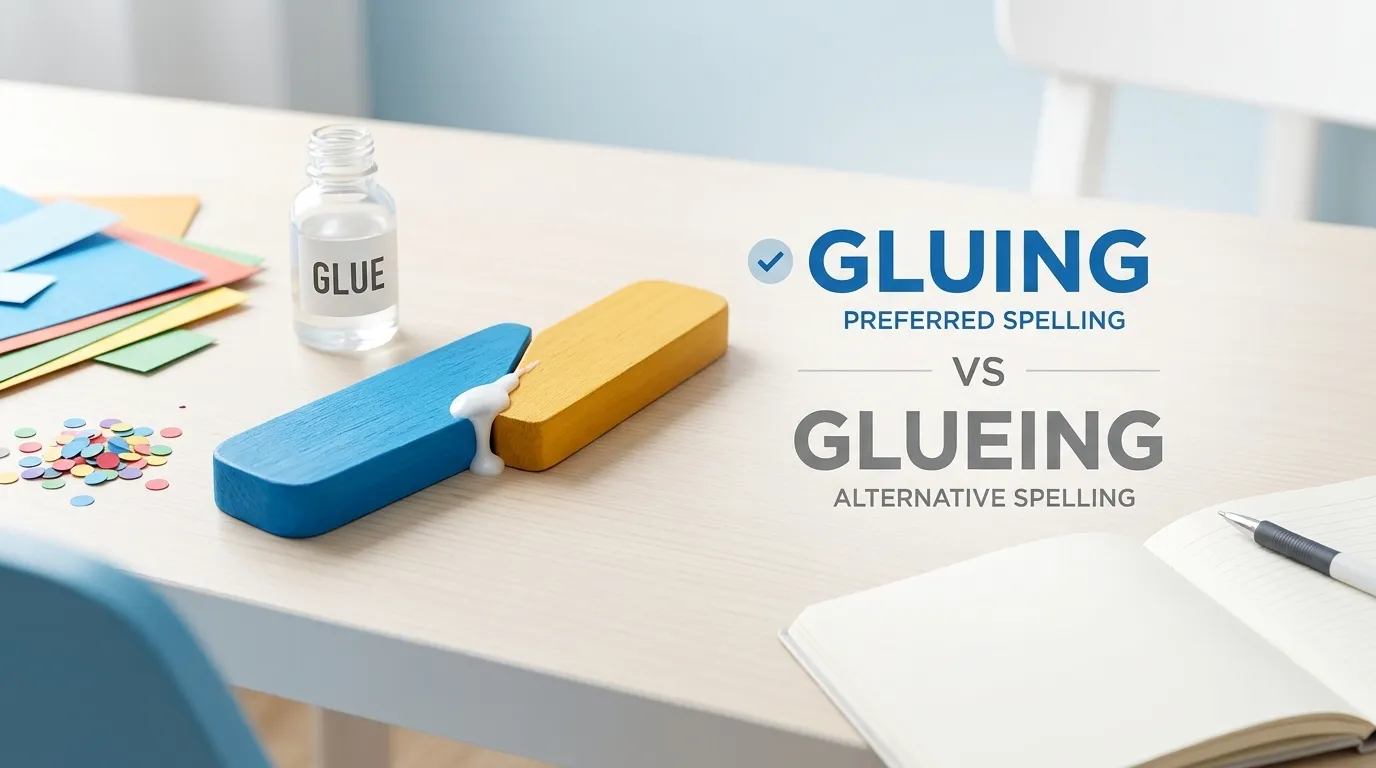
Quick Answer: Gluing or Glueing?
Gluing is the preferred spelling in American English. However, glueing is also recognized as an alternative spelling in major English dictionaries, including Oxford and Cambridge.
Both words mean attaching or joining something using glue or another adhesive. The difference is spelling, not meaning.
| Spelling | Status | Recommendation |
| Gluing | Standard and widely preferred | Best choice |
| Glueing | Recognized alternative | Less commonly preferred |
Quick tip: When writing for an American audience, choose gluing. It is the more familiar and practical spelling for everyday, academic, and professional writing.
What Does Gluing Mean?
Gluing is the present participle of the verb glue. It describes the action of joining, attaching, or sticking two or more objects together using an adhesive substance.
It can also function as a gerund, meaning it can act as a noun in a sentence.
For example:
- She is gluing the pictures onto the scrapbook pages.
- The children are gluing colorful shapes onto their classroom posters.
- Gluing the wooden pieces together requires patience.
- He spent the afternoon gluing the broken parts of his model airplane.
In each example, the word describes the process of attaching something with glue.
What Does Glueing Mean?
Glueing has exactly the same meaning as gluing. It is an alternative spelling of the present participle of glue.
Although it is less commonly preferred in American English, it appears in established dictionary references. Therefore, it should not automatically be treated as a spelling mistake.
For example:
- She is glueing the paper decorations onto the card.
- The students are glueing their artwork into their notebooks.
- He finished glueing the wooden pieces together.
These sentences communicate the same meaning as their versions using gluing.
The main difference is that gluing is the safer and more familiar choice for most American readers.
Gluing vs. Glueing: Key Differences
Although the two spellings refer to the same action, there are a few practical differences worth understanding.
| Feature | Gluing | Glueing |
| Meaning | Joining things with glue | Joining things with glue |
| Word form | Present participle / gerund | Present participle / gerund |
| Dictionary recognition | Yes | Yes |
| American English preference | Preferred | Less commonly used |
| Pronunciation | /ˈɡluː.ɪŋ/ | /ˈɡluː.ɪŋ/ |
| Everyday writing | Recommended | Alternative |
As you can see, neither spelling creates a different meaning. The distinction mainly concerns spelling convention and common usage.
Why Is Gluing Spelled Without an E?
The confusion comes from a common English spelling rule involving verbs that end in a silent e.
Generally, when a verb ends in a silent e, you remove that final letter before adding -ing.
For example:
| Base Verb | Correct -ing Form |
| Make | Making |
| Bake | Baking |
| Write | Writing |
| Drive | Driving |
| Take | Taking |
| Glue | Gluing |
Following this pattern:
Glue + ing = Gluing
The final e is dropped before the suffix is added.
However, English spelling has exceptions. Some words retain their final e when taking -ing.
Consider these examples:
| Base Verb | Correct -ing Form |
| See | Seeing |
| Agree | Agreeing |
| Dye | Dyeing |
| Free | Freeing |
These examples explain why spelling can sometimes feel inconsistent. The important thing is to learn the established form of each word rather than assume that every verb follows exactly the same pattern.
When Should You Use Gluing or Glueing?
Although both forms are recognized, your choice should depend on your audience and writing preferences.
1. Use Gluing in American English
If you’re writing an American school assignment, blog post, email, instruction manual, or professional document, gluing is the recommended option.
Examples:
- I am gluing the broken handle back onto the cup.
- She enjoys gluing pictures into her scrapbook.
- The teacher is gluing the students’ artwork onto the display board.
- We are gluing the cardboard pieces together for our science project.
This spelling is familiar to American readers and is a reliable choice for everyday writing.
2. Recognize Glueing as an Alternative
You may encounter glueing in books, online articles, or other English-language publications. It is a recognized alternative spelling, not a word with a different definition.
Examples:
- The children were glueing paper shapes onto their posters.
- He spent the evening glueing the model airplane together.
- She finished glueing the decorations before the party started.
If you’re following a publication’s house style, use whichever spelling its guidelines recommend. Otherwise, gluing is the better choice for an American audience.
Gluing or Glueing in Sentences
The following examples show how gluing works in different everyday situations.
- Crafts: My daughter is gluing colorful stickers onto her notebook.
- School Projects: The students are gluing paper shapes together for their art assignment.
- Woodworking: The carpenter is gluing the wooden joints before assembling the cabinet.
- Home Repairs: I am gluing the broken handle back onto the drawer.
- Scrapbooking: She enjoys gluing old photographs into her family album.
- Model Building: He spent three hours gluing the miniature airplane together.
- Decorating: We are gluing small decorations onto the birthday cards.
- DIY Projects: They are gluing cardboard pieces to create a model house.
- Packaging: The workers are gluing labels onto the product boxes.
- Art Class: The teacher showed the children how to avoid using too much glue when gluing their artwork.
These examples demonstrate that gluing can describe many activities involving paper, wood, cardboard, decorations, and other materials.
What Is the Difference Between Gluing and Glued?
Another common source of confusion is the difference between gluing and glued. Both come from the verb glue, but they serve different grammatical purposes.
Gluing is the present participle or gerund. It describes an ongoing action or the activity of attaching something with glue.
Glued is the simple past and past participle form. It describes an action that has already happened or a resulting condition.
Compare these examples:
- Gluing: She is gluing the broken pieces together.
- Glued: She glued the broken pieces together yesterday.
- Glued (adjective): The two pieces are firmly glued together.
Remember that the correct past tense is glued, not glueed.
Common Mistakes to Avoid
Even though the spelling difference seems small, a few mistakes can make your writing less consistent.
1. Assuming Glueing Is Always Incorrect
Some writers believe that glueing is never acceptable. However, major dictionaries recognize it as an alternative spelling. For most American writing, simply choose gluing.
2. Writing Glueed Instead of Glued
The past tense of glue is glued, not glueed.
Incorrect: She glueed the broken toy yesterday.
Correct: She glued the broken toy yesterday.
3. Mixing Both Spellings in One Article
Using both forms interchangeably can make an article look inconsistent. Choose one spelling and maintain it throughout your writing.
4. Forgetting the Meaning of the Word
Both gluing and glueing describe attaching objects with adhesive. Neither has a separate meaning.
Frequently Asked Questions
1. Is It Gluing or Glueing in American English?
Gluing is the preferred spelling in American English. Although glueing is recognized as an alternative form, gluing is the safer choice for most American readers.
2. Is Glueing a Real Word?
Yes. Glueing is recognized as an alternative spelling of gluing in major dictionary references. Both forms have the same meaning, although gluing is generally preferred in American writing.
3. Why Does Gluing Drop the E?
The final silent e is generally removed when adding -ing to a verb. For example, make becomes making, and glue becomes gluing.
4. What Is the Past Tense of Glue?
The past tense of glue is glued. For example: “I glued the broken pieces together yesterday.”
5. Is Gluing a Verb or a Noun?
Gluing can function as both a present participle and a gerund. As a present participle, it describes an ongoing action. As a gerund, it acts as a noun.
Examples:
- Present participle: She is gluing the photographs.
- Gerund: Gluing requires patience.
6. Is Gluing One Word or Two?
Gluing is one word. It is formed by adding the suffix -ing to the verb glue after removing the final e.
7. Is It Glueing Wood or Gluing Wood?
Gluing wood is the preferred spelling, especially in American English. Both forms describe attaching wooden pieces using an adhesive.
8. Do Gluing and Glueing Have Different Pronunciations?
No. Both spellings have the same pronunciation: /ˈɡluː.ɪŋ/. The difference is purely written, not spoken.
Final Verdict: Gluing or Glueing?
So, which spelling should you use: gluing or glueing?
The answer is simple: Choose gluing for American English writing.
Both forms are recognized, and they share the same meaning and pronunciation. However, gluing is the more familiar and widely preferred option for American readers.
Remember the simple spelling pattern: glue → gluing. Once you understand this rule and recognize the alternative form, you’ll have no trouble choosing the right spelling for your writing.
Read more: Prooving or Proving: The Correct Spelling Guide

I started writing about English word differences after years of teaching students who kept making the same mistakes. My focus is on making spelling rules feel simple and easy to remember. At WordsCombo, I turn confusing word pairs into clear comparisons.