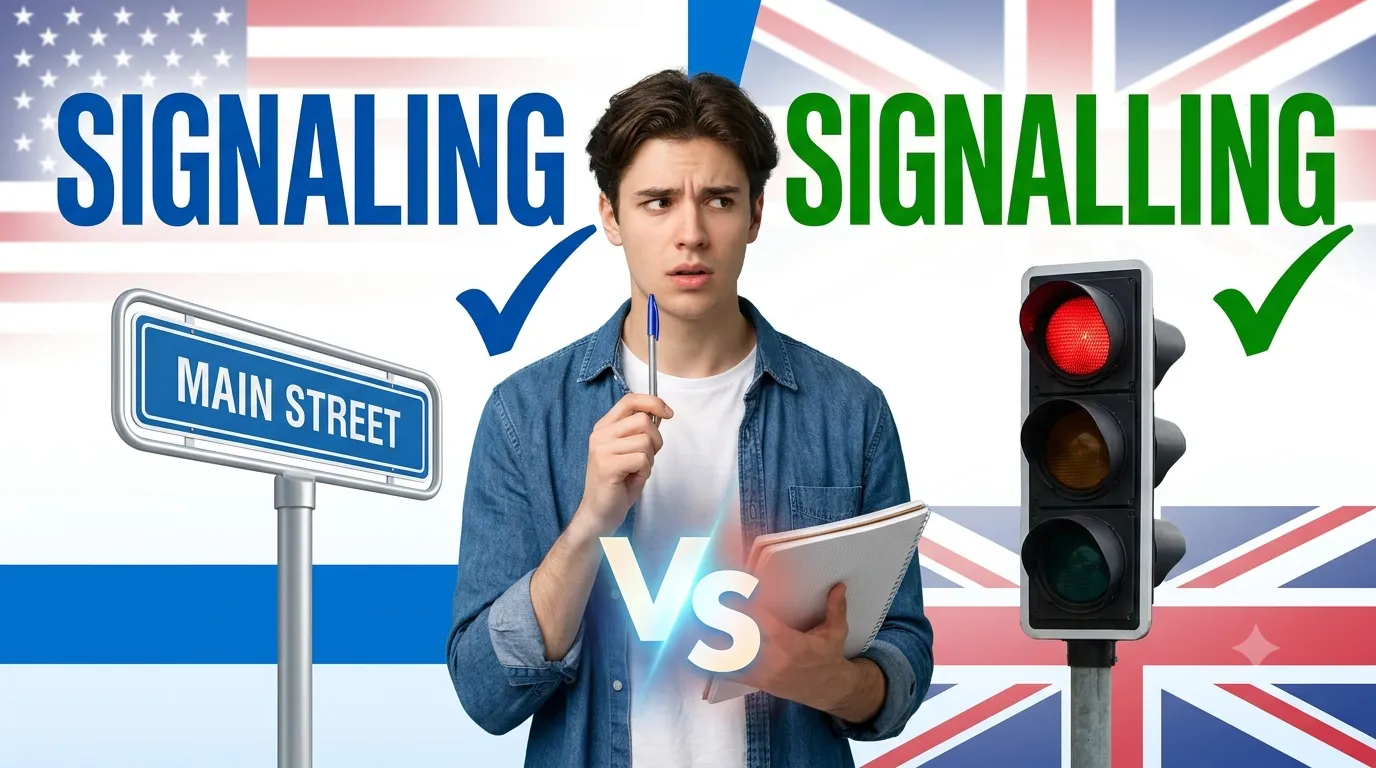
Signaling and signalling mean the same thing. The only difference is spelling. Signaling is the preferred spelling in American English, while signalling is the standard spelling in British English. Choose the version that matches your audience and stay consistent throughout your writing.
A few years ago, I was editing a blog post for an international client. Everything looked great until I noticed something odd. The article used signaling in one paragraph and signalling in the next. Neither spelling was wrong, but mixing both made the content look unprofessional.
That small mistake taught me an important lesson. English changes depending on where your readers live. A single extra “l” can tell your audience whether your writing follows American or British English.
Many writers search for “signaling or signalling” because they want to avoid mistakes in essays, business emails, websites, or academic papers. They wonder if one spelling is correct and the other is not.
The good news is that the answer is simple. Both spellings are correct. The real question is which one fits your audience.
In this guide, you’ll learn the difference between signaling and signalling, why both exist, when to use each one, and how to avoid common writing mistakes.
Signaling or Signalling
The difference between signaling and signalling comes down to regional spelling, not meaning.
- Signaling → American English (United States)
- Signalling → British English (United Kingdom, Australia, New Zealand, and many Commonwealth countries)
Both words mean:
- Giving a sign
- Sending a message
- Communicating information
- Showing intention through words, actions, or signals
Example 1 (American English)
The traffic light is signaling that drivers should stop.
Example 2 (British English)
The traffic light is signalling that drivers should stop.
Both sentences are correct. The only difference is the spelling style.
Quick Tip
If your document already uses American spelling like:
- color
- organize
- traveled
then use signaling.
If your document uses British spelling like:
- colour
- organise
- travelled
then use signalling.
Consistency matters more than choosing one over the other.
The Origin and Background of Signaling or Signalling
To understand why there are two spellings, it helps to look at the history of English.
The word comes from the noun signal, which entered English through French and Latin. For hundreds of years, writers used the word to describe signs, symbols, warnings, and messages.
Later, the verb signal appeared. It simply meant to give a signal.
When writers added -ing, two spelling systems developed.
American English
American English often keeps only one “l” before adding -ing.
Examples include:
- travel → traveling
- cancel → canceling
- signal → signaling
This style became common after American dictionaries simplified many spellings.
British English
British English usually doubles the “l” before adding -ing when the word ends with -l.
Examples include:
- travel → travelling
- cancel → cancelling
- signal → signalling
This spelling follows long-standing British writing conventions.
Why Does the Confusion Continue?
Many people read content from websites around the world every day.
For example:
- American news websites write signaling.
- British newspapers write signalling.
- International companies often publish content in both styles.
Because both versions appear online, writers often wonder if one is a typo.
It isn’t.
The spelling simply reflects the variety of English being used.
A Simple Way to Remember
Think about these familiar pairs:
| American English | British English |
|---|---|
| Color | Colour |
| Favorite | Favourite |
| Traveling | Travelling |
| Counseling | Counselling |
| Signaling | Signalling |
The pattern is the same.
British English often keeps the extra “l”, while American English usually does not.
Signaling or Signalling Explained: Key Differences
The meaning never changes.
Only the spelling changes depending on the audience.
| Term | Meaning | When to Use | Region/Context |
|---|---|---|---|
| Signaling | Giving a signal or communicating information | American writing | United States |
| Signalling | Giving a signal or communicating information | British writing | United Kingdom, Australia, New Zealand, Ireland, many Commonwealth countries |
Example in Everyday Writing
American English
The company is signaling a major change in its marketing strategy.
British English
The company is signalling a major change in its marketing strategy.
In Technology
American documentation:
The device uses signaling to establish a secure connection.
British documentation:
The device uses signalling to establish a secure connection.
In Sports
American English:
The referee is signaling a penalty.
British English:
The referee is signalling a penalty.
In Business
American style:
Rising prices are signaling stronger demand.
British style:
Rising prices are signalling stronger demand.
Does Pronunciation Change?
No.
Both words are pronounced exactly the same.
Pronunciation:
SIG-nuh-ling
The extra “l” changes only the spelling, not the sound.
Why This Matters for SEO and Professional Writing
Using one spelling consistently helps build trust with readers and search engines.
For example:
- A website targeting U.S. readers should consistently use signaling.
- A website targeting UK readers should consistently use signalling.
- International brands should choose one style guide for each region and follow it throughout their content.
Consistency improves readability, strengthens your brand voice, and creates a more polished experience for your audience.
Which Version Should You Use?
Choosing between signaling and signalling is easier than many people think. Both spellings are correct. The best choice depends on who will read your writing.
Always match the spelling to your audience. Most readers expect the style they see every day.
For Students
If your school follows American English, use signaling.
If your school follows British English, use signalling.
Check your teacher’s instructions or your school’s style guide before you submit your work.
Example
- American English: The experiment is signaling a change in temperature.
- British English: The experiment is signalling a change in temperature.
For Bloggers and Website Owners
Think about your target audience.
- Writing for readers in the United States? Choose signaling.
- Writing for readers in the United Kingdom, Australia, or New Zealand? Choose signalling.
If your website serves a global audience, pick one style and use it consistently across every page.
For Business Professionals
Many international companies follow a style guide.
Here are some simple rules:
- American companies: Use signaling.
- British companies: Use signalling.
- Global businesses: Match the spelling to the country or region you are targeting.
A consistent writing style helps your brand look professional.
For Academic Writing
Universities usually require one variety of English.
Before writing your paper:
- Read the assignment guidelines.
- Follow your university’s preferred style.
- Avoid switching between American and British spelling.
Even one mixed spelling can make your work look careless.
For SEO Writers
Search engines understand both spellings.
However, readers usually search using the spelling common in their country.
For example:
- U.S. users often search for signaling.
- UK users often search for signalling.
If you’re targeting a specific market, use that region’s spelling naturally throughout the article.
Quick Recommendations
- American audience → Use signaling
- British audience → Use signalling
- International audience → Pick one style and stay consistent
- Academic writing → Follow your institution’s style guide
- Business writing → Match your company’s preferred English
Common Mistakes with Signaling or Signalling
Many writers know both spellings are correct. The real problem comes from using them incorrectly or inconsistently.
Here are the mistakes you should avoid.
| Mistake | Correct Version | Why It Happens |
|---|---|---|
| Using signaling and signalling in the same article | Choose one spelling | Mixing American and British English |
| Using signalling in an American document | Use signaling | Wrong regional style |
| Using signaling in a British report | Use signalling | Wrong regional convention |
| Thinking one spelling is incorrect | Both are correct | Regional differences cause confusion |
| Ignoring your style guide | Follow one style consistently | Consistency improves professionalism |
Mistake 1: Mixing Both Spellings
❌ The report is signaling a trend. Later, it mentions signalling another issue.
✅ The report is signaling a trend. Later, it mentions signaling another issue.
OR
✅ The report is signalling a trend. Later, it mentions signalling another issue.
Mistake 2: Using the Wrong Regional Style
If you’re writing for an American audience, don’t suddenly switch to British spelling.
Likewise, don’t use American spelling in a document written entirely in British English.
Mistake 3: Copying Text from Different Sources
Many writers copy examples from websites.
One source may use American English.
Another may use British English.
Always edit the final draft so every spelling follows the same style.
Mistake 4: Believing One Version Is Better
Neither spelling is more correct.
Both appear in respected dictionaries and professional publications.
The only difference is location.
Mistake 5: Forgetting Related Words
If you choose American English, related words should also match.
For example:
- color
- organize
- traveled
- signaling
If you choose British English:
- colour
- organise
- travelled
- signalling
Your spelling style should stay consistent from start to finish.
Signaling or Signalling in Real World Examples
Seeing the words in context makes the difference much easier to remember.
Professional Email
American English
We are signaling our intention to expand into new markets next year.
British English
We are signalling our intention to expand into new markets next year.
News Headline
American Style
Rising fuel prices are signaling slower economic growth.
British Style
Rising fuel prices are signalling slower economic growth.
Social Media Post
American version:
Our latest update is signaling exciting changes. Stay tuned!
British version:
Our latest update is signalling exciting changes. Stay tuned!
Business Report
American English:
Customer feedback is signaling a growing demand for faster delivery.
British English:
Customer feedback is signalling a growing demand for faster delivery.
Academic Writing
American English:
The results are signaling a clear relationship between the variables.
British English:
The results are signalling a clear relationship between the variables.
Everyday Conversation
American:
He’s signaling that he’s ready to leave.
British:
He’s signalling that he’s ready to leave.
Signaling or Signalling: Data, Trends & Usage
Understanding where each spelling is used can help you make the right choice for your audience.
Where Is It Most Common?
Signaling
Most common in:
- United States
- American businesses
- U.S. universities
- American news websites
- U.S.-based technology companies
Signalling
Most common in:
- United Kingdom
- Australia
- New Zealand
- Ireland
- Many Commonwealth countries
Who Searches for This Topic?
People searching “signaling or signalling” often include:
- Students
- Bloggers
- Content writers
- SEO professionals
- Business writers
- Editors
- Teachers
- English learners
Most want to know which spelling is correct and whether one should be used over the other.
Search Intent
Primary Search Intent: Informational
Readers usually want quick answers to questions like:
- Which spelling is correct?
- What’s the difference?
- Which one should I use?
- Is one American and the other British?
- Which version fits formal writing?
Why This Topic Matters Today
More people now write for global audiences than ever before.
A blog written in Canada may be read in the United States, the United Kingdom, Australia, and India on the same day.
Because of this, choosing the right spelling is no longer just a grammar issue. It also affects:
- Reader trust
- Brand consistency
- Professional appearance
- User experience
- Regional SEO performance
Even though search engines recognize both spellings, readers notice inconsistency. Using the version that matches your audience helps your content feel natural and polished.
Standalone Comparison Table
| Term/Variant | Meaning | Region/Context | Best Used When |
|---|---|---|---|
| Signaling | Giving a signal or communicating information | American English | Writing for U.S. readers, businesses, schools, or publications |
| Signalling | Giving a signal or communicating information | British English | Writing for UK, Australian, New Zealand, Irish, or Commonwealth audiences |
Frequently Asked Questions (FAQs)
Q1: What does signaling or signalling mean?
A: Both signaling and signalling mean giving a signal, sending a message, or showing an intention through words, actions, symbols, or signs. The meaning is exactly the same. The only difference is the regional spelling.
Q2: How do you use signaling or signalling correctly?
A: Use signaling if you’re writing in American English. Use signalling if you’re writing in British English. Once you choose a spelling style, use it consistently throughout your document.
Q3: Signaling vs. signalling: what’s the difference?
A: There is no difference in meaning or pronunciation. The only difference is spelling. Signaling is the standard American English form, while signalling is the standard British English form.
Q4: Is signaling or signalling acceptable in formal writing?
A: Yes. Both spellings are correct in formal writing. The key is to match the spelling to your audience or the required style guide. Academic institutions, businesses, and publishers often specify whether they use American or British English.
Q5: Which version is correct, signaling or signalling?
A: Both are correct. If your audience is in the United States, use signaling. If your audience is in the United Kingdom, Australia, or other Commonwealth countries, use signalling.
Q6: Where do signaling and signalling come from?
A: Both words come from the verb signal, which has roots in French and Latin. Over time, American and British English developed different spelling conventions, creating signaling and signalling as regional variants.
Q7: Can signaling or signalling be used in technical or business writing?
A: Absolutely. Both spellings are common in fields such as technology, engineering, finance, healthcare, transportation, and business. Choose the version that matches your organization’s preferred English style.
Conclusion
By now, the choice between signaling and signalling should feel much simpler. Both spellings are correct, and neither is more accurate than the other. The real difference lies in the type of English you are using.
Here are the key points to remember:
- Signaling is the standard spelling in American English.
- Signalling is the standard spelling in British English.
- Both words have the same meaning and pronunciation.
- The most important rule is to stay consistent throughout your writing.
Whether you’re writing a blog post, business email, academic paper, website, or social media update, matching your spelling to your audience helps your content look polished and professional. It also creates a better reading experience and strengthens your credibility.
Now you know exactly when to use signaling or signalling with confidence. Bookmark this guide so you never second-guess the spelling again, and share it with a friend or colleague who has wondered which version is correct.
Read more: Prioritize or Prioritise: Which Spelling Should You Use?

I studied English literature and have spent years editing content for blogs and digital platforms. I noticed most people struggle with choosing between two similar words. At WordsCombo, I make that choice simple and clear.