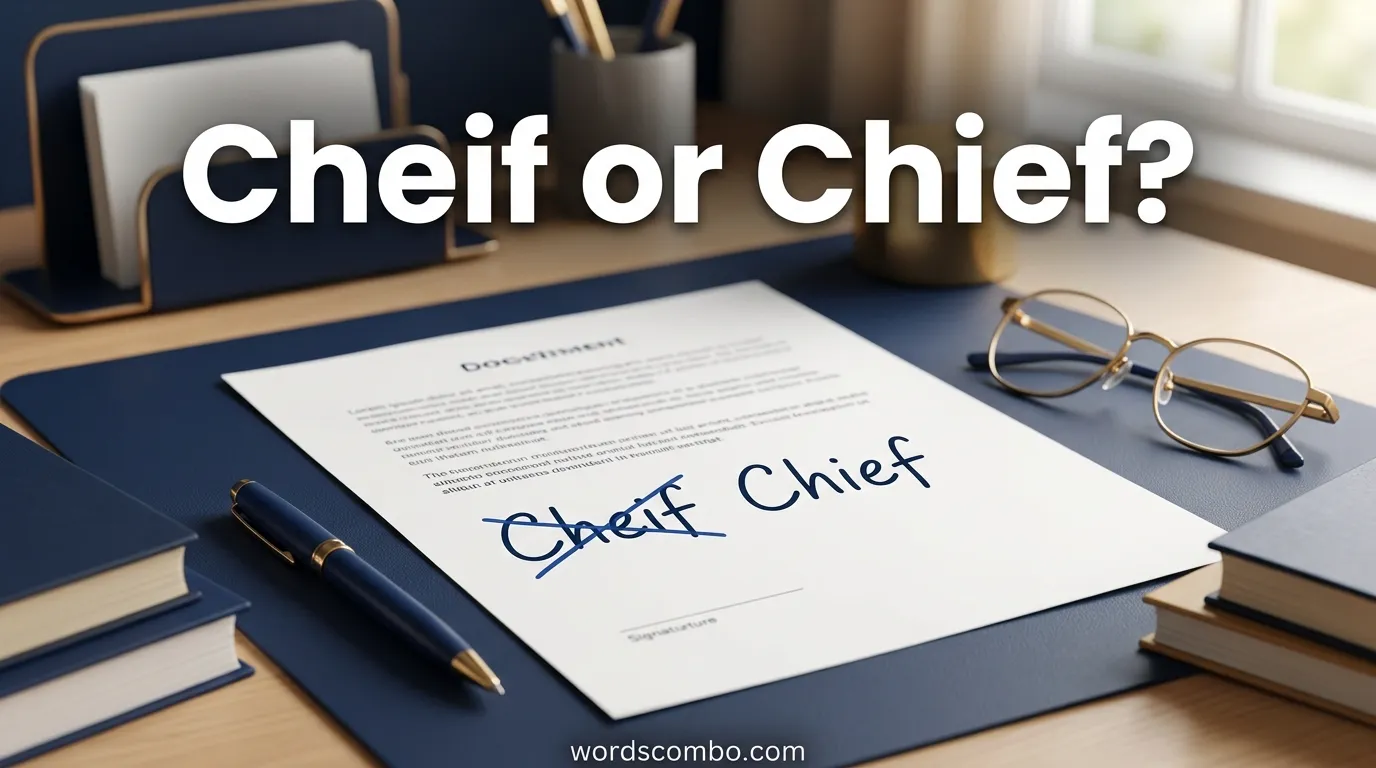
Cheif or chief is a spelling choice where chief is correct, while cheif is a common misspelling.
I caught this one in a document late one evening, just before sending a short report to a client. The word was sitting in a heading: “Department Cheif.” I knew the meaning was clear, but the spelling looked wrong. A quick pause was enough to spot the problem. The letters had been flipped.
That tiny mistake is easy to make. Chief sounds simple when you say it, but the middle letters can cause trouble when you type quickly. Many people remember the sound first and then guess whether the word should contain ie or ei.
If you have typed “cheif” into an email, school assignment, report, or search box, you are not alone. The good news is that there is only one standard spelling you need for modern English: chief.
This guide shows you exactly why chief is correct, what it means, where it came from, and how to remember the spelling without stopping to think every time.
Cheif or Chief: Quick Answer
The correct spelling is chief.
Cheif is an incorrect spelling of the word. It is usually caused by reversing the i and e.
Examples:
- Correct: The police chief spoke to reporters.
- Incorrect: The police cheif spoke to reporters.
Chief can mean a leader, a person in charge, or something that is most important.
For example, you might write:
The chief reason for the delay was bad weather.
So, when you are choosing between cheif or chief, always use chief.
The Origin and Background of Chief
The spelling chief has a long history. It entered English from Old French, where related forms meant head, leader, or principal person. Its deeper root comes from Latin caput, meaning head.
That history helps explain the meaning we use today. A person called a chief is often the head of a group. The word can also describe something that stands above others in importance.
English spelling changed over many centuries. The modern form became chief, not cheif.
The mistake happens because English has many words with confusing ie and ei patterns. Writers may remember the sound of the word but not the order of its letters.
There is also an interesting connection with the word chef. Both words trace back to the same Old French word connected with the idea of a head or leader. English later developed separate meanings for them.
Today, however, the spelling question is simple. Chief is the standard English form.
Cheif or Chief Explained: The Key Difference
There is no regional spelling difference between cheif and chief.
The difference is simple:
| Term | Meaning | When to Use | Region/Context |
| chief | Leader, person in charge, or most important | Use in all standard English writing | American, British, and international English |
| cheif | No standard English meaning | Do not use it | Common spelling error |
Chief as a noun
As a noun, chief means a leader or person who has authority.
- The police chief gave a statement.
- The village chief welcomed the visitors.
- She became the chief of the department.
Chief as an adjective
As an adjective, chief means main or most important.
- Safety was our chief concern.
- Her chief goal was to finish the project.
- Cost was the chief reason for the change.
The spelling stays the same in both uses.
Which Spelling Should You Use?
The answer is direct: use chief.
You do not need a different spelling for American English or British English. Both use chief. Pronunciation is also essentially the same in standard American and British English.
Here is the practical rule:
- For students: use chief in essays, homework, and exams.
- For professionals: use chief in emails, reports, job titles, and business documents.
- For American English: use chief.
- For British English: use chief.
- For global English: use chief.
If you see cheif in a draft, correct it.
This is not a case where both spellings are accepted. Cheif is simply a spelling mistake.
Common Mistakes with Cheif or Chief
1. Writing “cheif” instead of “chief”
Mistake: The company hired a new cheif executive.
Correction: The company hired a new chief executive.
The letters i and e are in the wrong order in the mistake.
2. Assuming “cheif” is a British spelling
Mistake: I thought cheif was the British version.
Correction: Chief is used in both American and British English.
There is no standard regional spelling called cheif.
3. Forgetting the spelling in job titles
Mistake: She is the Cheif Financial Officer.
Correction: She is the Chief Financial Officer.
This mistake can look especially noticeable in professional documents.
4. Trusting pronunciation to choose the letters
Mistake: The word sounds like “cheef,” so the spelling feels uncertain.
Correction: Remember the written form: chief.
English spelling does not always follow sound perfectly. This is one case where memorizing the letter order helps.
5. Using “cheif” in formal writing
Mistake: The cheif investigator submitted the report.
Correction: The chief investigator submitted the report.
A spell-check tool may catch this error, but it is better to know the correct spelling yourself.
Cheif or Chief in Real World Examples
Seeing chief in normal sentences makes the correct spelling easier to remember.
Professional email
Subject: Meeting With the Chief Financial Officer
We have scheduled a meeting with the chief financial officer for Monday.
Here, chief is part of a formal job title.
News headline
Police Chief Announces New Safety Measures
The word chief identifies the person who leads the police department.
Social media post
Proud to welcome our new chief technology officer to the team!
Here, chief appears in a professional title.
Formal report
The chief cause of the delay was a shortage of materials.
In this sentence, chief means main or most important.
These examples show why getting the spelling right matters. Chief appears often in leadership, business, government, news, and formal writing.
Cheif or Chief: Data, Trends & Usage
The search intent behind “cheif or chief” is strongly informational. People who search this phrase are usually trying to check a spelling before using the word in writing.
The most useful contexts include:
- School assignments
- Business emails
- Job titles
- Reports and applications
- Professional editing
- Online writing
- English spelling practice
The spelling error is especially understandable because ie and ei create confusion in many English words. Search results for this query also commonly focus on the basic question, “Is it cheif or chief?” and how to spell the word correctly.
There is also a practical reason this matters now. People write quickly across emails, documents, chats, and social platforms. A small spelling error can easily survive until the final version.
The simple takeaway is useful: when you mean a leader or something most important, type chief.
Cheif or Chief: Comparison at a Glance
| Term/Variant | Meaning | Region/Context | Best Used When |
| chief | Leader, person in charge, or most important | Standard English | Always use this spelling |
| cheif | Incorrect spelling | Common typing or spelling mistake | Do not use |
| chef | A professional cook | English, borrowed from French | Use when talking about cooking |
One extra point can prevent another common mix-up: chief and chef are not interchangeable.
- Chief = leader or most important
- Chef = professional cook
For example:
The chief addressed the staff.
The chef prepared dinner.
The words are historically related, but their modern meanings are different.
FAQs About Cheif or Chief
Q: Is it cheif or chief?
A: Chief is the correct spelling. Cheif is a misspelling and should not be used in standard English.
Q: How do you spell chief correctly?
A: Spell it C-H-I-E-F. The important part to remember is ie, not ei.
Q: What does chief mean?
A: Chief can mean a leader or person in charge. It can also mean main or most important, as in “the chief reason.”
Q: Is chief used in American English?
A: Yes. Chief is the standard spelling in American English. British English uses the same spelling as well.
Q: Is chief acceptable in formal writing?
A: Yes. Chief is completely acceptable in formal writing. You will often see it in job titles, reports, government language, and professional documents.
Q: Why do people spell chief as cheif?
A: The error usually comes from confusion over ie and ei. The two letter patterns can sound similar, so writers may reverse them when typing from memory.
Q: What is the difference between chief and chef?
A: Chief refers to a leader or something most important. Chef refers to a professional cook. The words have a shared historical connection, but their modern meanings are different.
Final Thoughts on Cheif or Chief
If you only remember one thing from this guide, remember this: chief is correct, and cheif is incorrect.
The word chief can describe a leader, a person in charge, or something that matters most. You can use it in school writing, business documents, job titles, news writing, and everyday English.
The spelling becomes much easier when you focus on the middle letters. Write chief with ie. Do not switch them to ei.
It also helps to connect the word with familiar phrases such as chief executive, police chief, and chief reason. The more often you see the correct form, the more natural it becomes.
You do not need to worry about American versus British spelling here. Chief works in both.
So, the next time your fingers hesitate between cheif or chief, trust the correct form and keep going.
Bookmark this guide so you never second guess the spelling of chief again.
Curious about similar spelling traps? Explore Commenter or Commentor: The Easy Answer.

I started writing about English word differences after years of teaching students who kept making the same mistakes. My focus is on making spelling rules feel simple and easy to remember. At WordsCombo, I turn confusing word pairs into clear comparisons.







2 thoughts on “Cheif or Chief: The Easy Spelling Guide”