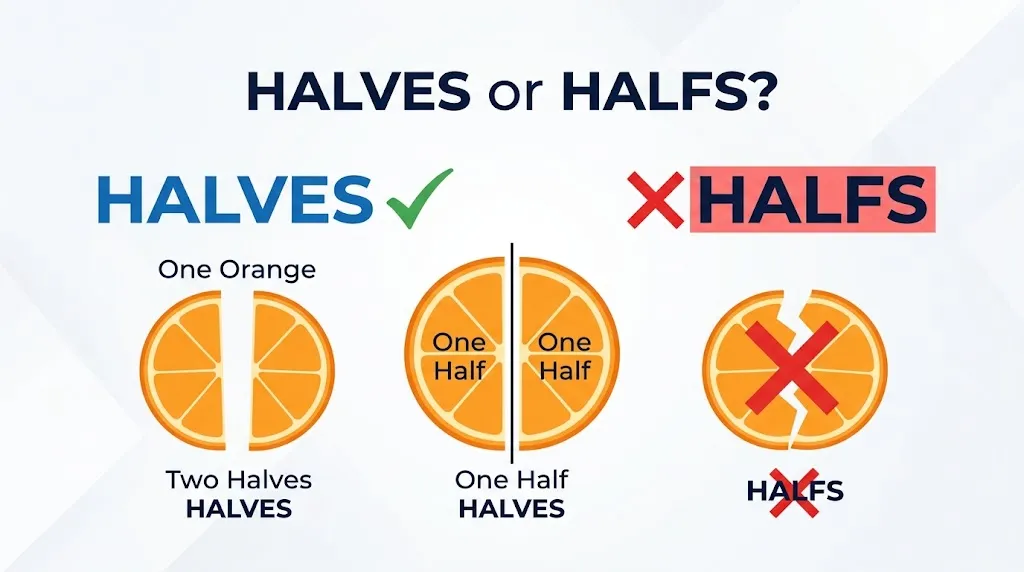
Halves is the correct plural of half; halfs is not the standard plural form in English.
Have you ever typed “halfs” and then stopped to wonder, “Wait, is that really right?” It is a small spelling question, but it can cause a big pause when you are writing an email, school assignment, report, or article.
I have seen this mistake often in beginner English writing. The reason is easy to understand. Most English nouns form their plural by adding s. We have book → books, car → cars, and apple → apples. So half → halfs seems like a natural choice.
But English has its surprises.
The correct plural is halves. The spelling changes from f to ves. Cambridge and Oxford both list halves as the plural of half.
Once you know the rule, the choice becomes simple. You do not need to guess between halves and halfs again.
Let’s look at why this happens, how to use halves correctly, and how to avoid similar mistakes.
Halves or Halfs
The correct word is halves.
- Singular: half
- Plural: halves
- Incorrect standard plural: halfs
A half means one of two equal or nearly equal parts of something. Two halves make one whole.
Simple examples
- Cut the orange into two halves.
- The two halves of the cake were the same size.
- We watched the first and second halves of the match.
- Divide the paper into two halves.
So, if you are talking about more than one half, use halves.
Half → Halves
That is the spelling pattern to remember.
The Origin and Background of Halves
Why does half become halves instead of halfs?
The answer comes from the history of English. The word half comes from Old English half or healf. Oxford notes that it has Germanic roots and is related to words such as Dutch half and German halb.
Over time, English changed the way some words were pronounced and spelled.
This is why English has several older plural patterns that do not simply add s.
For example:
- leaf → leaves
- wolf → wolves
- knife → knives
- life → lives
- wife → wives
- half → halves
The pattern is not completely regular. That is one reason learners may write halfs.
There is also a sound change. In halves, the final sound is pronounced like /vz/ rather than the /fs/ sound you might expect from half. Cambridge gives the plural pronunciation as /hɑːvz/ in UK English and /hævz/ in US English.
The good news is that you do not need to study Old English to use the word correctly. Just remember the modern form:
one half → two halves
Halves or Halfs Explained: Key Differences
There is a very important point here: halves and halfs are not two standard regional spellings.
In normal modern English, halves is the accepted plural of half. Cambridge and Oxford both identify halves as the plural form.
| Term | Meaning | When to Use | Region/Context |
|---|---|---|---|
| half | One of two equal or nearly equal parts | When talking about one part | Standard English worldwide |
| halves | More than one half | When talking about two or more halves | Standard British and American English |
| halfs | Nonstandard spelling of the plural | Avoid in normal English writing | Not the standard plural |
Example: one half
I ate half of the sandwich.
There is only one half being discussed.
Example: two halves
I cut the sandwich into two halves.
Now there are two parts, so halves is correct.
Example: several halves
You can also use halves when more than two half sized parts are discussed in different objects or situations.
The students compared the left and right halves of the diagrams.
Here, halves refers to several separate parts.
Which Version Should You Use?
If you are writing in standard English, the answer is simple:
Use “halves.”
For students
Use halves in essays, homework, exams, and classwork.
The teacher divided the class into two halves.
This is the safest form for school writing.
For professional writers
Use halves in reports, emails, articles, presentations, and business documents.
The results were divided into two halves for comparison.
There is no need to use halfs.
For global English
Use halves if your readers come from different English speaking countries.
The word is standard in both British and American English. Cambridge lists the plural as halves in both varieties.
Best rule: When the noun is plural, write halves, not halfs.
Common Mistakes with Halves
Small spelling errors are easy to fix once you know the pattern.
1. Mistake: halfs
Wrong:
Cut the apple into two halfs.
Correct:
Cut the apple into two halves.
Why does the mistake happen? English often forms plurals with s, so halfs looks logical. But half follows an irregular plural pattern.
2. Mistake: using half when you need halves
Wrong:
The two half of the box were empty.
Correct:
The two halves of the box were empty.
If you have two parts, use the plural halves.
3. Mistake: confusing halves with halve
Wrong:
Please halves the amount.
Correct:
Please halve the amount.
Halves is normally the plural noun.
Halve is a verb meaning to divide something into two equal parts.
For example:
We need to halve the recipe.
But:
We divided the recipe into two halves.
4. Mistake: adding an unnecessary plural
Wrong:
I ate one halves of the cake.
Correct:
I ate one half of the cake.
Use half after one. Use halves when you mean more than one.
5. Mistake: confusing half with whole
Remember the relationship:
One half + one half = one whole.
Or:
Two halves make a whole.
Oxford uses this same basic relationship when explaining the noun half.
Halves in Real World Examples
Knowing the spelling is useful. Knowing how people actually use the word is even better.
1. Professional email
Subject: Report Results
I have divided the report into two halves. The first half covers the background, while the second half presents the results.
Here, halves refers to two sections.
2. News article
The team improved in both halves of the match.
This is common sports language. A match can have a first half and a second half. Cambridge also lists half as a sports term for one of the two periods of play.
3. Social media post
We worked hard in both halves and finished with a great result!
The word sounds natural because it describes two periods.
4. Formal report
The sample was divided into two equal halves for further analysis.
This is a clear use in academic or professional writing.
5. Everyday conversation
Can you cut these two apples into halves?
Simple, natural, and correct.
Halves or Halfs: Data, Trends & Usage
The search “halves or halfs” is mainly an informational spelling and grammar query. People who search it usually want a quick answer to one question: Which spelling is correct?
Dictionary evidence is very consistent. Cambridge lists halves as the plural of half, and Oxford does the same. Both also provide examples showing how the word works in real sentences.
There is also no major British versus American spelling split here. Both varieties use halves. The main difference is pronunciation, not plural spelling. Cambridge gives different UK and US pronunciations, while keeping the spelling halves.
This matters because online writing often spreads plausible looking spellings. A word such as halfs may look correct because adding s is so common.
When in doubt, check the base word and its established plural rather than applying the simplest spelling rule.
Halves vs. Half: A Simple Comparison
| Term/Variant | Meaning | Region/Context | Best Used When |
|---|---|---|---|
| half | One of two equal or nearly equal parts | All standard English | Talking about one part |
| halves | Plural of half | British and American English | Talking about two or more halves |
| halve | To divide into two parts | Standard English | Using the word as a verb |
| halfs | Nonstandard plural spelling | Avoid in standard writing | Not recommended |
The key difference is simple:
Half is the singular noun.
Halves is the plural noun.
Halve is the verb.
Why Does Half Become Halves?
This is one of the most common questions learners ask.
The short answer is that half has an irregular plural. It does not simply take s.
You can remember the pattern with a small group of familiar words:
- half → halves
- leaf → leaves
- knife → knives
- life → lives
- wife → wives
- wolf → wolves
However, do not assume every word ending in f changes to ves.
For example:
- roof → roofs
- chef → chefs
- belief → beliefs
English has exceptions. That is why it is better to learn common plurals as individual word forms.
FAQs About Halves or Halfs
Q: What does halves mean?
A: Halves is the plural of half. It means two or more parts that are each one half of a whole.
Q: Is halfs a correct spelling?
A: No. Halfs is not the standard plural spelling of half. In normal English writing, use halves.
Q: Which is correct: halfs or halves?
A: Halves is correct. For example, “Cut the cake into two halves.”
Q: How do you use halves in a sentence?
A: Use halves when you mean more than one half. For example: “The two halves of the apple were equal.”
Q: Is halves acceptable in formal writing?
A: Yes. Halves is the standard plural form and is fully acceptable in formal writing, academic work, business documents, and everyday English.
Q: Where does the word half come from?
A: Half comes from Old English and has Germanic roots. Oxford connects it with related Germanic words such as Dutch half and German halb.
Q: What is the difference between halve and halves?
A: Halve is a verb meaning “divide into two equal parts.” Halves is the plural noun. For example, “Halve the cake” but “The cake has two halves.”
Q: Do British and American English use different spellings?
A: No. Both British and American English use halves as the plural. The pronunciation can differ slightly between the two varieties.
Conclusion
When you are choosing between halves and halfs, do not overthink it.
The correct standard spelling is halves.
Remember these three forms:
- Half = one part.
- Halves = two or more parts.
- Halve = the action of dividing something into two parts.
The word may look unusual because it does not follow the simple s plural rule. That is why halfs can seem tempting. But standard dictionaries agree on halves, and the spelling is used in both British and American English.
So, if you write “the two halves of the cake,” “the first and second halves of the game,” or “divide the results into halves,” you are on safe ground.
The next time halfs looks tempting, stop and remember one simple line:
One half, two halves.
Now you know exactly how to use halves — use it confidently in your next piece of writing, and bookmark this guide so you never second guess the spelling again.
Read more: Isaac or Issac: The Easy Way to Get It Right

I started writing about English word differences after years of teaching students who kept making the same mistakes. My focus is on making spelling rules feel simple and easy to remember. At WordsCombo, I turn confusing word pairs into clear comparisons.






1 thought on “Halves or Halfs? You Might Be Getting This Wrong”