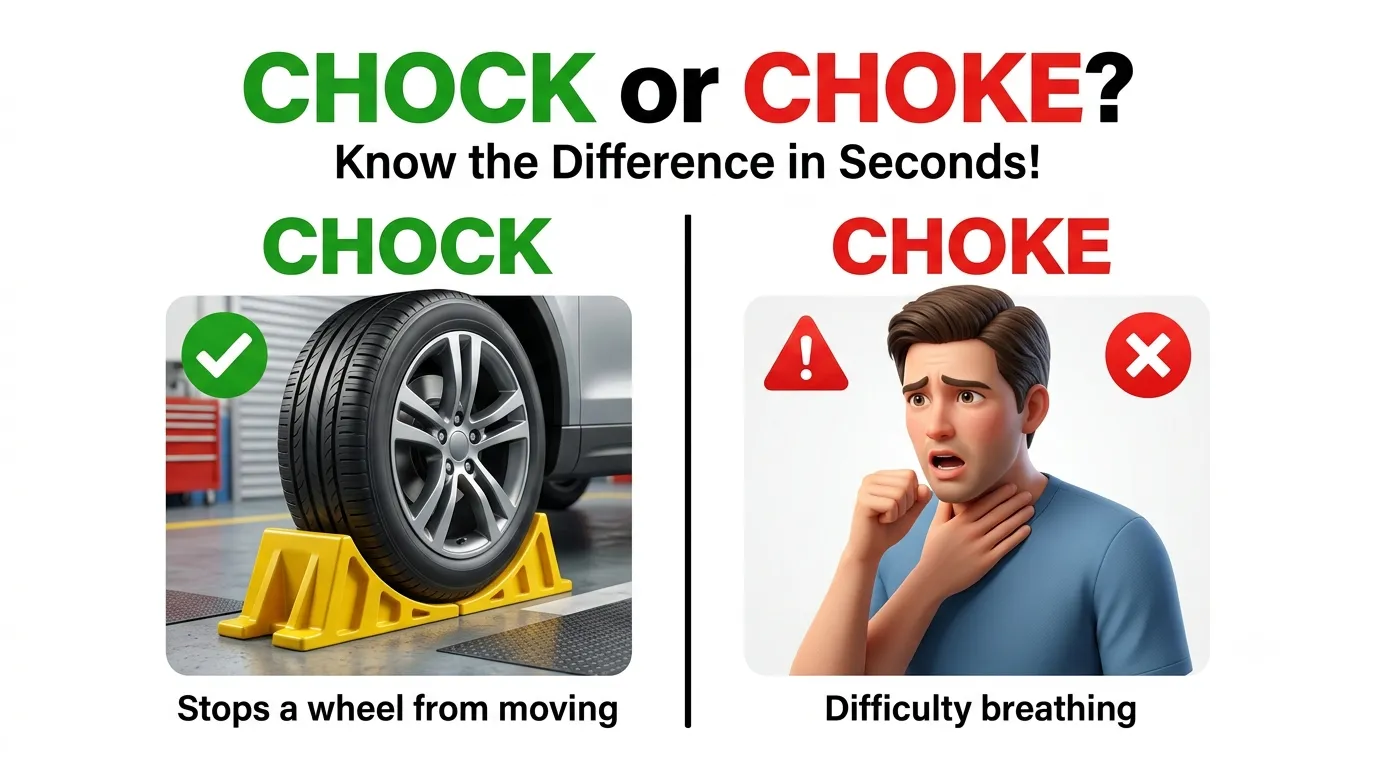
Chock and choke are different words with different meanings. Chock means to block or secure something so it cannot move, while choke means to stop breathing, block airflow, or struggle because something is stuck.
Have you ever written “wheel choke” instead of “wheel chock”? I have.
Years ago, while helping a friend load a trailer, I told someone to “put the wheel choke behind the tire.” A mechanic nearby smiled and gently corrected me. He explained that a wheel chock keeps a vehicle from rolling, while choke is something completely different.
That small mistake stayed with me because these two words sound almost the same. Many English learners—and even native speakers—mix them up. Spell check often misses the mistake because both words are real.
The good news is that the difference is simple once you understand it. In this guide, you’ll learn what chock and choke really mean, where they came from, when to use each one, and how to avoid common mistakes. You’ll also see easy examples that you can remember long after you finish reading.
Let’s clear up the confusion once and for all.
Chock or Choke: Quick Answer
Although they sound similar, chock and choke are not interchangeable.
- Chock means to block, wedge, or secure something so it cannot move.
- Choke means to have trouble breathing, block airflow, or stop something from flowing.
Examples
✅ Put a wheel chock behind the tire.
✅ He began to choke on a piece of food.
Notice how the meanings are completely different.
The Origin of Chock and Choke
Understanding where these words came from makes them easier to remember.
Where Did “Chock” Come From?
The word chock has been used for hundreds of years. It comes from old words meaning a block, wedge, or piece of wood placed under an object to stop it from moving.
Today, you often hear it in:
- Construction
- Aviation
- Trucking
- Shipping
- Camping
- Automotive repair
Common phrases include:
- Wheel chock
- Chock the wheels
- Chock block
Its meaning has stayed almost the same over time.
Where Did “Choke” Come From?
The word choke comes from Old English words that meant to suffocate or to stop breathing.
Over time, its meaning expanded.
Now it can describe:
- Difficulty breathing
- Blocking a pipe or drain
- Heavy traffic slowing movement
- Plants growing too thick
- Strong emotions making someone unable to speak
- Engines receiving too much or too little air
Because both words begin with “cho-” and sound alike, people often confuse them.
Chock vs Choke Explained
The easiest way to remember them is to focus on movement versus breathing.
| Term | Meaning | When to Use | Region/Context |
|---|---|---|---|
| Chock | A wedge or block that stops movement | Vehicles, aircraft, machinery | Worldwide |
| Choke | To block breathing or airflow | Health, cooking, engines, emotions | Worldwide |
What Does Chock Mean?
A chock is usually a solid object placed against something to stop it from rolling or sliding.
Examples:
- Put the wheel chock behind the truck.
- The airplane stayed still because workers placed chocks under the tires.
- Always chock the trailer before unloading it.
What Does Choke Mean?
Choke usually relates to breathing or blocking.
Examples:
- Don’t eat too quickly or you might choke.
- Smoke can choke the room.
- Leaves choked the drain.
- Heavy traffic choked the highway.
The word can also describe emotions.
Example:
- She choked up while giving her speech.
Easy Way to Remember
Think about these simple memory tricks.
Chock = Block
Both words end with CK.
- ChoCK
- BloCK
Both involve stopping movement.
Choke = Breathing
When someone chokes, breathing becomes difficult.
Think of:
- choking on food
- choking smoke
- choking emotions
That connection makes it easier to remember.
Which One Should You Use?
The right choice depends on what you’re talking about.
If you’re talking about vehicles
Use chock.
Example:
Place wheel chocks before working underneath the truck.
If you’re talking about breathing
Use choke.
Example:
The child started to choke on candy.
If you’re talking about engines
Usually use choke.
Example:
Pull the choke before starting the lawn mower.
If you’re talking about safety equipment
Use chock.
Examples include:
- Wheel chock
- Aircraft chock
- Trailer chock
- Tire chock
Quick Recommendations
| Audience | Best Choice | Why |
|---|---|---|
| Students | Learn both separately | They have different meanings |
| Drivers | Chock | Used for vehicle safety |
| Mechanics | Chock | Standard industry term |
| Healthcare workers | Choke | Medical meaning |
| General writers | Choose based on meaning | Never swap them |
Common Mistakes with Chock and Choke
These mistakes appear often online.
Mistake 1
❌ Put the wheel choke behind the tire.
✅ Put the wheel chock behind the tire.
Why?
A wheel is secured with a chock, not a choke.
Mistake 2
❌ He began to chock on his food.
✅ He began to choke on his food.
Why?
Breathing problems always use choke.
Mistake 3
❌ The smoke chocked everyone.
✅ The smoke choked everyone.
Why?
Smoke affects breathing.
Mistake 4
❌ Don’t forget the tire chokes.
✅ Don’t forget the tire chocks.
Why?
The safety blocks are called wheel chocks.
Mistake 5
❌ Choke the wheels before parking.
✅ Chock the wheels before parking.
Why?
You chock wheels to stop movement.
Quick Memory Trick
Ask yourself one simple question:
Is something being stopped from moving?
- Yes → Chock
Is breathing, airflow, or flow being blocked?
- Yes → Choke
That one question solves almost every situation.
Chock or Choke in Real World Examples
Seeing these words in everyday writing makes the difference much easier to remember.
Professional Email
Subject: Safety Reminder for Loading Trucks
Before unloading the trailer, please place wheel chocks behind both rear tires. This will prevent the vehicle from rolling and improve workplace safety.
Here, chocks are safety tools that stop movement.
News Headline
Driver Begins to Choke After Swallowing Small Toy Part
In this headline, choke refers to difficulty breathing.
Social Media Post
Always carry wheel chocks when towing a trailer. They are small, cheap, and can help prevent serious accidents.
Formal Report
The inspection found that employees failed to use wheel chocks while parking heavy equipment on the loading ramp.
Everyday Conversation
Correct
- Please chock the wheels before changing the tire.
- I almost choked on my drink because I laughed so hard.
- Thick smoke began to choke the room.
- The pilot waited until the aircraft was safely chocked.
Incorrect
- Please choke the wheels.
- He chocked on his sandwich.
Chock or Choke: Data, Trends & Usage
Many people search for “chock or choke” because the words sound almost identical. Search engines also show that users want to know which spelling fits phrases like wheel chock and wheel choke.
Who Searches for This Topic?
The topic is popular among:
- English learners
- Students
- Drivers
- Mechanics
- Truck drivers
- Construction workers
- Technical writers
- Safety trainers
Search Intent
Primary Intent: Informational
People usually want to know:
- Which spelling is correct?
- What does each word mean?
- Can they be used interchangeably?
- Why do they sound the same?
- Which one should I use in writing?
Regions Where It Is Commonly Searched
Interest comes from English-speaking countries, including:
- United States
- United Kingdom
- Canada
- Australia
- New Zealand
Because both words are standard English, the meanings stay the same across regions.
Why This Matters Today
More people are learning English online than ever before. At the same time, industries like transportation, aviation, and construction use the word chock every day. Knowing the correct word helps you write more clearly, avoid misunderstandings, and sound more confident in both casual and professional communication.
Chock vs Choke Comparison Table
| Term/Variant | Meaning | Region/Context | Best Used When |
|---|---|---|---|
| Chock | A wedge or block that prevents movement | Worldwide | Talking about wheels, aircraft, trailers, or machinery |
| Choke | To block breathing, airflow, or flow | Worldwide | Talking about breathing, engines, smoke, emotions, or blocked passages |
Quick Difference Table
| Feature | Chock | Choke |
|---|---|---|
| Part of Speech | Noun & Verb | Noun & Verb |
| Main Meaning | Stops movement | Blocks breathing or flow |
| Used With | Wheels, trailers, aircraft | Food, smoke, engines, emotions |
| Safety Equipment | ✔ Yes | ✘ No |
| Medical Meaning | ✘ No | ✔ Yes |
| Can They Replace Each Other? | No | No |
Frequently Asked Questions
Q1: What does “chock” mean?
A: Chock is a block or wedge used to stop something from moving. It is commonly used with vehicles, trailers, aircraft, and heavy machinery to improve safety.
Q2: What does “choke” mean?
A: Choke means to have trouble breathing because something blocks your airway. It can also mean blocking airflow, water flow, traffic, or even becoming unable to speak because of strong emotions.
Q3: What is the difference between chock and choke?
A: The difference is simple. Chock stops movement, while choke blocks breathing or flow. Even though they sound alike, they have completely different meanings.
Q4: Is “wheel choke” correct?
A: No. The correct term is wheel chock. A wheel chock is a safety device placed against a tire to keep a vehicle from rolling.
Q5: Can “chock” and “choke” be used interchangeably?
A: No. They are separate words with different meanings. Replacing one with the other creates a spelling mistake and changes the meaning of your sentence.
Q6: Is “chock” acceptable in formal writing?
A: Yes. Chock is the correct and accepted word in technical manuals, engineering documents, safety reports, transportation guides, and professional writing.
Q7: How can I remember the difference between chock and choke?
A: Remember this simple trick:
- ChoCK = BloCK (both end with CK and stop movement)
- ChoKE = Can’t breathe (related to breathing or blocked airflow)
This memory tip works in almost every situation.
Conclusion
The difference between chock and choke is easier than it first appears. Although they sound similar, they serve completely different purposes. Chock refers to a block or wedge that keeps something from moving, especially vehicles and heavy equipment. Choke, on the other hand, relates to blocked breathing, airflow, engines, or anything that restricts flow.
Whenever you write, think about the meaning first. If you’re talking about safety equipment or stopping movement, choose chock. If you’re describing breathing problems, blocked passages, smoke, emotions, or engine controls, choose choke.
Learning small word differences like this can make your English clearer and more professional. It also helps you avoid common mistakes that spell check may not catch.
Now you know exactly when to use chock and choke. Bookmark this guide so you never confuse them again, and share it with someone who has made the same mistake.
Read more: Tares or Tears: What’s the Difference?

I have been writing about English spelling and word usage for the past five years. My goal is to give readers a clear answer without overwhelming them with complicated rules. At WordsCombo, I focus on making everyday English easier for everyone.