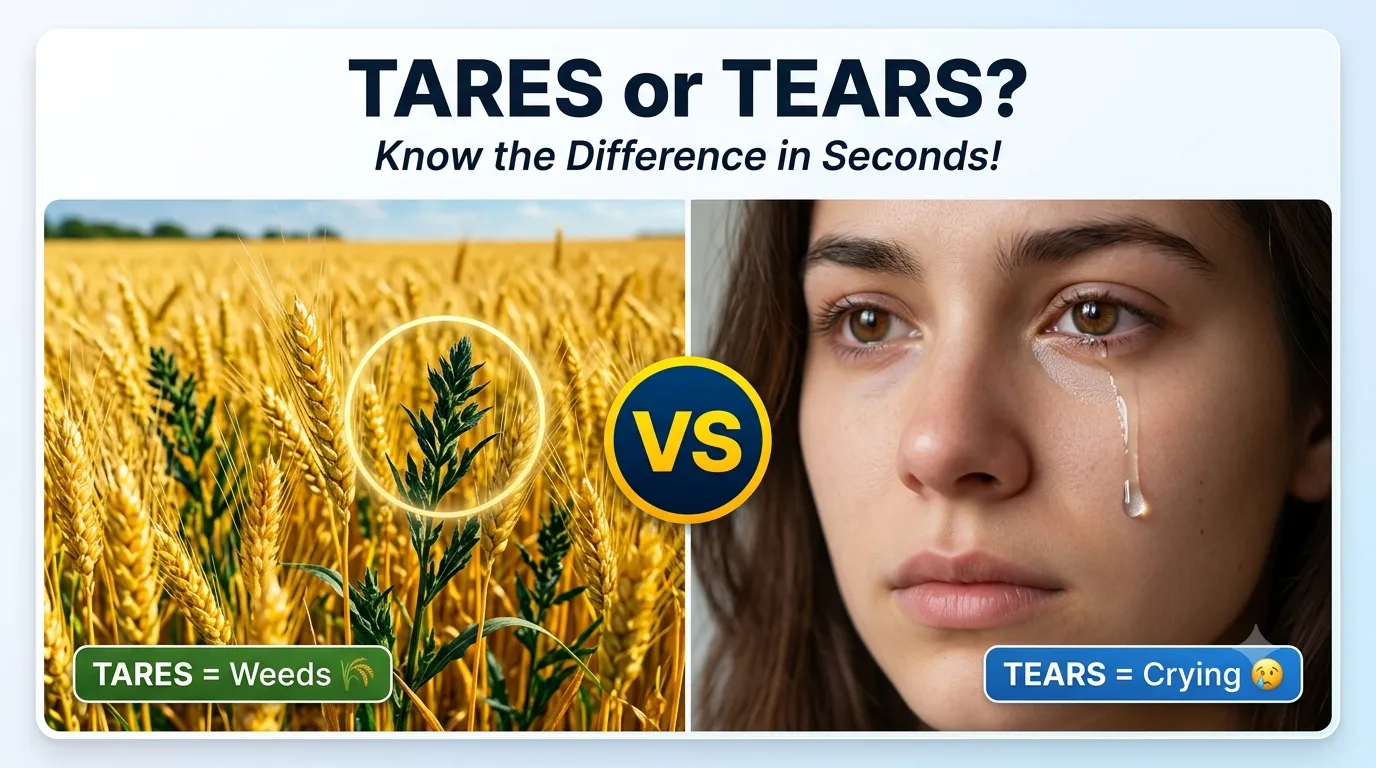
Tares are unwanted weeds that grow among crops, while tears are drops of water from your eyes or the act of ripping something.
A few years ago, I was proofreading a student’s English assignment when I found a funny sentence: “The farmer removed the tears from his wheat field.” At first, I smiled because I imagined a field full of crying plants. Of course, the student meant tares, not tears.
This is a common mistake. These words are close in spelling, but their meanings are very different. One belongs to farming and old stories. The other is part of everyday English. Because tares is rare, many people assume tears is always the correct choice.
If you have ever paused while writing and wondered which word to use, you are not alone. Students, writers, and even native English speakers sometimes mix them up.
By the end of this guide, you will know exactly what tares and tears mean, when to use each one, and how to avoid this mistake forever. You’ll also see simple examples, easy memory tricks, and practical tips you can use every day.
Tares or Tears: Quick Answer
The difference is simple.
- Tares are harmful weeds that grow among crops such as wheat.
- Tears are drops from your eyes when you cry. The word can also mean to rip or pull something apart.
Simple Examples
✅ The farmer removed the tares before harvesting the wheat.
✅ Happy tears filled her eyes after the surprise.
✅ Be careful not to tear the paper.
Remember: If the sentence is about farming or weeds, use tares. If it is about crying or ripping, use tears.
The Origin and Background of Tares or Tears
Knowing where these words come from makes them much easier to remember.
The Origin of Tares
The word tares has been used in English for hundreds of years. It comes from Old French and Latin words that referred to wild plants growing in fields. Today, tares usually means weeds that grow among grain crops, especially wheat.
The word appears in many older books and in the famous biblical story known as the Parable of the Wheat and the Tares, where weeds grow beside healthy wheat until harvest.
Because modern farming uses different terms today, many people rarely see the word tares outside religious texts, literature, or farming discussions.
The Origin of Tears
The word tears has two different meanings because it comes from two different Old English words.
The first meaning is the liquid that comes from your eyes.
Example:
Tears rolled down her face after hearing the good news.
The second meaning comes from the verb tear, which means to rip something apart.
Example:
He tears the envelope open every morning.
Although they share the same spelling, their pronunciation changes depending on the meaning.
Why People Confuse Them
There are several reasons why these words cause confusion.
- They look almost identical.
- Tares is uncommon in modern English.
- Most people use tears every day.
- Spell-checkers often suggest tears because it is far more common.
- Many learners have never heard the word tares before.
As a result, people often replace tares with tears without noticing the mistake.
Tares or Tears Explained: Key Differences
Although these words differ by only one letter, they belong to completely different topics.
| Term | Meaning | When to Use | Region/Context |
|---|---|---|---|
| Tares | Harmful weeds growing among crops | Farming, agriculture, biblical stories | Formal, historical, agricultural |
| Tears | Drops from the eyes caused by emotion | Daily conversation and writing | Worldwide English |
| Tear (verb) | To rip or split something | Everyday writing and speech | Worldwide English |
Meaning of Tares
Tares refers to unwanted plants that grow in fields. They compete with crops for sunlight, water, and nutrients.
Examples:
- Farmers removed the tares before harvesting.
- The field contained wheat mixed with tares.
- Too many tares can reduce crop growth.
Meaning of Tears
The noun tears describes the drops that come from your eyes because of emotions, pain, or even laughter.
Examples:
- She cried joyful tears.
- His eyes filled with tears.
- The movie brought everyone to tears.
Meaning of Tear (Verb)
The verb tear means to rip or pull something into pieces.
Examples:
- Don’t tear the letter.
- She accidentally tore her dress.
- The wind could tear the flag.
Notice that the noun tears and the verb tear are connected, but tares has no relation to either meaning.
Easy Memory Trick
Here’s a simple way to remember them forever.
Tares = Farm
Think of the letter A in tares as standing for Agriculture.
Tares → Agriculture → Weeds
Tears = Eyes
Think of the letter E in tears as standing for Eyes and Emotion.
Tears → Eyes → Crying
This quick trick helps many students remember the difference instantly.
Which Version Should You Use?
The correct choice depends entirely on what you are writing about.
For Students
Use tares only when talking about weeds, farming, or religious stories.
Use tears whenever discussing emotions, crying, or eye drops.
For Writers and Bloggers
Choose tares if your topic involves agriculture, gardening, history, or biblical references.
Choose tears in stories, articles, poems, news reports, or everyday writing.
For English Learners
Remember one simple rule:
- Fields = tares
- Faces = tears
That single idea will prevent most mistakes.
For Global English
There is no British or American spelling difference here.
Both British English and American English use:
- tares for weeds
- tears for crying
- tear for ripping
The meanings stay exactly the same worldwide.
Common Mistakes with Tares or Tears
Many learners make the same errors because they focus only on spelling instead of meaning.
Here are the most common mistakes.
| ❌ Mistake | ✅ Correct |
|---|---|
| The farmer removed the tears from the wheat. | The farmer removed the tares from the wheat. |
| The sad movie made me cry tares. | The sad movie made me cry tears. |
| Wheat and tears grew together. | Wheat and tares grew together. |
| She wiped away her tares. | She wiped away her tears. |
| Don’t tare the paper. | Don’t tear the paper. |
Why These Mistakes Happen
- Tares is much less common than tears.
- Many people have never studied farming vocabulary.
- Spell-check tools often suggest tears first.
- Similar spelling causes readers to choose the familiar word automatically.
A good habit is to ask yourself one quick question:
Is this sentence about crops or about people?
If it’s about crops, choose tares.
If it’s about people, emotions, or ripping something, choose tears or tear.
Tares or Tears in Real-World Examples
Seeing words in real sentences is one of the best ways to remember them. Below are examples from different situations.
Professional Email
Dear Team,
During today’s field inspection, we found several tares growing among the wheat crop. Please arrange weed removal before harvesting begins.
Kind regards,
Farm Manager
Here, tares is correct because the email is about farming.
News Headline
Farmers Battle Tares to Protect This Year’s Wheat Harvest
This headline uses tares because it refers to unwanted weeds affecting crops.
Social Media Post
I couldn’t stop my tears after watching that beautiful graduation speech. ❤️
Here, tears means drops from the eyes caused by emotion.
Formal Report
The inspection found a significant number of tares growing throughout the northern wheat field. Early removal is recommended to protect crop quality.
Again, tares is the correct choice because the report discusses agriculture.
Everyday Conversation
Friend 1: Why are your eyes red?
Friend 2: I was laughing so hard that tears came out.
Story Example
As the little girl hugged her grandfather, happy tears rolled down both of their faces.
Biblical Context
The farmer allowed the wheat and the tares to grow together until harvest.
This is one of the most well-known historical uses of the word.
Tares or Tears: Data, Trends & Usage
Although these words look similar, people search for them for very different reasons.
| Topic | Insight |
|---|---|
| Most searched word | Tears is searched far more often because it is used in everyday English. |
| Less common word | Tares appears mostly in farming, literature, and biblical discussions. |
| Search Intent | Mainly informational. People want to know the difference and correct usage. |
| Popular Audience | Students, English learners, writers, teachers, and Bible readers. |
| Regions | Interest comes from English-speaking countries such as the United States, the United Kingdom, Canada, Australia, and many ESL learners worldwide. |
Why This Matters Today
Online writing has made spelling mistakes more visible than ever. Because tares is uncommon, many writers accidentally replace it with tears. Knowing the difference helps you write more clearly, avoid embarrassing mistakes, and improve your English vocabulary.
Comparison Table
| Term/Variant | Meaning | Region/Context | Best Used When |
|---|---|---|---|
| Tares | Weeds growing among crops | Agriculture, history, biblical writing | Talking about fields or farming |
| Tears | Drops from the eyes | Everyday English | Talking about emotions or crying |
| Tear (verb) | To rip or split | Everyday English | Talking about damaging or opening something |
Frequently Asked Questions (FAQs)
Q: What does “tares” mean?
A: Tares are harmful weeds that grow among crops such as wheat. The word is mostly used in farming, older literature, and biblical passages.
Q: What does “tears” mean?
A: Tears are drops of liquid that come from your eyes when you cry, laugh, or feel strong emotions. It is one of the most common words in everyday English.
Q: How do you use tares correctly?
A: Use tares only when referring to unwanted weeds in a field. It is not used to describe emotions or crying.
Example: The farmer removed the tares before harvest.
Q: Tares vs. tears: what’s the difference?
A: Tares are weeds found in crop fields. Tears are drops from your eyes or the plural form of the noun related to crying. They have different meanings and cannot replace each other.
Q: Is “tares” acceptable in formal writing?
A: Yes. Tares is a correct English word. It is appropriate in agricultural reports, historical writing, academic work, and religious texts.
Q: Which word is correct, tares or tears?
A: Both are correct. The right choice depends on the meaning. Use tares for weeds and tears for crying.
Q: Where does the word “tares” come from?
A: The word comes from older French and Latin roots referring to weeds that grow among grain crops. It has been part of English for many centuries.
Q: Can “tares” be used in everyday conversation?
A: It can, but it is uncommon. Most people only use tares when discussing farming, gardening, or the Bible.
Conclusion
At first glance, tares and tears seem almost identical. However, their meanings are completely different. Tares are unwanted weeds that grow among crops, while tears are drops from your eyes or relate to the verb tear, meaning to rip something.
A simple way to remember them is this: tares belong in fields, and tears belong on faces. That one sentence can save you from making this common spelling mistake.
Whenever you write, stop for a moment and think about the context. Are you talking about farming? Choose tares. Are you talking about emotions or crying? Choose tears. If you mean ripping paper or fabric, use the verb tear.
Small spelling choices can make a big difference in how clear and professional your writing sounds. Now you know exactly how to use tares and tears with confidence.
Bookmark this guide so you never second-guess “tares or tears” again, and share it with anyone who wants to improve their English writing.
Read more: Knead or Kneed: Easy Guide to Correct Usage

I have been writing about English spelling and word usage for the past five years. My goal is to give readers a clear answer without overwhelming them with complicated rules. At WordsCombo, I focus on making everyday English easier for everyone.