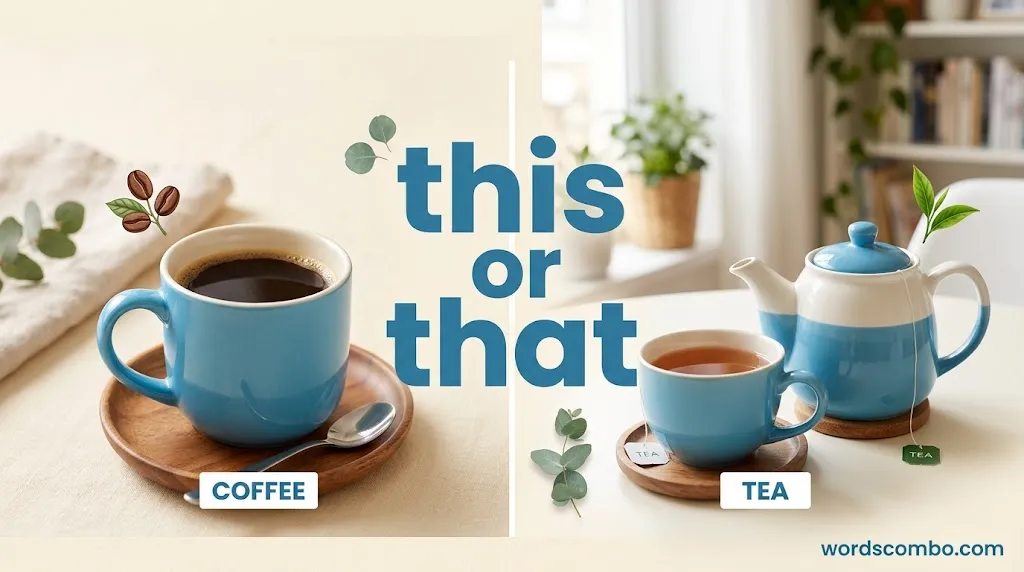
This or that means choosing between two options, ideas, or things, usually to show a preference or make a simple choice.
The cursor was blinking at the end of a short team message when I stopped before sending it. I had written, “Would you prefer this or that?” It looked simple, but the sentence made me pause. Was I asking about two clear choices, or did the wording sound too vague?
That small pause is exactly why this or that can be confusing. The phrase is easy to understand in a game or casual chat, but its use changes a little when it appears in a question, poll, classroom activity, or formal writing.
You may see it in social media posts, team icebreakers, quizzes, and everyday conversations. You may also wonder whether this or that is the same as “either or” or “would you rather.”
The good news is that the basic idea is simple. Once you understand how the phrase works and when to use it, you can create clear questions, make quick choices, and avoid awkward wording.
This or That: Quick Answer
This or that presents two choices and asks someone to select one.
For example:
- Coffee or tea?
- Would you choose this or that?
- Morning or night?
The phrase is especially common in games and conversation prompts. A person may ask, “This or that: beach or mountains?” The other person simply chooses one option.
In normal writing, this or that can also point to two things already mentioned. The exact meaning depends on the sentence.
The Background of This or That
The words this and that are basic English demonstratives. They help speakers point to people, things, ideas, or situations.
This usually points to something close, current, or being discussed now. That often points to something farther away, earlier, or less immediate.
When the two words appear together as this or that, they can create a simple contrast. The speaker is presenting one option against another.
Over time, the phrase became especially useful for choice-based questions. It works because the listener does not need to create an answer from scratch. They only need to select between two options.
That makes it useful in many settings. You can use it with friends, students, coworkers, customers, or an online audience.
This or That Explained: Meaning and Uses
The meaning of this or that depends on how you use it.
| Term | Meaning | When to Use | Region/Context |
| This or that | A choice between two options | Games, polls, chats, comparisons | General English |
| Either or | A choice between alternatives | Clear choices in sentences | Formal and informal |
| Would you rather | A choice between two actions or situations | Hypothetical questions | Casual conversation |
| This | Points to something close or current | Referring to one thing or idea | General English |
| That | Points to something farther away or less immediate | Referring to another thing or idea | General English |
This or That as a Choice
This is the most common modern use.
Example:
“Pizza or burgers? This or that?”
The speaker wants one choice.
This or That in a Normal Sentence
The phrase can also refer to two possible things.
Example:
“I cannot decide between this or that design.”
Here, this and that point to two choices.
For clearer formal writing, however, it is often better to name the choices directly.
Better:
“I cannot decide between the blue design and the green design.”
That removes any doubt about what the two choices are.
Which Version Should You Use?
The best choice depends on what you are trying to do.
For beginners and students
Use this or that when you want to present two simple choices.
For example:
This or that: cats or dogs?
It is short and easy to understand.
For social media
This or that works well for quick polls and interactive posts.
Examples include:
- Coffee or tea?
- Summer or winter?
- Books or movies?
The short format makes the question easy to answer.
For classrooms
Teachers can use this or that questions as warm-ups, speaking activities, or quick opinion prompts.
For example:
Reading or writing? Pick one and explain why.
This gives students an easy starting point for speaking.
For professional writing
Use the phrase carefully. It is natural in an informal message, but a formal document often benefits from naming the choices clearly.
Instead of:
“Please select this or that.”
Try:
“Please select either Option A or Option B.”
For global and neutral English
This or that is widely understandable. Still, the clearest option is usually the one that names the two choices directly.
Common Mistakes with This or That
1. Making both choices unclear
Mistake:
“Do you want this or that?”
Better:
“Do you want the blue folder or the red folder?”
The first sentence works only when both people already know what this and that mean.
2. Using too many choices
Mistake:
“This or that or something else?”
That weakens the simple two-choice format.
Better:
“Coffee or tea?”
If you want several choices, make it a multiple-choice question instead.
3. Confusing it with “would you rather”
Mistake:
Treating every two-choice question as a this or that question.
Better:
Use this or that for direct choices and would you rather when comparing actions, situations, or hypothetical experiences.
4. Making one option obviously better
A good choice question should make both options worth considering.
Weak:
“Free vacation or staying home?”
Better:
“Beach vacation or mountain getaway?”
The second example creates a more balanced choice.
5. Using vague words in formal writing
Mistake:
“Please approve this or that.”
The reader may not know what the words refer to.
Better:
“Please approve the revised budget or the original budget.”
Clear nouns make the message easier to follow.
This or That in Real-World Examples
Professional Email
Could you let me know which you prefer, the morning meeting or the afternoon meeting?
In a casual workplace message, you could also write:
This or that: morning meeting or afternoon meeting?
The first version is more professional and specific.
News Headline or Article
A headline might use the format to create a quick contrast:
This or That: Remote Work or Office Work?
The format makes the topic feel direct and easy to scan.
Social Media Post
This or that? Coffee or tea? ☕
This is a natural setting for the phrase. Readers immediately understand that they should choose one option.
Formal Document
Please select either the standard plan or the premium plan.
Here, either/or is clearer and more formal than this or that.
This or That: Data, Trends & Usage
The strongest search intent around this or that is informational and entertainment-focused. People commonly look for question ideas, game prompts, conversation starters, classroom activities, polls, and ways to use the format with friends or groups.
The phrase also works across several audiences:
- Students use it for classroom speaking activities.
- Teachers use it for warm-ups and group participation.
- Friends and families use it for games and conversation.
- Work teams use it for icebreakers.
- Content creators use it for polls and social engagement.
One reason the format remains useful is its low effort. A person can answer a two-choice question in seconds.
That simplicity also makes the format easy to adapt. You can make the choices funny, serious, personal, practical, or completely random.
This or That: Comparison at a Glance
| Term/Variant | Meaning | Region/Context | Best Used When |
| This or that | Choose between two options | General, casual | Games, polls, conversations |
| Either/or | One alternative or another | Formal and informal | Clear choices and decisions |
| Would you rather | Choose between two situations | Mostly casual | Hypothetical questions |
| This | Points to a close or current thing | General English | Referring to one option |
| That | Points to a distant or less immediate thing | General English | Referring to another option |
The key difference is simple: this or that often names a choice format, while either/or is a broader grammatical structure.
For example:
This or that: coffee or tea?
is a quick choice game.
But:
You can choose either coffee or tea.
is a normal sentence using either/or.
FAQs About This or That
What does “this or that” mean?
This or that usually means choosing between two options. It is common in questions, games, polls, conversations, and social media posts.
How do you use “this or that” correctly?
Give two clear options and ask the person to choose one. For example, “This or that: morning or night?” is a simple and natural use.
Is “this or that” the same as “either or”?
They are closely related, but they are not always interchangeable. This or that often describes a choice-based prompt, while either/or is commonly used inside a complete sentence to show alternatives.
Is “this or that” formal English?
Yes, the phrase itself is standard English, but the choice format is usually more casual. In formal writing, it is often clearer to name the two options or use either/or.
Which is correct, “this or that” or “either or”?
Both can be correct. Choose this or that for a simple choice prompt, especially in casual settings. Use either/or when you are building a sentence around two alternatives.
Where does “this or that” come from?
The phrase is built from two common English demonstratives, this and that. Their basic job is to point to different things or ideas, and together they can create a contrast between two choices.
Can “this or that” be used in a classroom?
Yes. It works well for quick speaking practice, warm-ups, opinion questions, and group activities. A teacher can ask students to choose one option and then explain their choice.
Is “this or that” the same as “would you rather”?
Not exactly. This or that usually compares two direct choices, while would you rather often compares two actions, experiences, or hypothetical situations.
Final Thoughts on This or That
This or that is a simple phrase with a surprisingly wide range of uses. It can help you create a quick game, start a conversation, run a poll, or present two choices.
The main rule is easy: give people two clear options and make the choice easy to understand.
For casual conversations, social media, games, and classroom activities, this or that is a natural choice. It keeps questions short and encourages quick responses.
For formal writing, be more specific. Instead of asking someone to choose “this or that,” name the actual options when there is any chance of confusion.
Remember the basic difference: this or that is a choice format, either/or is a grammatical way to show alternatives, and would you rather usually presents a choice between situations or actions.
Now you know how this or that works. Use it the next time you need a quick, clear way to make a choice or start a conversation.
Curious about similar word choices? Explore Gasses or Gases: When to Use Each.

I have been writing about English spelling and word usage for the past five years. My goal is to give readers a clear answer without overwhelming them with complicated rules. At WordsCombo, I focus on making everyday English easier for everyone.


1 thought on “This or That: Easy Guide to Meaning and Use”