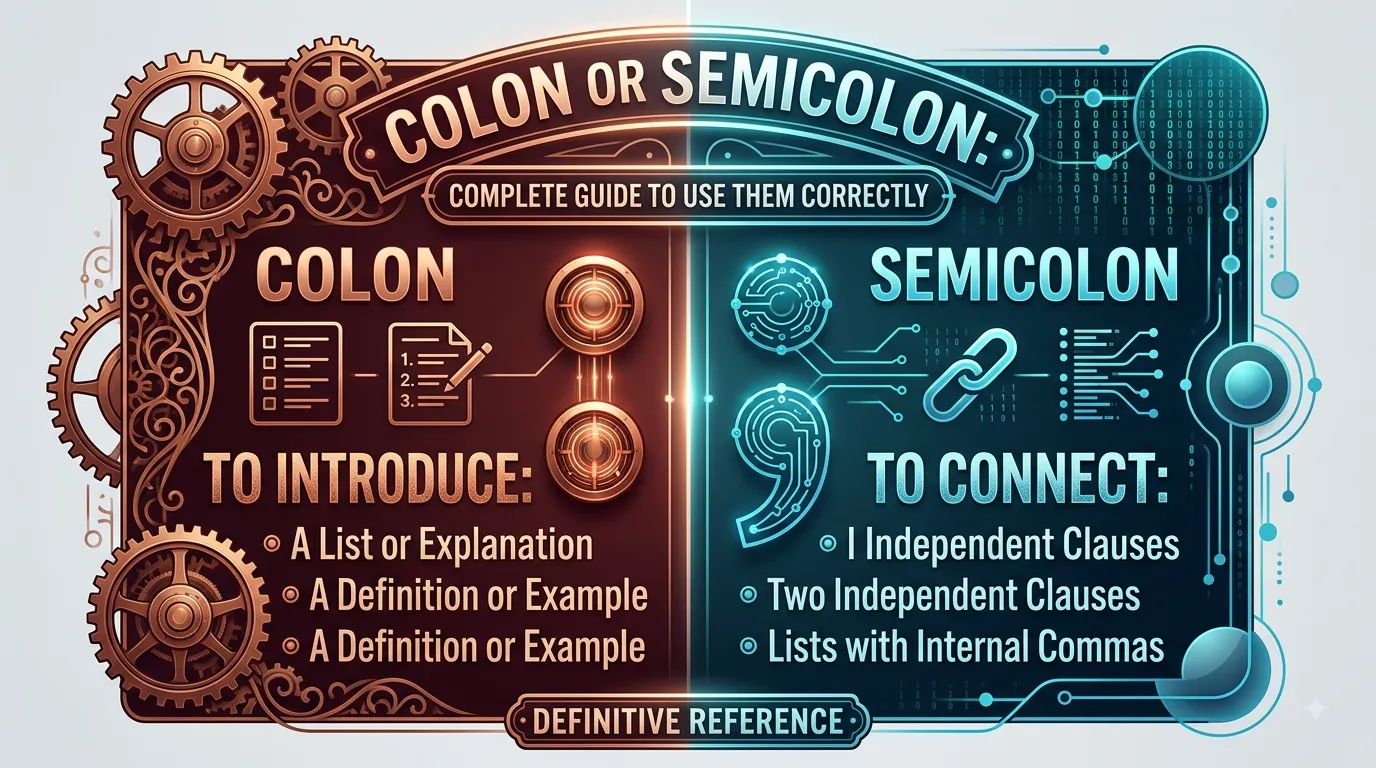
A colon introduces or explains something that follows, while a semicolon connects two closely related independent sentences. Use a colon to add information and a semicolon to join ideas.
Have you ever stopped while writing an email, essay, or report and wondered, “Should I use a colon or a semicolon here?” You are not alone. Even experienced writers sometimes pause when choosing between these two punctuation marks.
I remember reviewing a student’s assignment where every long sentence had either a comma, colon, or semicolon used randomly. The ideas were good, but the punctuation made the writing harder to understand. Once we fixed the punctuation, the entire piece became clearer and more professional.
The confusion happens because both marks look similar and both can connect ideas. However, they have different jobs. A colon points forward and tells the reader, “Something important is coming.” A semicolon works like a bridge that connects two complete but related thoughts.
In this guide, you will learn the real difference between a colon and semicolon, when to use each one, common mistakes to avoid, and practical examples that will help you write with confidence.
Colon or Semicolon : Quick Answer
A colon (:) is used before an explanation, list, example, quotation, or important detail.
A semicolon (;) is used to connect two complete sentences that are closely related.
Colon example:
She had one goal: to become a successful writer.
The colon introduces the explanation of the goal.
Semicolon example:
She wanted to become a writer; she practiced every day.
The semicolon connects two related sentences.
A simple way to remember:
- Colon = “Here comes more information.”
- Semicolon = “These two complete ideas belong together.”
The Origin and Background of Colon and Semicolon
Punctuation marks have changed over centuries as writing systems developed. Early writers often used spaces or simple marks to separate ideas. As books became more common, writers needed clearer ways to organize complex thoughts.
The colon comes from the Greek word “kōlon,” meaning a part or section of a sentence. Ancient Greek writers used it to separate parts of a larger idea.
The semicolon appeared much later. It was introduced in the 15th century by Italian printer Aldus Manutius. The symbol combined the comma and the period to create a mark that was stronger than a comma but weaker than a full stop.
Over time:
- The colon became a tool for introducing information.
- The semicolon became a tool for linking related thoughts.
The reason people confuse them is simple: both marks create a pause. The difference is the purpose of that pause.
A colon says:
“Pay attention. The explanation is coming.”
A semicolon says:
“These two ideas are connected.”
Colon vs Semicolon Explained : Key Differences
Understanding the basic function of each mark makes punctuation much easier.
| Term | Meaning | When to Use | Region/Context |
|---|---|---|---|
| Colon (:) | Introduces information that explains or expands an idea | Before lists, examples, explanations, and quotations | Used widely in English writing |
| Semicolon (;) | Connects two related complete sentences | Between independent clauses with a close relationship | Common in formal writing |
When to Use a Colon
Use a colon when the first part of the sentence creates anticipation.
1. Introducing a List
Example:
You need three things for the trip: a passport, money, and a phone.
The words after the colon explain the “three things.”
2. Introducing an Explanation
Example:
There was one reason for his success: hard work.
The second part explains the first idea.
3. Introducing a Quote
Example:
The teacher gave one important message: “Never stop learning.”
The colon prepares the reader for the quotation.
When to Use a Semicolon
A semicolon joins two complete thoughts.
Example:
The weather was cold; we still went hiking.
Both sides can stand alone:
- The weather was cold.
- We still went hiking.
The semicolon shows a strong connection between them.
Other examples:
She studied for months; she wanted to pass the exam.
The company improved its service; customer satisfaction increased.
Which Version Should You Use?
The choice depends on what you want your sentence to do.
For Students and Beginners → Use Colons More Often
If you are learning English writing, colons are usually easier because their purpose is clear.
Use a colon when you want to:
- Explain something
- Add examples
- Introduce a list
- Highlight information
Example:
Remember this rule: always check your spelling.
For Academic and Professional Writers → Use Semicolons Carefully
Semicolons can make writing smoother and more sophisticated.
Use them when:
- Two sentences are strongly connected
- You want to avoid short repetitive sentences
- You are writing reports, essays, or articles
Example:
The project was successful; the team achieved all targets.
For Global English Writing → Keep It Simple
English readers worldwide understand both punctuation marks. However, simple writing is often clearer.
If you are unsure:
- Use a period instead of a semicolon.
- Use a colon only when introducing something.
Clear writing is always better than complicated writing.
Common Mistakes with Colon and Semicolon
Many writers misuse these punctuation marks because they focus on appearance instead of function.
| Mistake | Correction | Why It Happens |
|---|---|---|
| I bought: apples and oranges | I bought apples and oranges | A colon should follow a complete thought |
| She likes books; movies; and music | She likes books, movies, and music | Semicolons are not used like commas |
| The reason is; he was tired | The reason is: he was tired | An explanation needs a colon |
| I studied hard; because I had an exam | I studied hard because I had an exam | A semicolon cannot separate incomplete ideas |
Mistake 1: Using a Colon After “Is” Without a Complete Thought
Wrong:
My favorite foods are: pizza and pasta.
Better:
My favorite foods are pizza and pasta.
Or:
I have two favorite foods: pizza and pasta.
Mistake 2: Using a Semicolon Like a Strong Comma
Wrong:
My hobbies include reading; writing; and painting.
Correct:
My hobbies include reading, writing, and painting.
Mistake 3: Joining Unrelated Ideas
Wrong:
I love coffee; my brother plays football.
The ideas are not closely connected.
Better:
I love coffee; my brother loves tea.
Colon and Semicolon in Real-World Examples
Professional Email
Colon Example:
Dear Manager:
I would like to discuss three topics: project progress, deadlines, and future goals.
Semicolon Example:
The report is complete; I have attached it for your review.
News Headline or Article
Colon Example:
New Study Reveals One Major Finding: Exercise Improves Sleep Quality
The colon introduces the main discovery.
Semicolon Example:
Markets Rise After Investors Gain Confidence; Experts Predict More Growth
The semicolon connects two related ideas.
Social Media Post
Colon Example:
My productivity secret: planning tomorrow before going to bed.
Semicolon Example:
I wanted to quit; I decided to try one more time.
Formal Report
Colon Example:
The research focused on three areas: customer behavior, market trends, and product quality.
Semicolon Example:
The results were positive; the company exceeded its annual goals.
Colon or Semicolon : Data, Trends and Usage
Search interest around colon vs semicolon mainly comes from:
- Students learning English grammar
- ESL learners
- Writers and bloggers
- Professionals improving business communication
- Teachers preparing grammar lessons
The topic has strong informational search intent because users usually want a quick answer: “Which punctuation mark should I use?”
The confusion remains popular because digital writing has become faster. People write emails, social posts, reports, and online content daily, but punctuation rules are often forgotten.
Correct punctuation matters because small marks can change how readers understand your message.
A colon can create clarity.
A semicolon can create flow.
Knowing the difference improves your writing quality.
Standalone Comparison Table: Colon vs Semicolon
| Term/Variant | Meaning | Region/Context | Best Used When |
|---|---|---|---|
| Colon (:) | Introduces additional information | Formal and informal English | Adding lists, explanations, examples, or quotes |
| Semicolon (;) | Connects related complete sentences | Mostly formal writing | Linking two connected independent clauses |
| Comma (,) | Creates a short pause | Everyday writing | Separating items or smaller ideas |
| Period (.) | Ends a complete thought | All writing styles | Creating clear sentence breaks |
Frequently Asked Questions About Colon or Semicolon
Q: What does colon or semicolon mean?
A: A colon introduces information that explains or expands an idea. A semicolon connects two related complete sentences.
Q: How do you use a colon correctly?
A: Use a colon after a complete sentence when you want to introduce a list, explanation, example, or quotation. The information after the colon should explain what comes before it.
Q: Colon vs semicolon — what is the difference?
A: A colon points toward new information, while a semicolon connects two related thoughts. A colon introduces; a semicolon joins.
Q: Is a semicolon acceptable in formal writing?
A: Yes. Semicolons are common in academic papers, reports, and professional writing. However, they should be used correctly and not overused.
Q: Which is correct: colon or semicolon?
A: Neither is always “more correct.” The right choice depends on your sentence. Use a colon for introduction and a semicolon for connection.
Q: Where does the semicolon come from?
A: The semicolon was created during the Renaissance period by Italian printer Aldus Manutius. It was designed to create a pause between a comma and a period.
Q: Can I use a colon in an email?
A: Yes. Colons are commonly used in professional emails, especially before lists, explanations, and important points.
Conclusion
Understanding the difference between a colon or semicolon can instantly improve your writing. These two punctuation marks may look similar, but they serve different purposes.
Remember these simple rules:
- A colon introduces something new.
- A semicolon connects two related complete ideas.
- Use punctuation to make your message clearer, not more complicated.
If you are writing a report, email, article, or essay, choosing the right punctuation helps your readers follow your ideas easily.
You do not need to memorize complicated grammar rules. Just understand the job of each mark.
A colon opens the door for more information. A semicolon builds a bridge between ideas.
Now you know exactly how to use a colon and semicolon, try these rules in your next piece of writing and make your sentences stronger.
Read more: Me or I: Complete Guide to Using Them Correctly

I have been writing about English spelling and word usage for the past five years. My goal is to give readers a clear answer without overwhelming them with complicated rules. At WordsCombo, I focus on making everyday English easier for everyone.