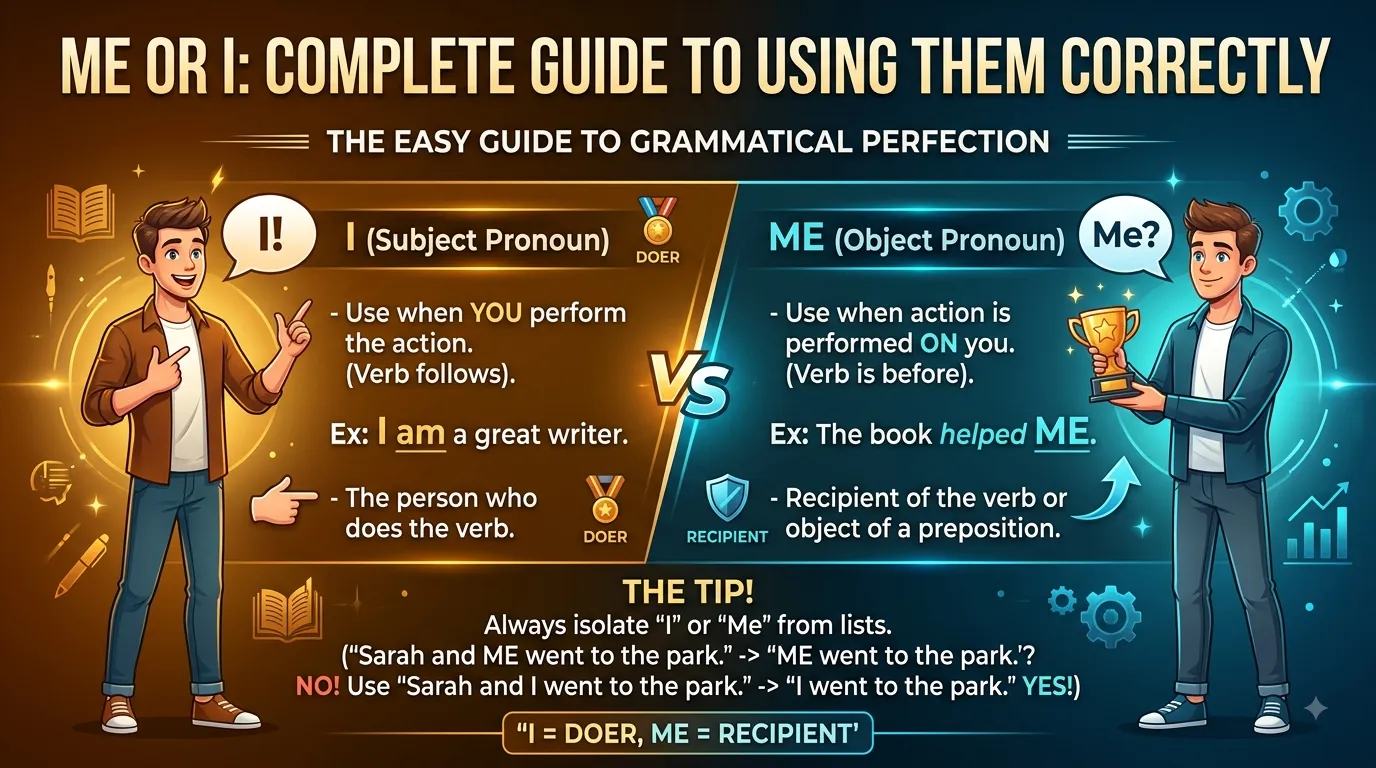
“Me” and “I” are both first-person pronouns, but “I” is used as the subject of a sentence, while “me” is used as the object. Use “I” when someone does the action and “me” when the action happens to you.
Have you ever written a sentence like “My friend and me went to the market” and wondered if it sounds right? You are not alone. Even many fluent English speakers pause when choosing between “me” and “I.”
When I started teaching English, I noticed that learners often avoided using these words because they were afraid of making mistakes. Some people believed that “I” always sounds more correct because it feels more formal. Others used “me” everywhere because it sounded natural in daily conversations.
The truth is much simpler. The choice depends on one small question:
Is the person doing the action, or receiving the action?
Understanding this difference can improve your grammar, writing, emails, conversations, and professional communication.
Me or I : Quick Answer
“I” is a subject pronoun. It performs an action.
Example:
- I wrote an article.
- I completed the project.
“Me” is an object pronoun. It receives an action or comes after a preposition.
Example:
- Sarah helped me.
- The manager spoke with me.
A simple way to remember:
I = I do something.
Me = something is done to me.
The Origin and Background of Me and I
The words “I” and “me” come from Old English, one of the earliest forms of the English language.
The word “I” developed from the Old English word “ic,” which was used by speakers to refer to themselves as the person performing an action.
The word “me” came from the Old English word “mē,” which was used when someone was affected by an action or when the person was the receiver.
Over hundreds of years, English changed. Many word endings disappeared, but the difference between subject and object pronouns remained.
This is why modern English still keeps two separate forms:
- I → subject form
- Me → object form
The confusion exists because people often focus on what sounds polite instead of looking at the grammar role of the word.
Me vs I Explained : Key Differences
The main difference between me and I is their position and function in a sentence.
| Term | Meaning | When to Use | Region/Context |
|---|---|---|---|
| I | First-person subject pronoun | When you perform an action | All English varieties |
| Me | First-person object pronoun | When you receive an action | All English varieties |
Using “I” as the Subject
Use I when you are the person doing something.
Examples:
- I started a new job.
- I enjoy reading books.
- I finished my homework.
Here, “I” is the person responsible for the action.
Using “Me” as the Object
Use me when something happens to you.
Examples:
- My teacher praised me.
- She invited me to dinner.
- The company hired me.
Here, another person performs the action.
The Easy Subject-Object Test
Remove the other person from the sentence and check what sounds correct.
Example:
❌ John and me went shopping.
Remove John:
❌ Me went shopping.
That sounds wrong.
Correct:
✅ John and I went shopping.
Now:
✅ The manager called John and me.
Remove John:
✅ The manager called me.
That works.
Which Version Should You Use?
Choosing between me and I depends on the situation.
For Students and English Learners
Use this simple rule:
- Use I before verbs.
- Use me after verbs and prepositions.
Examples:
✅ I study English.
✅ My teacher teaches me English.
This basic rule will solve most everyday mistakes.
For Professional Writing
In emails, reports, and business communication, correct pronoun use creates a stronger impression.
Incorrect:
❌ The director and me prepared the presentation.
Correct:
✅ The director and I prepared the presentation.
Incorrect:
❌ Please contact Sarah or I for more details.
Correct:
✅ Please contact Sarah or me for more details.
For Global English Use
English speakers around the world follow the same grammar rule.
Whether you write American English, British English, or international business English:
Subject = I
Object = me
Common Mistakes with Me and I
Mistake 1: Using “Me” as the Subject
❌ Me and my brother watched a movie.
Why is it wrong?
Because “me” cannot perform the action.
Correct:
✅ My brother and I watched a movie.
Mistake 2: Using “I” After a Preposition
❌ The gift was given to my sister and I.
Why is it wrong?
The word “to” needs an object.
Correct:
✅ The gift was given to my sister and me.
Mistake 3: Thinking “I” Is Always More Formal
Some people believe “I” sounds smarter.
Example:
❌ Between you and I, this plan may fail.
Correct:
✅ Between you and me, this plan may fail.
After “between,” always use me.
Mistake 4: Forgetting to Remove the Other Person
People often say:
❌ My friend and me attended the meeting.
A quick test:
“My friend attended the meeting.”
“Me attended the meeting.”
The second sentence is wrong.
So the correct choice is:
✅ My friend and I attended the meeting.
Me or I in Real-World Examples
Professional Email
Incorrect:
❌ Please send the report to John and I.
Correct:
✅ Please send the report to John and me.
News Headline
Example:
“I Completed My First Marathon After Six Months of Training.”
“I” works because the person is performing the action.
Social Media Post
Example:
✅ “My team and I just launched our new website!”
The writer and team are doing the action.
Formal Report
Example:
✅ “The research team and I analyzed the survey results.”
“I” is correct because the writer is part of the group performing the analysis.
Me or I : Data, Trends & Usage
The confusion between me and I remains one of the most searched English grammar topics online.
People commonly search:
- “Is it me or I?”
- “Should I say my friend and I or my friend and me?”
- “Which is correct: you and me or you and I?”
The reason is simple:
English speakers learn these words naturally through conversation, but grammar rules are not always obvious.
This topic is especially important for:
- English learners
- Students
- Writers
- Job applicants
- Professionals communicating globally
Clear grammar builds confidence and makes your writing look more professional.
Standalone Comparison Table: Me vs I
| Term/Variant | Meaning | Region/Context | Best Used When |
|---|---|---|---|
| I | Subject pronoun | Worldwide English | You perform an action |
| Me | Object pronoun | Worldwide English | You receive an action |
| Myself | Reflexive pronoun | Worldwide English | You refer back to yourself |
Frequently Asked Questions (FAQs)
Q: What does “me or I” mean in English grammar?
A: “Me or I” refers to choosing the correct first-person pronoun. Use I when you are the subject performing an action, and use me when you are the object receiving an action.
Q: How do you know whether to use me or I?
A: Look at the role of the pronoun. If the person does the action, use I. If something happens to the person, use me.
Q: Which is correct: “John and I” or “John and me”?
A: Both can be correct depending on the sentence. Use John and I when they are doing the action: “John and I went home.” Use John and me when they receive the action: “She called John and me.”
Q: Is “me and my friend” grammatically correct?
A: In casual speech, many people say “me and my friend,” but standard English prefers “my friend and I” when they are the subject. Example: “My friend and I visited London.”
Q: Is it correct to say “between you and I”?
A: No. The correct phrase is “between you and me.” The word “between” requires an object pronoun.
Q: Can “I” be used after a verb?
A: Usually, no. After a verb, you normally need an object pronoun like me. Example: “She helped me,” not “She helped I.”
Q: Why do people confuse me and I?
A: Many people think “I” sounds more educated or formal, so they use it incorrectly. The real rule depends on grammar function, not formality.
Conclusion
Understanding me or I does not need complicated grammar rules. The key is simple:
- I performs the action.
- Me receives the action.
- Check whether the pronoun is the subject or object.
Once you understand this small difference, many common grammar mistakes disappear. Your emails become clearer. Your writing sounds more professional. Your conversations become more confident.
Remember, both words are correct. The mistake happens only when they are used in the wrong place.
Keep practicing with real sentences, and choosing between me and I will soon become automatic.
Now you know exactly how to use me and I , try this rule in your next conversation or piece of writing.
Read more: Shall or Will: The Easy Guide to Future English

I have been writing about English spelling and word usage for the past five years. My goal is to give readers a clear answer without overwhelming them with complicated rules. At WordsCombo, I focus on making everyday English easier for everyone.