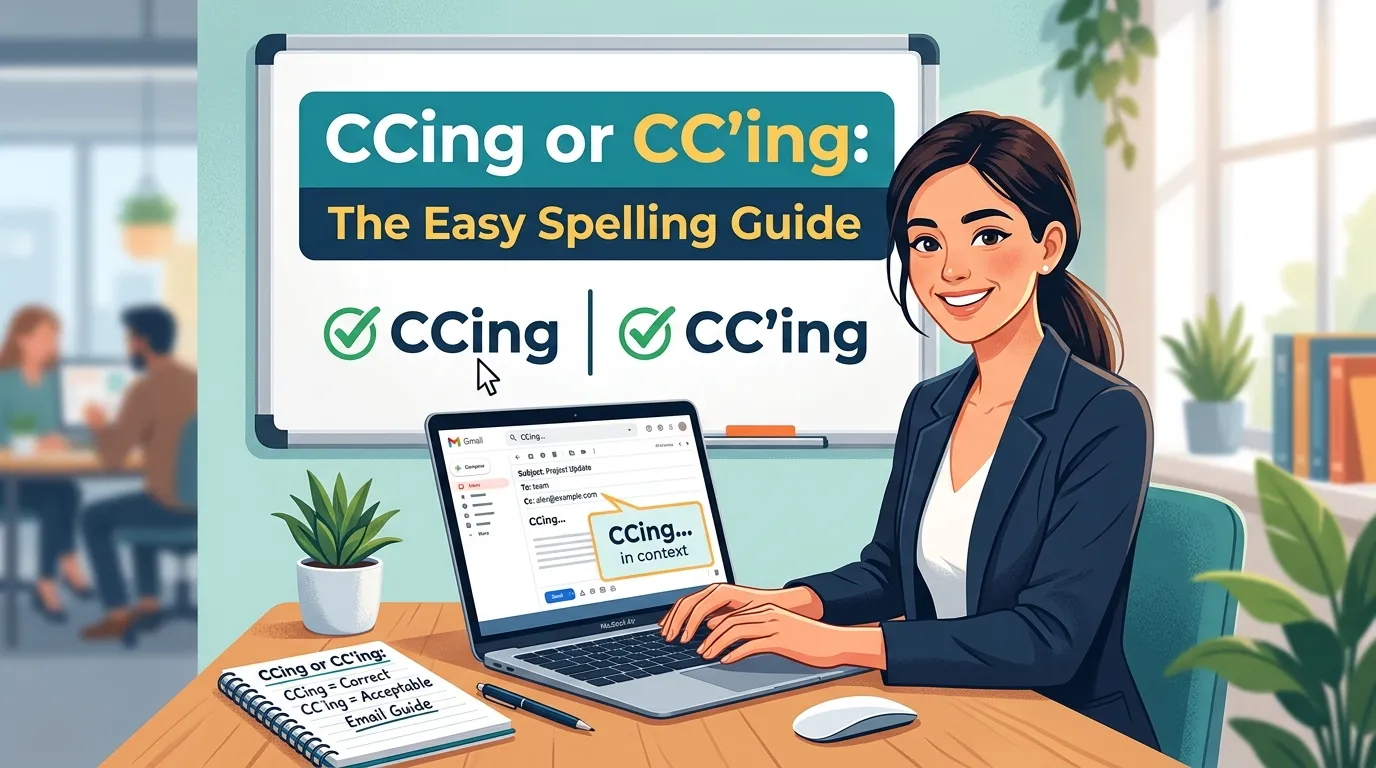
CC’ing is the clearest and most widely accepted spelling when you use cc as a verb. Ccing is also seen, but the apostrophe makes the word easier to read and understand.
Have you ever typed, “I’m ccing you on this email,” and then stopped to wonder if it looked right?
I have seen this small spelling question cause a surprising amount of hesitation in professional writing. The problem is simple: cc is an abbreviation, not a normal word. When you add -ing, the result can look strange.
Should it be ccing?
Should it be cc’ing?
Or should you avoid both and write “sending you a copy”?
The answer matters more than you might think. Email is part of everyday work, school, and business communication. A tiny spelling choice can make a sentence look polished—or slightly awkward.
The good news is that you do not need to overthink it.
CC comes from carbon copy, an old office term that existed long before email. Today, to cc someone means to send that person a copy of an email or message. Merriam-Webster lists the present participle as cc’ing, which supports the apostrophe form.
In this guide, you will learn which form to use, why the apostrophe appears, where CC came from, and how to use it naturally in emails and other writing.
Ccing or CC’ing : Quick Answer
If you need the safest and clearest form, use CC’ing.
For example:
- I’m CC’ing Sarah on this email.
- Thanks for CC’ing me on the report.
- We are CC’ing the manager for visibility.
The word CC works as a verb here. It means to send someone a copy of an email, letter, or memo. Merriam-Webster records cc’d as the past form and cc’ing as the present participle.
You may also see ccing without an apostrophe:
I’m ccing John on the email.
This form is understandable and does appear in real-world writing. However, CC’ing is often easier to read because it clearly separates the abbreviation CC from the -ing ending.
A simple rule
CC + ing → CC’ing
That is the easiest rule to remember when you are writing for work or formal communication.
The Origin and Background of CC
To understand why CC’ing looks unusual, you need to go back before email.
The term carbon copy came from the use of carbon paper. Carbon paper allowed a person to create a duplicate while typing or writing a document. Pressure from the writing instrument transferred pigment onto another sheet underneath.
The abbreviation cc later became common in business correspondence. Etymological sources date cc as an abbreviation for carbon copy to the 1930s.
Then email arrived.
The technology changed, but the office language stayed. Email systems kept the Cc field, where you can add people who should receive a copy of the message.
So when you say:
“I’ll cc you.”
You are using an old office abbreviation as a modern verb.
That is why the word can feel strange when you add -ing.
The verb itself is relatively modern. Merriam-Webster gives 1983 as the first known use of cc as a verb in this sense.
CC’ing Explained : Why Is There an Apostrophe?
The main issue is not the meaning. It is the spelling.
CC is an initialism. When you turn it into a verb and add -ing, the apostrophe helps show where the abbreviation ends and the suffix begins.
Compare these:
- CC’ing → easy to read
- cc’ing → also clear
- CCing → commonly seen
- ccing → understandable, but visually crowded
Merriam-Webster specifically lists the verb forms cc’d and cc’ing.
LanguageTool also recommends cc’ing rather than CCing in a sentence such as “I am CCing you on the mail.”
Comparison table
| Term | Meaning | When to Use | Region/Context |
|---|---|---|---|
| CC’ing | Sending someone a copy | Best clear choice | Professional/general English |
| cc’ing | Sending someone a copy | Good in normal sentence text | General English |
| CCing | Same meaning | Used in some modern styles | Informal/digital writing |
| ccing | Same meaning | Seen online and in casual writing | Informal writing |
| sending a copy | Giving someone a copy | Best when avoiding abbreviation | Formal or plain English |
The key point is that CC’ing and cc’ing have the same meaning. The difference is mainly capitalization and style.
Which Version Should You Use?
The best choice depends on where you are writing.
For professional emails
Use CC’ing or cc’ing.
Example:
I’m CC’ing Mark so he can review the figures.
This looks clean and professional.
For casual messages
You may see ccing or CCing.
Example:
I’m ccing you so you have the details.
Most readers will understand it without any problem.
For formal documents
If you want maximum clarity, avoid the abbreviation altogether.
Instead of:
We are CC’ing the department head.
You can write:
We are sending a copy to the department head.
This is longer, but it leaves no room for confusion.
For global audiences
Use CC’ing when the context is clearly about email.
If your audience may not know the abbreviation, write sending a copy the first time.
For example:
I’m sending a copy to the finance team and will keep you informed.
That is often more natural than forcing an unfamiliar abbreviation into the sentence.
Common Mistakes with Ccing or CC’ing
Small abbreviation-based verbs can create several common errors.
1. Writing “cced” when you mean “cc’d”
Less clear:
I cced you yesterday.
Better:
I cc’d you yesterday.
The apostrophe makes the abbreviation easier to recognize.
2. Writing “CC’ing” as if it were a normal full word
Some writers are unsure whether the apostrophe is needed.
Recommended:
I’m CC’ing you on this email.
The apostrophe helps separate CC from -ing.
3. Using “CC” when you mean “BCC”
These two email fields are not the same.
CC lets other recipients see who received the copy.
BCC hides the BCC recipients from the other recipients.
For example:
I CC’d my manager.
Everyone on the email can normally see that the manager received a copy.
But:
I BCC’d my manager.
The other recipients normally cannot see that the manager was included through BCC.
4. Overusing CC
Not every email needs five people copied.
Before adding someone, ask:
Does this person need this information?
If yes, CC them.
If not, leave them out.
Too many CCs can make inboxes harder to manage.
5. Using “cc” without explaining it to an unfamiliar reader
Most email users know what CC means. Still, not every audience does.
If clarity matters, simply write:
I’m sending you a copy of the email.
Sometimes the plain version is the best version.
CC’ing in Real-World Examples
The easiest way to understand CC’ing is to see it in natural sentences.
1. Professional email
Subject: Project Update
Hi James,
I’ve attached the latest project report. I’m CC’ing Maria so she can review the budget section.
Best,
Daniel
Here, CC’ing means Maria receives a copy of the email.
2. News-style writing
A news or business article might say:
The manager confirmed that she was CC’ing the legal team on the latest update.
This uses CC’ing as a verb.
3. Social media post
A casual post might say:
Just ccing everyone here so nobody misses the update.
The lowercase version feels more informal.
4. Formal report
A report may say:
The department administrator was sent a copy of the notice.
This avoids the abbreviation and sounds more formal.
5. Workplace conversation
“Can you CC’ing me on the next update?”
This sentence is actually incorrect because can should be followed by the base verb.
Correct:
“Can you CC me on the next update?”
But:
“Thanks for CC’ing me on the update.”
Here, CC’ing is correct because it follows for.
This is an important distinction.
CC’ing vs CC’d vs CC
These forms look similar, but they do different jobs.
| Term/Variant | Meaning | Region/Context | Best Used When |
|---|---|---|---|
| CC | Send a copy | Email/business | Giving an instruction |
| CC’ing | Sending a copy | Professional/general | Describing an action in progress |
| cc’ing | Same as CC’ing | General text | Normal sentence writing |
| CC’d | Sent a copy | Professional/general | Talking about a completed action |
| BCC | Send a hidden copy | Hiding recipients from others | |
| sending a copy | Giving someone a copy | Formal/plain English | Maximum clarity |
Look at the grammar:
I will CC you.
Future action.
I am CC’ing you.
Action happening now.
I CC’d you.
Action already completed.
I’m sending you a copy.
Plain-language alternative.
When Should You Write CC’ing Instead of Ccing?
If you are choosing between the two, CC’ing is the safer editorial choice.
Why?
Because the apostrophe makes the word easier to scan.
Compare:
I’m ccing David on this email.
with:
I’m CC’ing David on this email.
The second version immediately shows that CC is the abbreviation and -ing is the ending.
That clarity is useful in professional writing.
However, do not panic if you see ccing. It is not a mysterious new word with a different meaning. It is simply another written form of the same verb.
Some style systems may prefer CCing without an apostrophe, especially when treating abbreviations as ordinary words. WordReference, for example, records both apostrophe and non-apostrophe forms, including cc’ing, ccing, CC’ing, and CCing.
So the issue is partly one of style consistency, not meaning.
Is CC’ing Formal or Informal?
CC’ing is acceptable in professional email.
You can safely use it in workplace messages when your readers understand the term.
For example:
I’m CC’ing our finance team for visibility.
That sounds normal in business communication.
Still, there are times when a full phrase works better.
For a legal document, academic paper, or formal report, consider:
A copy was sent to the finance team.
The rule is simple:
Use CC’ing when the audience knows email language. Use “sending a copy” when maximum formality or clarity matters.
CC’ing : Data, Trends & Usage
There is no single global spelling rule that forces every writer to choose one form. The variation comes from the unusual nature of CC itself.
It began as an abbreviation for carbon copy in business correspondence. It later became a verb meaning “to send a copy,” especially in email.
That history explains why several forms exist.
Searchers who type ccing or cc’ing are usually trying to solve a very specific informational spelling and usage question. They may already know what CC means. They simply want to know how to write the verb.
That is why the most useful answer is not just “one is correct.”
You also need to know:
- What CC means
- Why the apostrophe appears
- How to use the verb in a sentence
- How CC differs from BCC
- Which version looks best in professional writing
As email remains a core part of workplace communication, knowing how these small forms work can help your writing look more polished.
Quick Grammar Tip: CC Is Usually a Verb
One reason this topic causes confusion is that CC can be both a noun and a verb.
As a noun
Please add me to the CC.
Here, CC refers to the email field or copied recipient.
As a verb
Please CC me on the email.
Here, CC describes the action.
With -ing
I’m CC’ing you now.
The verb is being used in the present participle form.
In the past
She cc’d me yesterday.
The action already happened.
Once you see this pattern, CC’ing becomes much easier to understand.
FAQ: Ccing or CC’ing
Q: What does CC’ing mean?
A: CC’ing means sending someone a copy of an email, letter, or memo. In email, the person receives the message along with the main recipient.
Q: Is CC’ing the correct spelling?
A: CC’ing is a clear and widely accepted spelling. Merriam-Webster lists cc’ing as the present participle of the verb cc.
Q: Is ccing wrong?
A: Not necessarily. Ccing is used in real-world writing, and readers will understand it. However, CC’ing is often clearer because the apostrophe separates the abbreviation from -ing.
Q: Should I write CC’ing or CCing?
A: If you want a safe, easy-to-read form, choose CC’ing. Some styles use CCing without an apostrophe, so consistency with your organization’s style guide matters.
Q: What is the difference between CC’ing and BCC’ing?
A: CC’ing sends a visible copy to another recipient. BCC’ing sends a copy while hiding that recipient’s address from the other recipients.
Q: Where does CC come from?
A: CC comes from carbon copy, a term linked to carbon paper used to make duplicate copies of typed documents. The abbreviation later became part of business correspondence and email.
Q: Can I use CC’ing in a professional email?
A: Yes. It is common and easy to understand in workplace email. For very formal writing, you can replace it with sending a copy.
Q: Which is better: “I am CC’ing you” or “I am CCing you”?
A: I am CC’ing you is the clearer choice if you want to show the abbreviation and suffix separately. Both forms are understood, but style preferences can vary.
Q: Can I say “CC me on the email”?
A: Yes. CC me on the email is a natural and common expression. It means you want to receive a copy of the email.
Conclusion: Ccing or CC’ing?
The small difference between ccing and CC’ing can seem confusing, but the rule is easy once you understand where CC comes from.
CC is short for carbon copy. It began in the world of paper correspondence and later became a common email term. As a verb, to cc means to send someone a copy of a message.
When you add -ing, CC’ing is a clear and widely accepted choice. The apostrophe helps readers see the boundary between the abbreviation and the ending.
Remember these three forms:
- CC — send a copy
- CC’ing — sending a copy
- CC’d — sent a copy
You may still encounter ccing or CCing, especially in casual or digital writing. They are understandable, but CC’ing is a strong choice when you want clean, professional-looking English.
So, the next time you type, “I’m ___ you on this email,” you do not need to stop and second-guess yourself.
Write “I’m CC’ing you on this email.”
Bookmark this guide so you never have to wonder about CC’ing again.
Read more: i.e. or e.g.: Complete Guide to Use Them Correctly

I have been writing about English spelling and word usage for the past five years. My goal is to give readers a clear answer without overwhelming them with complicated rules. At WordsCombo, I focus on making everyday English easier for everyone.





2 thoughts on “Ccing or CC’ing: The Easy Spelling Guide”