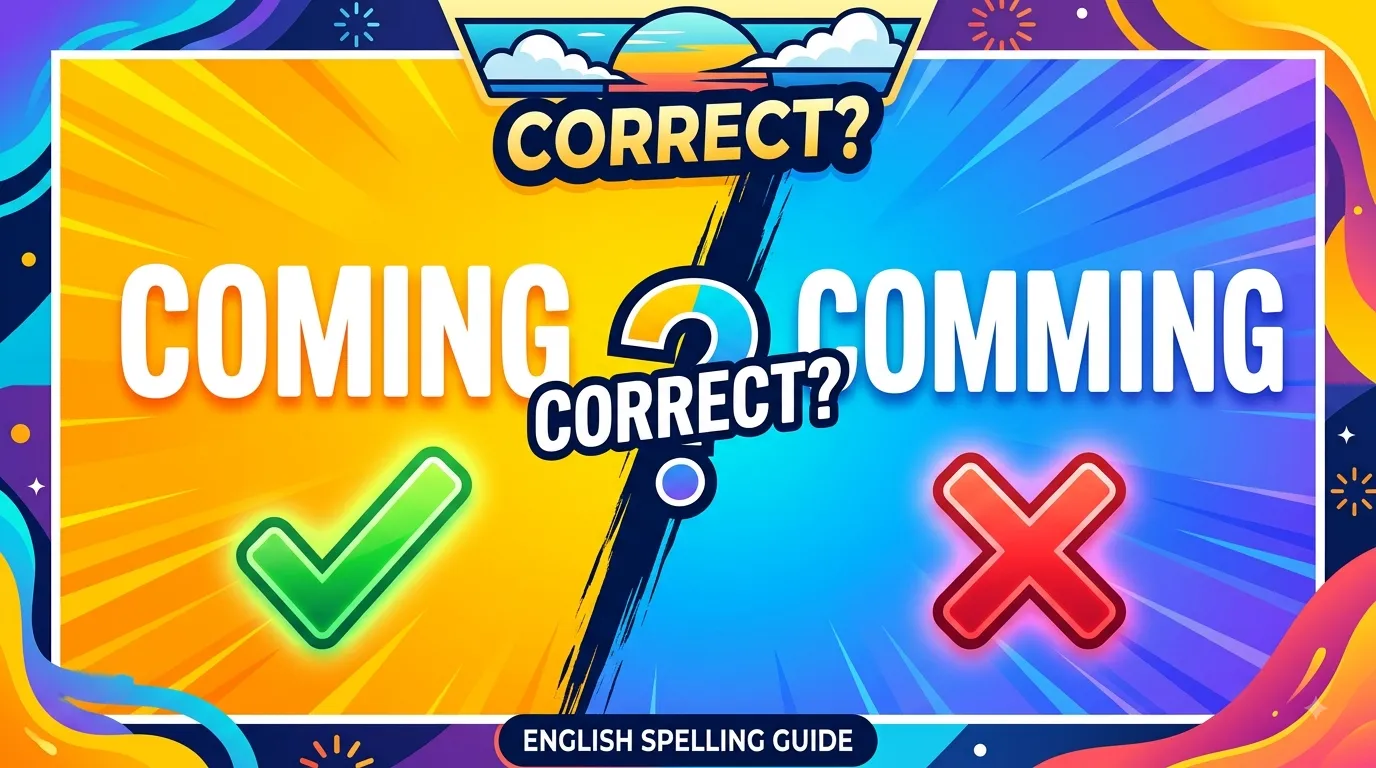
Coming is the correct spelling. Comming is not a standard English word and is considered a spelling mistake. Use coming when you mean moving toward a place, arriving, or happening soon.
Have you ever typed a message and suddenly stopped to ask, “Is it coming or comming?” You are not alone. This is one of the most common spelling mistakes people make while writing in English.
I remember checking student essays where many learners wrote “comming soon” instead of “coming soon.” The meaning was clear, but the extra “m” made the word incorrect. Small spelling errors like this can affect how professional your writing looks.
The confusion happens because many English words double their final letters when adding endings. For example, running, swimming, and stopping all have double letters. So, it feels natural to write comming.
However, English has rules, and coming follows a different pattern. In this guide, you will learn the correct spelling, why comming is wrong, how to use coming properly, and common mistakes to avoid.
Coming or Comming : Quick Answer
The correct spelling is coming.
Coming is the present participle form of the verb come. It means moving toward someone or something, arriving, or happening in the near future.
Examples:
- She is coming to my house today.
- The movie is coming out next month.
- Winter is coming soon.
The spelling comming is incorrect. It does not appear as a standard English word in dictionaries.
The Origin and Background of Coming
The word coming comes from the Old English word cuman, which meant “to move toward” or “to arrive.”
Over hundreds of years, the word changed into the modern English verb come.
When English speakers add -ing to verbs, spelling rules decide whether letters should be doubled.
For many short verbs, the final consonant is doubled:
- run → running
- sit → sitting
- stop → stopping
But come is different.
The word already has a silent e at the end. When adding -ing, the silent e is removed:
come + ing = coming
Not:
come + ing = comming
The extra “m” has no place in the correct spelling.
Coming Explained : Key Differences Between Coming and Comming
Many learners confuse these two spellings because they sound similar.
However, only one is correct.
| Term | Meaning | When to Use | Region/Context |
|---|---|---|---|
| Coming | Moving toward, arriving, or happening soon | Use in all normal English writing | Worldwide English |
| Comming | Incorrect spelling | Do not use | Not accepted in standard English |
Correct Examples:
✅ My friend is coming tomorrow.
✅ The new update is coming soon.
✅ Are you coming with us?
Incorrect Examples:
❌ My friend is comming tomorrow.
❌ The product is comming soon.
❌ Are you comming with us?
Which Version Should You Use?
There is only one correct choice:
For Students
Use coming because it follows standard English spelling rules.
Example:
- The exam results are coming next week.
For Professional Writing
Always use coming in:
- Emails
- Reports
- Articles
- Business documents
- Websites
Example:
- Our new service is coming soon.
For Social Media and Casual Messages
Use coming even in informal writing.
Example:
- Coming home now.
- The weekend is coming!
The word does not change based on the situation. The spelling remains the same everywhere.
Common Mistakes with Coming
1. Writing Comming Instead of Coming
Mistake:
❌ The new season is comming soon.
Correction:
✅ The new season is coming soon.
Why it happens:
People often remember words like running and swimming, where letters are doubled.
2. Forgetting the Silent “e” Rule
Mistake:
❌ I am comeing tomorrow.
Correction:
✅ I am coming tomorrow.
Why it happens:
The final “e” in come disappears before adding -ing.
3. Using Coming When You Need Came
Mistake:
❌ She coming yesterday.
Correction:
✅ She came yesterday.
Why it happens:
Coming describes an ongoing or future action. Came describes a completed past action.
4. Confusing Coming and Going
Mistake:
❌ I am going to your house when I mean arriving at your place.
Correction:
✅ I am coming to your house.
Why it happens:
“Coming” moves toward the speaker or destination. “Going” moves away.
Coming in Real-World Examples
Professional Email
Subject: New Product Coming Soon
“Our updated software version is coming next month. We appreciate your patience and support.”
News Headline
“New Technology Coming to Schools This Year”
Here, coming shows that something will arrive in the future.
Social Media Post
“Big changes are coming! Stay tuned for exciting updates.”
Formal Document
“The company’s annual report is coming after the financial review is completed.”
Coming : Data, Trends, and Usage
The search term “coming or comming” is mainly searched by people who want to check spelling before writing.
The search intent is:
Informational
Most searches come from:
- Students learning English
- Non-native English speakers
- Writers checking grammar
- People preparing professional messages
The reason this topic remains popular is simple: English spelling is not always predictable. Many learners know the pronunciation but are unsure about the written form.
Understanding small spelling rules like come → coming helps improve overall English accuracy.
Coming vs Comming: Complete Comparison Table
| Term/Variant | Meaning | Region/Context | Best Used When |
|---|---|---|---|
| Coming | Correct form of the verb come with -ing | All English-speaking regions | Writing, speaking, emails, articles, and conversations |
| Comming | Incorrect spelling | Not accepted in standard English | Never use |
Frequently Asked Questions About Coming or Comming
Q: What does coming mean?
A: Coming means moving toward someone, arriving at a place, or happening soon. It is the -ing form of the verb come.
Q: How do you spell coming correctly?
A: The correct spelling is coming with one “m.” The spelling comming is incorrect.
Q: Coming vs comming : which one is correct?
A: Coming is correct. Comming is a common spelling mistake and should not be used in standard English.
Q: Is comming a real word?
A: No. Comming is not considered a correct English word. It is usually a typing or spelling error.
Q: Why is coming spelled with one m?
A: The verb come loses its final silent “e” before adding -ing. This creates coming, not comming.
Q: Can I use coming in formal writing?
A: Yes. Coming is completely acceptable in formal writing, including reports, emails, and professional documents.
Q: Where does the word coming come from?
A: The word comes from Old English cuman, which meant to move toward or arrive.
Conclusion
The answer is simple: coming is the correct spelling, while comming is a mistake.
The confusion happens because many English verbs use double letters when adding -ing. However, come follows a different rule. The final silent e is removed, giving us coming.
Remember these key points:
- ✅ Coming is correct.
- ❌ Comming is incorrect.
- Coming works in casual, academic, and professional writing.
- The word means arriving, moving toward something, or happening soon.
Good spelling builds confidence. A small correction can make your writing look clearer and more professional.
Now you know exactly how to use coming, bookmark this guide so you never second-guess this spelling again.
Read more: Fourteen or Forteen: The Complete Spelling Guide

I started writing about English word differences after years of teaching students who kept making the same mistakes. My focus is on making spelling rules feel simple and easy to remember. At WordsCombo, I turn confusing word pairs into clear comparisons.