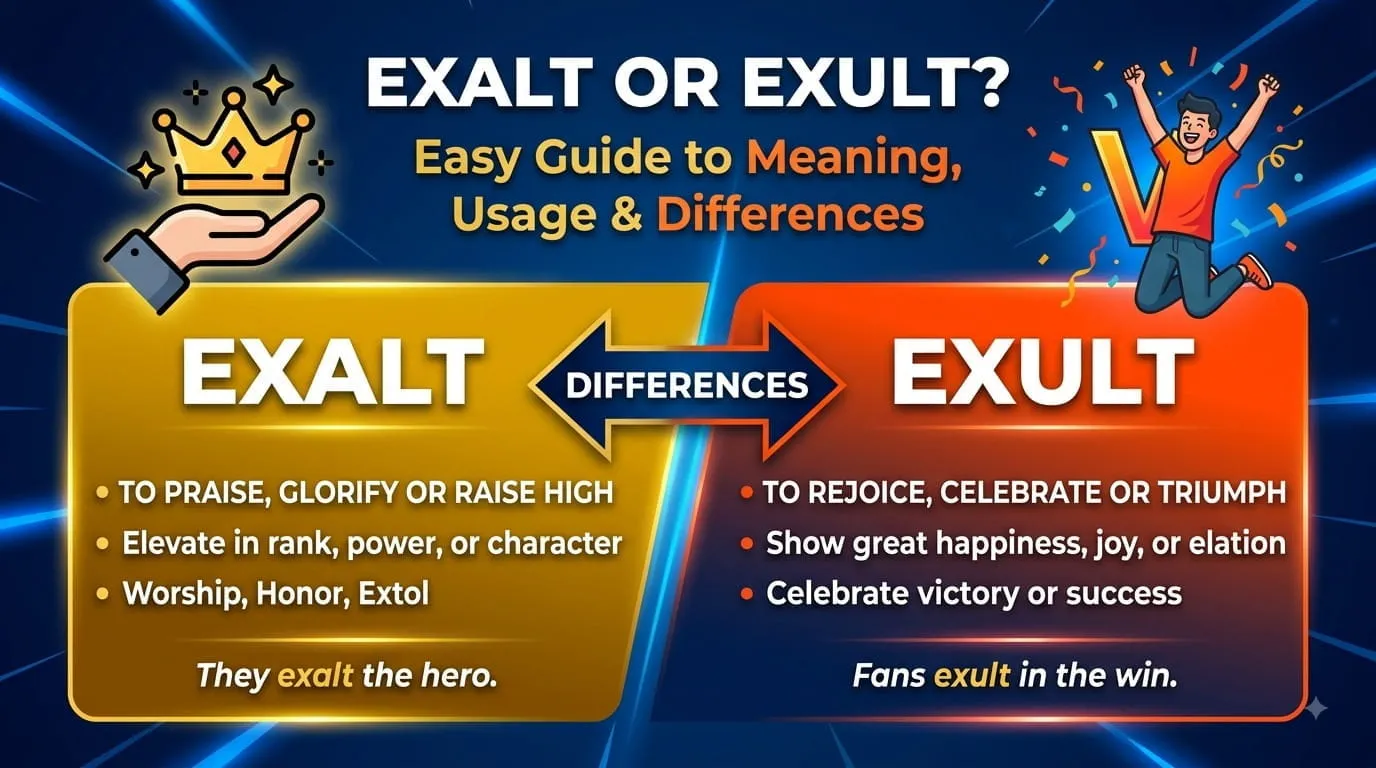
Exalt means to praise, honor, or raise someone or something to a higher level, while exult means to feel or show great happiness and excitement, especially after success.
Why I Once Confused Exalt and Exult
When I first started teaching English vocabulary, I noticed a common problem among learners. Many students could understand difficult words, but they often mixed up words that looked and sounded almost the same.
Exalt and exult are perfect examples.
A student once wrote in an essay: “The team exalted after winning the championship.” The sentence sounded positive, but the word choice was wrong. The team did not praise itself. It celebrated with great joy. The correct word was exulted.
This small spelling difference creates a big meaning change.
Many English learners search for “exalt or exult” because both words relate to positive feelings. Both can appear in formal writing, literature, speeches, and religious texts. However, they describe two different actions.
In this guide, you will learn the exact meaning of exalt and exult, their origins, differences, examples, common mistakes, and how to choose the right word every time.
Let’s remove the confusion once and for all.
Exalt or Exult : Quick Answer
Exalt and exult are different words with different meanings.
- Exalt = to praise highly, honor, or lift someone/something in importance.
- Exult = to feel extremely happy, proud, or excited because of success or good news.
Simple examples:
- The fans exalted the player for his outstanding performance.
(They praised him.) - The fans exulted after their team won the final match.
(They celebrated happily.)
Think of it this way:
Exalt = give praise.
Exult = feel joy.
The Origin and Background of Exalt and Exult
Although exalt and exult look almost identical, they come from different Latin roots.
Origin of Exalt
The word exalt comes from the Latin word “exaltare,” meaning “to raise high.”
Over time, English developed this meaning into:
- raising someone’s status
- praising someone greatly
- honoring something deeply
The word is often used in:
- religious writing
- formal speeches
- literature
- discussions about achievements
Example:
The ceremony was held to exalt the contributions of great leaders.
Here, exalt means to honor or elevate.
Origin of Exult
The word exult comes from the Latin word “exsultare,” meaning “to jump up with joy.”
The original image behind the word was a person physically jumping because of happiness.
Today, exult means:
- celebrate strongly
- express happiness openly
- feel great pleasure after success
Example:
The athletes exulted after winning the gold medal.
They were filled with happiness.
Exalt vs Exult Explained : Key Differences
The biggest difference is who experiences the emotion and what action happens.
| Term | Meaning | When to Use | Region/Context |
|---|---|---|---|
| Exalt | To praise, honor, or raise in importance | When someone or something receives admiration | Formal, religious, literary |
| Exult | To feel or show great happiness | When someone celebrates a victory or success | Emotional, personal, expressive |
Exalt: Giving Praise or Honor
When you exalt someone, you are lifting them up through words, respect, or admiration.
Examples:
- The article exalted her achievements.
- Many people exalt honesty and kindness.
- The poet exalted the beauty of nature.
The subject usually gives praise.
Exult: Showing Happiness
When you exult, you experience strong happiness.
Examples:
- The players exulted after the victory.
- She exulted when she received the job offer.
- The crowd exulted at the announcement.
The subject feels joy.
Which Version Should You Use?
Choosing between exalt or exult depends on what you want to express.
For Students and English Learners
Use exalt when you talk about:
- praising a person
- honoring achievements
- showing admiration
Example:
✅ The teacher exalted the student’s hard work.
Use exult when you talk about:
- winning
- celebration
- happiness
Example:
✅ The student exulted after passing the exam.
For Professional Writers
In business reports, articles, and formal documents:
Use exalt for:
- achievements
- leadership qualities
- positive descriptions
Example:
The report exalted the company’s commitment to innovation.
Use exult carefully because it is more emotional and dramatic.
Example:
Investors exulted after the company’s stock reached a record high.
For Neutral Global English
If you want simple, modern English:
- Use praise, honor, or celebrate when possible.
- Use exalt and exult when you want a more advanced vocabulary style.
Common Mistakes with Exalt and Exult
Many learners confuse these words because of their similar spelling.
| Mistake | Correction | Reason |
|---|---|---|
| The team exalted after winning. | The team exulted after winning. | The team felt happiness. |
| The article exulted the hero. | The article exalted the hero. | The article praised the hero. |
| She exulted his achievements. | She exalted his achievements. | Achievements receive praise. |
| The crowd exalted with joy. | The crowd exulted with joy. | Joy creates celebration. |
Why Does This Confusion Happen?
The confusion happens because:
- Both words start with ex-
- Both sound positive
- Both appear in formal writing
- Both are less common than everyday words
A simple memory trick:
Exalt has an “a” → Admire.
Exult has a “u” → Unbelievable joy.
Exalt and Exult in Real-World Examples
1. Professional Email Example
Exalt:
We want to exalt your outstanding contribution to this project. Your dedication helped our team succeed.
Meaning: We praise and honor your work.
Exult:
Our team can exult in this achievement after months of hard work.
Meaning: Our team can celebrate happily.
2. News Headline Example
Exalt:
“Community Leaders Exalt Local Teacher for 30 Years of Service”
Meaning: People praise the teacher.
Exult:
“Fans Exult After Historic Championship Victory”
Meaning: Fans celebrate.
3. Social Media Example
Exalt:
Today we exalt the courage of healthcare workers who serve communities every day.
Exult:
We exult today because our dream finally became reality!
4. Formal Report Example
Exalt:
The award committee exalted the researcher’s contribution to science.
Exult:
Employees exulted after receiving news of the company’s success.
Exalt or Exult : Data, Trends & Usage
The search interest around “exalt or exult” mainly comes from:
- English learners
- Students preparing for exams
- Writers improving vocabulary
- ESL teachers
- People checking grammar differences
The search intent is mainly informational.
People are not looking to buy anything. They want a clear explanation because dictionary definitions often feel too similar.
The reason this topic matters today is that advanced vocabulary is becoming more valuable in:
- academic writing
- professional communication
- content creation
- language learning
Using the correct word helps writers sound more accurate and confident.
Standalone Comparison Table: Exalt vs Exult
| Term/Variant | Meaning | Region/Context | Best Used When |
|---|---|---|---|
| Exalt | Praise or honor someone/something | Formal, religious, literary | Talking about admiration or respect |
| Exult | Feel extreme happiness | Emotional, expressive | Talking about celebration or victory |
| Praise | Express approval | Everyday English | General positive comments |
| Celebrate | Show happiness about an event | Common daily use | Parties, achievements, success |
| Honor | Show respect | Formal and social contexts | Recognizing contributions |
Frequently Asked Questions About Exalt or Exult
Q: What does exalt mean?
A: Exalt means to praise, honor, or raise someone or something to a higher position. It is often used when showing admiration or respect.
Example:
“The award ceremony exalted her achievements.”
Q: What does exult mean?
A: Exult means to feel or show great happiness, especially after success or victory.
Example:
“The team exulted after winning the competition.”
Q: Exalt vs exult : what is the difference?
A: The difference is simple. Exalt means to praise, while exult means to celebrate with joy. One is about admiration; the other is about happiness.
Q: Is exalt used in formal writing?
A: Yes. Exalt is acceptable in formal writing, especially in essays, speeches, religious texts, and literature. However, it may sound too formal for casual conversation.
Q: Which word is correct: exalt or exult?
A: Both words are correct, but they are used differently. Choose exalt for praise and exult for joy or celebration.
Q: Where does exalt come from?
A: Exalt comes from the Latin word exaltare, meaning “to raise high.” It developed into the modern meaning of honoring or praising.
Q: Can exult be used in professional writing?
A: Yes, but use it carefully. It works well when describing strong emotions, such as celebrating a major success or achievement.
Conclusion: Never Confuse Exalt and Exult Again
Understanding exalt or exult becomes easy when you remember one simple difference:
Exalt is about raising someone through praise.
Exult is about rising with happiness.
Use exalt when you admire, honor, or praise someone. Use exult when you celebrate a victory or feel great joy.
These two words may look almost identical, but their meanings create completely different messages. Choosing the right one will make your writing clearer, more professional, and more powerful.
Keep practicing with real examples. Vocabulary improves when you use words in context, not when you only memorize definitions.
Now you know exactly how to use exalt and exult, try them in your next piece of writing and avoid this common English mistake forever.
Read more: Credible or Creditable: The Easy Guide to Choosing the Right Word

I have been working with English language content for over six years. I specialize in word comparisons and spelling differences that most people overlook. At WordsCombo, I help readers choose the right word every time.