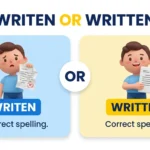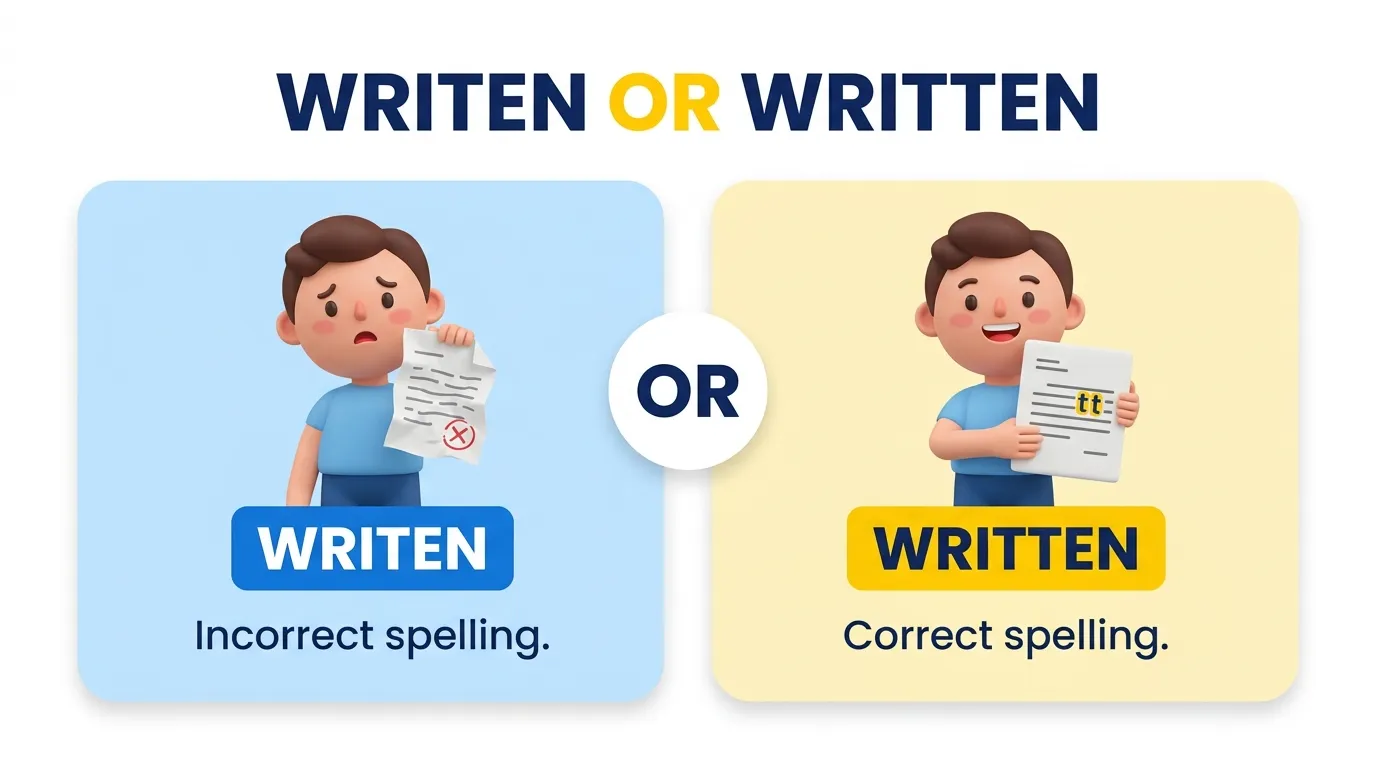
Written is the correct spelling. Writen is a spelling mistake. Use written when talking about words, books, letters, or other text that someone has put into writing.
You finish an email, read it one last time, and spot a red line under “writen.” You pause because both spellings look right at first glance. The correct choice is written, with two t’s.
The difference is easy to learn. Once you know how write, wrote, and written work, you can avoid this mistake in emails, schoolwork, work reports, and social posts.
Writen or Written: The Quick Answer
Written is the correct word in standard English, while writen is incorrect. The word written is the past participle of the verb write.
For example:
- Correct: I have written the email.
- Incorrect: I have writen the email.
Remember, written always has two t’s. This rule applies to both American and British English.
The Story Behind the Word Written
The confusion starts with the verb write, which does not follow the usual pattern for past-tense words.
For most regular verbs, you add “-ed” to show a past action. For example, walk becomes walked, and talk becomes talked. However, write changes in a different way.
Its three main forms are:
- Write: I write a letter every week.
- Wrote: I wrote a letter yesterday.
- Written: I have written a letter today.
Because these forms change in different ways, people may leave out a letter when spelling written. Still, the correct spelling always has two t’s.
Writen or Written: Understanding the Difference
The main difference is simple. Written is a real English word, but writen is not the standard spelling.
Written can also describe something that appears in words rather than speech. For example, a written rule is a rule recorded in text.
Compare these examples:
- Written: She has written a short story.
- Writen: She has writen a short story.
The first sentence is correct because written has two t’s. The second sentence has a spelling error.
Which Form Should You Use?
Choose written whenever you need the past participle of write or an adjective that describes text.
Here is how to choose the right form for your needs:
- For students: Use written in sentences such as “I have written my homework.”
- For office workers: Use written in emails, reports, and business records because correct spelling helps keep your message clear.
- For writers and bloggers: Use written when talking about work you have finished, such as “The article was written for beginners.”
- For everyday messages: Use written in casual texts, notes, and posts, too.
However, if you are talking about a past action that happened at a known time, wrote may be the right choice. For example, “I wrote the email yesterday” is correct.
Common Mistakes with Writen or Written
Small spelling and grammar errors can change how a sentence reads. Here are five mistakes to watch for.
Leaving Out One T
- Incorrect: I have writen the report.
- Correct: I have written the report.
This happens because the second t can be easy to miss when typing quickly. So, check that written contains two t’s.
Using Wrote After Have
- Incorrect: She has wrote a letter.
- Correct: She has written a letter.
The word have needs the past participle written in this sentence. However, wrote works on its own in a simple past sentence, such as “She wrote a letter yesterday.”
Adding the Wrong Ending
- Incorrect: He has writed a book.
- Correct: He has written a book.
Write is an irregular verb, so you cannot make its past participle by adding “-ed.” Instead, learn the pattern write, wrote, written.
Thinking American English Uses Writen
- Incorrect: The report was writen in English.
- Correct: The report was written in English.
There is no US or UK spelling difference here. Both forms of English use written, so the single-t spelling is not correct in either one.
Confusing Written with Writing
- Incorrect: I am written a letter.
- Correct: I am writing a letter.
Use writing for an action happening now. By contrast, use written in a sentence such as “I have written a letter.”
Writen or Written in Real Life Examples
Seeing the correct spelling in common situations makes it easier to remember. Here are examples from everyday and professional writing.
Professional Email
“Hello, I have written the report and attached the file for you to review.”
This sentence works because have is followed by written. It also sounds clear and professional.
News Headline
“New Report Written by Local Experts Explains the Changes”
Here, written tells readers that experts prepared the report. Because it describes the report, it helps keep the headline short.
Social Media Post
“I finally written my first blog post!”
This sentence needs a small grammar fix. The correct version is, “I have finally written my first blog post!” Alternatively, you can say, “I finally wrote my first blog post!”
Formal Document
“This agreement was written to explain the rights of both parties.”
The word written is correct because the sentence uses the passive form was written. This pattern is common in contracts, reports, and other formal records.
School Assignment
“I have written three pages for my English project.”
This sentence uses written correctly after have. So, it is a useful pattern to remember for homework and essays.
Writen or Written: Usage and Search Trends
People search for “writen or written” when they want to check a spelling, fix a sentence, or learn English grammar. The search usually has a clear goal: find the right word quickly.
Several groups may need this answer:
- English learners who are learning irregular verbs.
- Students who want to avoid spelling errors in their work.
- Office workers who need to write clear emails and reports.
- Bloggers and content writers who want clean, easy-to-read text.
- Everyday users who need a quick spelling check before sending a message.
The main search intent is informational. People want a direct answer, a simple rule, and examples they can use right away.
However, the lesson goes beyond one spelling mistake. Knowing when to use write, wrote, and written helps you build better sentences, too. That is why learning the verb pattern is more useful than memorizing a single word.
Writen or Written: Comparison at a Glance
| Term or Variant | Meaning | Region or Context | Best Used When |
| Written | Correct past participle of write | All standard English | With have, has, had, or passive forms |
| Writen | Incorrect spelling | Nonstandard spelling error | Never in standard English |
| Wrote | Simple past form of write | All standard English | Describing a past action |
| Writing | The “-ing” form of write | All standard English | Describing an action in progress |
| Write | Base form of the verb | All standard English | Present actions, commands, or after “to” |
The easiest way to remember the difference is to learn the forms together: write, wrote, written.
Frequently Asked Questions About Writen or Written
Is it writen or written?
Written is correct, and writen is a spelling mistake. Always use two t’s when writing the past participle of write.
What does written mean?
Written means put into words, recorded in text, or created by writing. For example, “She has written a book” means she created the book using words.
Is written the past tense of write?
Written is the past participle of write, while wrote is the simple past form. For example, “I wrote a note yesterday” is correct, and so is “I have written a note.”
Is written correct in formal writing?
Yes, written is correct in formal and informal English. Use it in school essays, job applications, business emails, reports, and other documents.
Is written correct in American and British English?
Yes, both American and British English use written. There is no regional spelling rule that makes writen correct.
Why does written have two t’s?
Written is an irregular form of write, so its spelling does not follow the simple “add -ed” rule. Learn the full pattern, write, wrote, written, to help you remember the extra t.
Should I write “have written” or “have wrote”?
Use have written because have takes the past participle in this sentence. However, use wrote when you describe a past action without have, as in “I wrote the note yesterday.”
Final Thoughts on Writen or Written
The correct spelling is written, not writen. Keep the two t’s in mind whenever you use this word in a message, school assignment, or work document.
Also, remember the difference between the three main forms. Write is the base form, wrote is the simple past, and written is the past participle. Once you learn this pattern, you can choose the right word with more confidence.
In short, always choose written when you mean the past participle of write. Before you send your next email or publish your next post, take a moment to check your spelling. Practice the pattern today, and make your writing clearer every day.
Curious about similar words? Explore Questionaire or Questionnaire.

I started writing about English word differences after years of teaching students who kept making the same mistakes. My focus is on making spelling rules feel simple and easy to remember. At WordsCombo, I turn confusing word pairs into clear comparisons.