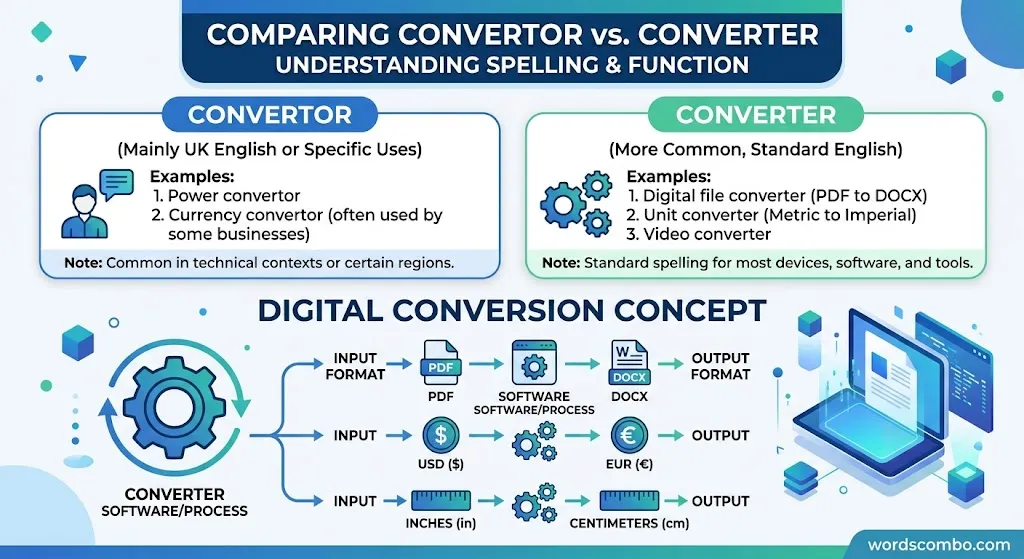
Converter is the standard and preferred spelling in modern English. Convertor is a recognized variant, but it is much less common and can look unusual in general writing.
You are finishing an email when you notice a simple spelling question: should you write “file converter” or “file convertor”? Both forms look reasonable, especially because English uses both -er and -or endings in many words.
That is why Convertor or Converter can be confusing. You may see the less common form in technical material, older writing, or specialized contexts. However, seeing a word occasionally does not mean it is the best choice for everyday writing.
The good news is that the practical rule is simple. Converter is the spelling most readers expect, and it works naturally in American and British English. It is also the safer choice for schoolwork, business writing, websites, software descriptions, and technical documents.
In this guide, you will learn what both forms mean, why the spelling differs, whether either form is British or American, and when you might encounter convertor. You will also see clear examples that make the difference easy to remember.
By the end, you should know exactly which form to choose when you are writing for a general audience.
Convertor or Converter: Quick Answer
Converter is the standard spelling and the best choice for most situations.
A converter is a person, device, machine, or program that changes something from one form into another.
For example:
- I used a currency converter to check the exchange rate.
- This software includes a PDF converter.
- The car needs a new catalytic converter.
- The device works as a power converter.
Convertor has the same basic meaning. However, it is much less common and is generally treated as a variant of converter.
So, if you are unsure, remember this simple rule:
Use “converter” by default.
The Origin and Background of Convertor or Converter
Both forms come from the verb convert, which means to change something from one form, condition, or use into another.
The verb has Latin roots connected with the idea of turning or changing. English later developed the noun converter from the verb.
The ending -er is common when English creates a noun for a person or thing that performs an action.
For example:
- teach → teacher
- drive → driver
- print → printer
- convert → converter
The -or ending also appears in English. Words such as actor, creator, and operator show this pattern.
Because English has several word-building patterns, convertor can seem logical. It has existed as an alternative form, but converter became the much more common spelling.
Today, the two forms generally have the same basic meaning. The main difference is how frequently they are used and which form readers expect.
Convertor or Converter: Key Differences
| Term | Meaning | When to Use | Region/Context |
| Converter | A person, device, or program that converts something | General, professional, academic, and technical writing | Standard in American and British English |
| Convertor | A person or thing that converts something | Mainly as a less common variant or established usage | Occasional, including some technical contexts |
The important point is that this is not a normal American-versus-British spelling difference.
For example, color/colour has a clear regional distinction. Convertor/converter does not work that way.
American English normally uses converter. British English also commonly uses converter. Therefore, changing from one form to the other based only on your audience is unnecessary.
You may still encounter convertor, particularly in certain technical or older contexts. However, its presence does not make it the standard spelling for general writing.
Which Version Should You Use?
For most readers, converter is the safest and clearest choice.
Use it when you are writing:
- For U.S. English: Choose converter.
- For British English: Choose converter.
- For formal writing: Choose converter.
- For academic writing: Choose converter.
- For business writing: Choose converter.
- For general websites: Choose converter.
- For technical writing: Usually choose converter, unless an established term requires otherwise.
There is one useful exception. If you are reproducing an official product name, quotation, document title, or established technical terminology that uses convertor, keep the original spelling.
Otherwise, changing to converter will usually make your writing look more familiar to modern readers.
Common Mistakes with Convertor or Converter
Mistake 1: Treating Convertor as the Standard Form
Wrong: “I need a new power convertor.”
Correct: “I need a new power converter.”
The first version may be understood, but converter is the normal spelling.
Mistake 2: Assuming Convertor Is British English
Wrong: “Convertor is British, while converter is American.”
Correct: “Converter is standard in both American and British English.”
This is not a typical regional spelling pair. The less common form can appear in British contexts, but that does not make it the standard British spelling.
Mistake 3: Using Both Forms in the Same Document
Wrong: “Our software has a file converter. The convertor supports several formats.”
Correct: “Our software has a file converter. The converter supports several formats.”
Consistency makes your writing easier to read.
Mistake 4: Avoiding Converter Because It Looks Too Technical
Wrong: “Use this file convertor to change the document.”
Correct: “Use this file converter to change the document.”
The word converter is not limited to engineering. It is common in everyday technology and online tools.
Convertor or Converter in Real-World Examples
The standard form appears in many areas of everyday life.
Professional Email
Please use the PDF converter before sending the final document.
This sounds natural and professional.
Headline
Free Image Converter for Quick File Changes
Converter is the expected spelling in a website heading.
Social Post
I finally found a simple video converter for my old files.
The standard form works well in casual writing, too.
Formal Document
The system requires a digital-to-analog converter.
This is appropriate for technical or academic writing.
Everyday Conversation
Do you have a currency converter on your phone?
Here, converter refers to a tool that changes one currency value into another.
You can also find the word in familiar terms such as catalytic converter, power converter, unit converter, file converter, and video converter.
Convertor or Converter: Data, Trends and Usage
People usually search for this pair because they have seen both spellings and want to know which one is correct.
The search intent is mainly informational. Readers want a quick spelling decision, but many also want to understand whether the two forms have different meanings.
In modern general English, converter is the form most readers are likely to recognize. It appears across technology, software, electronics, automotive language, education, and everyday communication.
Convertor is less common. It can still appear in technical material, older texts, or specific established terminology.
Therefore, frequency and context matter more than simply asking whether the less common spelling exists.
If your goal is clear communication, converter is the practical choice. It reduces the chance that a reader will pause and wonder whether you made a spelling mistake.
Convertor or Converter: Comparison at a Glance
| Term/Variant | Meaning | Region/Context | Best Used When |
| Converter | Something or someone that converts | General English | Almost all modern writing |
| Convertor | Alternative form of converter | Less common and sometimes technical | When an established source or term uses it |
The table shows the key point: the meaning is essentially the same, but the usage is not equally common.
For everyday communication, there is little reason to choose the less familiar form.
Frequently Asked Questions About Convertor or Converter
What does Convertor or Converter mean?
Both forms refer to a person, device, machine, or program that converts something. For example, a currency converter changes one currency value into another.
Which form is correct?
Converter is the standard and preferred spelling in modern English. Convertor is a recognized alternative, but it is much less common.
Is convertor British English?
No. Convertor is not simply the British spelling of converter. British English commonly uses converter, just like American English.
Can I use both forms?
Yes, both forms can be understood, and convertor exists as a variant. However, converter is the better choice for most writing.
What is the difference between convertor and converter?
The main difference is spelling and usage frequency rather than meaning. Converter is far more common, while convertor is a less common variant.
Which version is better for formal writing?
Use converter in formal writing. It is the more familiar and widely accepted form, so it is the safest choice for reports, essays, emails, and professional documents.
Is convertor a misspelling?
Not necessarily. Convertor is a recognized variant of converter, although many readers may see it as unusual. Unless you have a specific reason to use it, converter is the better option.
Final Thoughts on Convertor or Converter
The difference between Convertor or Converter is easier to understand once you separate spelling from meaning. Both forms refer to something or someone that converts, so the basic definition does not create the confusion.
The main rule is simple: use converter in most situations. It is the standard form that readers commonly expect in American and British English.
You will see converter in familiar expressions such as currency converter, file converter, power converter, video converter, and catalytic converter. It also works naturally in academic, professional, technical, and casual writing.
The common mistake is assuming that convertor is the British version. It is not a straightforward regional spelling difference. Instead, convertor is a less common alternative that may appear in specific technical or older contexts.
Therefore, when you are writing an email, essay, report, website, or social post, choose converter. If you encounter convertor in an official name or established source, keep it when necessary. Otherwise, the standard spelling will help your writing sound clear and natural.
Want to improve your English further? Explore common spelling differences next Missle or Missile.

I started writing about English word differences after years of teaching students who kept making the same mistakes. My focus is on making spelling rules feel simple and easy to remember. At WordsCombo, I turn confusing word pairs into clear comparisons.







1 thought on “Convertor or Converter: Which Is Correct?”