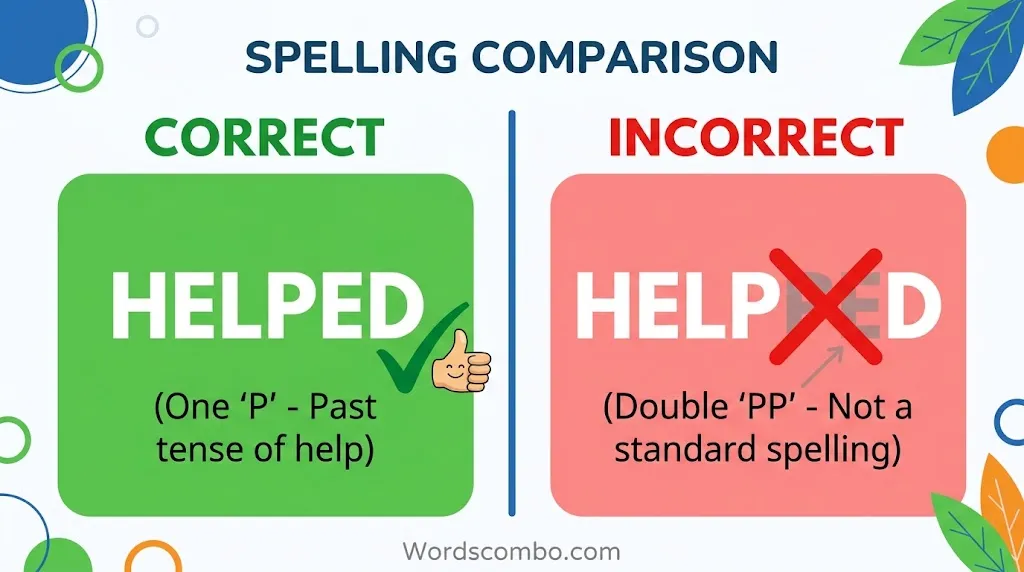
Helped is the correct spelling. Helpped is a misspelling. The past tense and past participle of help are both helped, with only one p.
If you are unsure whether to write helped or helpped, use helped. The word help already ends with a single p, and adding -ed does not require doubling that final consonant.
This spelling is used in sentences such as “She helped me with my homework” and “They helped clean the house.” Once you know the spelling rule, helped vs helpped becomes easy to remember.
Why the Confusion Happens
The confusion usually comes from a common spelling pattern in English: sometimes a final consonant is doubled before adding -ed or -ing.
For example, stop becomes stopped, and plan becomes planned. This can make it seem natural to write helpped, but help does not follow that doubling pattern.
A final consonant is commonly doubled when a short, stressed word ends in a single consonant after a short vowel sound, as in stop → stopped. In help, the ending does not meet that pattern, so the final p stays single.
Therefore:
- help → helped ✅
- help → helpped ❌
The extra p is simply unnecessary.
Meaning(s)
Helped
Helped is the past tense and past participle of the verb help. It means that someone gave assistance, support, or made something easier for another person.
Examples of its meaning include:
- gave someone assistance
- supported someone
- made a task easier
- contributed to a solution
For example, “Tom helped his friend move” means Tom gave his friend assistance with moving.
Helpped
Helpped is not the standard spelling of the past tense of help. It is a spelling error created by incorrectly doubling the final p.
If you see helpped in a sentence, it should normally be changed to helped.
Correct Usage Examples
Because this is a spelling comparison, helped is the valid form and helpped is the misspelling.
Helped
- She helped me finish the project.
- The teacher helped the students understand the lesson.
- He helped his brother carry the boxes.
- Your advice helped me make the right decision.
Helpped
❌ She helpped me finish the project.
The correct version is:
✅ She helped me finish the project.
❌ The teacher helpped the students.
The correct version is:
✅ The teacher helped the students.
❌ He helpped his brother carry the boxes.
The correct version is:
✅ He helped his brother carry the boxes.
The important point is that adding -ed to help gives helped, not helpped.
Memory Trick
Think of HELP as already having all the help it needs.
HELP + ED = HELPED
Do not give the P an extra partner.
You can remember it as:
One P in HELP, one P in HELPED.
If you write helpped, ask yourself: “Did help have two p’s before I added -ed?” It did not, so keep just one p.
Helped vs Helpped at a Glance
| Word | Status/Context | Why | Example |
|---|---|---|---|
| Helped | Correct | Standard past tense and past participle of help | She helped me yesterday. |
| Helpped | Misspelling | The final p should not be doubled | ❌ She helpped me yesterday. |
The difference between helped or helpped is therefore straightforward. Helped is the only standard spelling for the past form of help.
Similar Word Pairs to Watch For
Learning other commonly confused spellings can make English writing easier.
Stoped or Stopped
Stopped is correct. Here, the final consonant is doubled before -ed because stop follows the consonant-doubling pattern.
- She stopped the car.
- ❌ She stoped the car.
This pair can help explain why helpped may look tempting, even though the spelling rule works differently.
Planed or Planned
Both planed and planned can be real words, but they have different uses. Planned is the past tense of plan, while planed can refer to smoothing something with a plane.
- We planned the trip carefully.
- The carpenter planed the wood.
The extra consonant changes more than just appearance here.
Prefered or Preferred
Preferred is the standard spelling. The final r is doubled before -ed because prefer follows a consonant-doubling pattern in its stressed final syllable.
- She preferred tea.
- ❌ She prefered tea.
Occured or Occurred
Occurred is correct, with two r’s.
- The accident occurred yesterday.
- ❌ The accident occured yesterday.
Adressed or Addressed
Addressed is correct, with two d’s.
- She addressed the problem.
- ❌ She adressed the problem.
These examples show why English spelling cannot always be handled by simply doubling or not doubling the final consonant. The spelling depends on the word and the applicable pattern.
Mini FAQ
Is helped the correct spelling?
Yes. Helped is the correct spelling of the past tense and past participle of help.
Is helpped a word?
Helpped is not the standard spelling of the past form of help. It is a misspelling of helped.
Why is there only one p in helped?
The final p in help is not doubled when -ed is added. Therefore, help + ed = helped.
Is helped the past tense of help?
Yes. Helped is the simple past tense of help and is also used as its past participle.
How do I remember helped vs helpped?
Remember: HELP + ED = HELPED. There is only one p in both forms.
Conclusion
When choosing helped or helpped, always use helped. It is the standard past tense and past participle of help, while helpped is a spelling mistake caused by incorrectly doubling the final p.
For more useful spelling comparisons, see Convertor or Converter and Forty vs. Fourty.

I started writing about English word differences after years of teaching students who kept making the same mistakes. My focus is on making spelling rules feel simple and easy to remember. At WordsCombo, I turn confusing word pairs into clear comparisons.