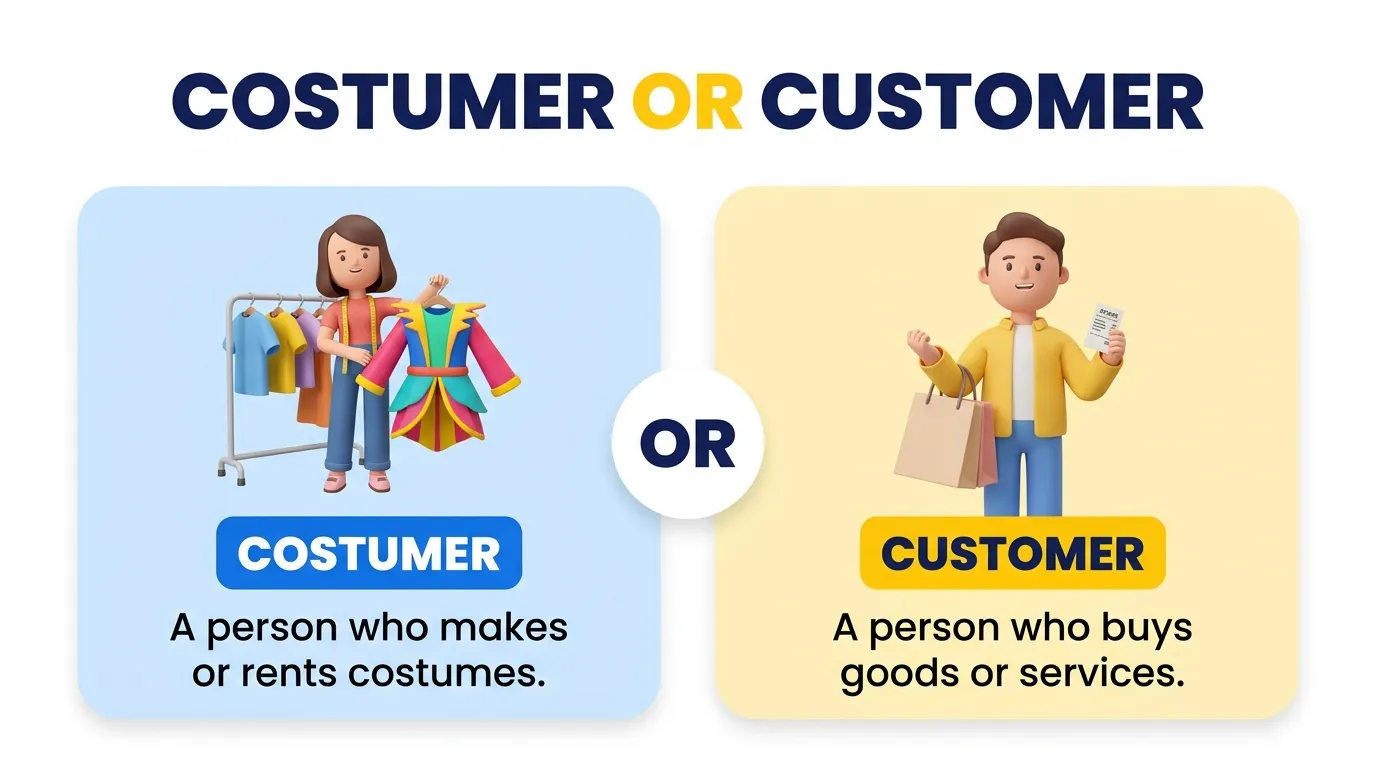
Customer means a person who buys goods or services. Costumer means a person who makes, sells, or rents costumes. Choose the right word based on what you mean.
You are about to send an email to a client, but your spell checker flags the word costumer. Should you change it to customer? The answer depends on your message. These words look almost the same, but they have very different meanings.
In everyday business writing, customer is the word you usually need. However, costumer is also a real English word when you talk about costumes for plays, films, or shows. Let’s look at the difference, simple examples, and easy ways to remember the correct spelling.
Costumer or Customer: Quick Answer
Use customer when you mean someone who buys a product or service. Use costumer when you mean someone who makes, sells, or rents costumes.
For example:
- Correct: Every customer gets a receipt after a purchase.
- Correct: The costumer made a bright red outfit for the school play.
The main difference is simple. A customer buys something, but a costumer works with costumes.
The Origin of Costumer or Customer
The words customer and costumer come from different word roots, which helps explain why they have different meanings.
The word customer grew from an older word related to custom and regular trade. Over time, it came to mean a person who buys goods or services from a shop or business.
By contrast, costumer comes from the word costume with the ending -er. That ending often means a person who does a job. So, a costumer is someone who makes, supplies, or rents costumes.
The words look alike because they share many letters. However, the letter order changes their meaning. This small spelling difference can cause errors in emails, reports, websites, and business posts.
Costumer or Customer Explained: Key Differences
The easiest way to tell these words apart is to think about what the person does.
A customer pays for something, such as food, clothes, a haircut, or a phone plan. A costumer, on the other hand, works with special outfits worn by actors, dancers, or performers.
Here is a simple comparison.
| Term | Meaning | When to Use | Region/Context |
| Customer | A person who buys goods or services | Shopping, sales, and business | Common in American and British English |
| Costumer | A person who makes, sells, or rents costumes | Theater, film, and stage shows | Commonly used in American English |
| Costume designer | A person who plans the look of costumes | Films, plays, and TV shows | Creative work |
| Consumer | A person who uses goods or services | Markets, products, and business reports | General and formal writing |
Although customer and consumer can have similar meanings, they are not always the same. A customer buys a product, while a consumer is the person who uses it. For example, a parent may buy a toy, but a child may use it.
Similarly, a costumer may help create the clothes that actors wear, but that person is not called a customer unless they also buy something.
Which One Should You Use?
The right choice depends on your message and your reader.
- For business owners: Use customer because it refers to people who buy your products or services.
- For writers and students: Choose customer when writing about buyers, shops, or sales.
- For theater workers: Use costumer when talking about someone who makes or rents stage outfits.
- For customer service teams: Write customer service, not costumer service, because the team helps buyers.
- For general writing: Pick customer if you mean a buyer. However, use costumer if you mean a costume worker.
When you are unsure, ask yourself one simple question: Is this person buying something, or are they working with costumes? That quick check can help you choose the right spelling.
Common Mistakes with Costumer or Customer
These spelling errors are easy to make because the words differ by just one letter. However, a quick check can help you avoid them.
Mistake: Writing “costumer service”
Incorrect: Our costumer service team is ready to help.
Correct: Our customer service team is ready to help.
This error happens because costumer looks like customer. However, customer service means help given to people who buy or use a service.
Mistake: Calling a buyer a costumer
Incorrect: Every costumer gets a free shopping bag.
Correct: Every customer gets a free shopping bag.
The first sentence suggests that the person works with costumes. Therefore, use customer when you mean someone who shops at a store.
Mistake: Calling a costume worker a customer
Incorrect: The customer prepared the outfits for the actors.
Correct: The costumer prepared the outfits for the actors.
Here, the person prepares costumes rather than buying them. So, costumer is the better choice.
Mistake: Using the wrong plural form
Incorrect: Our costumers placed hundreds of orders.
Correct: Our customers placed hundreds of orders.
Both words can take an -s at the end. However, the meaning stays different, so adding the plural ending does not fix the wrong word.
Mistake: Trusting spell check without checking meaning
A spell checker may accept both words because both are real English words. As a result, it may not catch the meaning error.
Before sending an email or publishing a page, read the full sentence. If you mean buyers, check that you wrote customer.
Costumer or Customer in Real-World Examples
Real examples make the difference easier to remember. Notice how the meaning changes with each setting.
Professional email
“Dear team, we should reply to every customer within one business day.”
This sentence is about people who buy from a business. Therefore, customer is correct.
News headline
“Local Theater Costumer Creates Costumes for a New School Play”
Here, costumer fits because the story is about someone who makes outfits for performers.
Social media post
“We love our customers! Thank you for supporting our small business.”
The post thanks people who buy from the business. So, customers is the correct plural form.
Formal document
“The company aims to improve customer satisfaction through faster replies and better service.”
This sentence uses the word in a business setting. Because it refers to buyers and their experience, customer is correct.
Theater program
“Our costumer designed colorful outfits for the main cast.”
In this example, the word refers to a person who works with costumes. Therefore, costumer is the right choice.
Online store description
“We help every customer find the right size, color, and style.”
The store is talking about its buyers. As a result, customer is the correct word.
Costumer or Customer: Data, Trends and Usage
The difference between these words matters most when people write about shopping, sales, and customer care.
The search phrase “customer” often connects to business topics, such as customer service, customer reviews, and customer satisfaction. People may search for “costumer or customer” when they want to check a spelling mistake or learn which word fits a sentence.
The search intent is mainly educational. People want a quick answer, a clear meaning, and examples they can use right away.
However, costumer has a real place in creative work. Theater teams, film workers, and costume makers may use it in job titles and work descriptions.
For website owners, bloggers, and business writers, the lesson is simple. Use customer in shopping and sales content because the wrong spelling can make a page look careless. Meanwhile, use costumer when the subject is costume work.
There is no need to guess based on how often you see a word. Instead, check the meaning of the sentence and choose the word that fits.
Costumer vs Customer: Comparison at a Glance
Use this table for a quick spelling check before you send a message or publish content.
| Term/Variant | Meaning | Region/Context | Best Used When |
| Customer | A person who buys goods or services | Everyday English and business | Talking about buyers |
| Costumer | A person who makes, sells, or rents costumes | Theater, film, and shows | Talking about costume work |
| Customers | More than one buyer | Shops and businesses | Describing a group of buyers |
| Costumers | More than one costume worker or supplier | Stage and film work | Describing costume teams |
| Customer service | Help given to buyers | Business and support | Talking about help and care |
| Costume designer | A person who plans costume looks | Film and theater | Talking about costume design |
Remember that customer is the usual choice in business writing. However, both customer and costumer are correct words when used with their proper meanings.
Frequently Asked Questions
Is it costumer or customer?
Both are real words, but they have different meanings. A customer buys goods or services, while a costumer makes, sells, or rents costumes.
What does customer mean?
A customer is a person or business that buys goods or services. For example, someone who buys coffee from a cafe is a customer.
Is costumer a real word?
Yes, costumer is a real English word. It refers to a person or business that makes, sells, or rents costumes, often for plays and films.
Is costumer service correct?
No, customer service is the correct phrase when you mean help for buyers. However, costumer is correct when you are talking about someone who works with costumes.
Which spelling is correct in American English?
Both customer and costumer are correct in American English, but they mean different things. Use customer for a buyer and costumer for a costume worker.
Where does the word costumer come from?
The word costumer comes from costume with the ending -er. This ending often refers to a person who does a job, so a costumer works with costumes.
Should I use customer or costumer in a business email?
Use customer when you write about buyers, orders, payments, or customer service. By contrast, use costumer only when the email is about costume work.
Final Thoughts on Costumer or Customer
Choosing between costumer or customer is easy once you know what each word means. A customer buys goods or services, while a costumer makes, sells, or rents costumes. Although the words look alike, they belong in different settings.
For business emails, online stores, school work, and sales reports, customer is usually the word you need. However, if you write about theater, films, or stage outfits, costumer may be the right choice.
Before you send your next email or publish a page, take a moment to check the meaning. That small habit can help you avoid spelling errors and make your writing clear. Keep learning, keep practicing, and choose your words with confidence!
Curious about more tricky word pairs? Explore Foward or Forward.

I started writing about English word differences after years of teaching students who kept making the same mistakes. My focus is on making spelling rules feel simple and easy to remember. At WordsCombo, I turn confusing word pairs into clear comparisons.