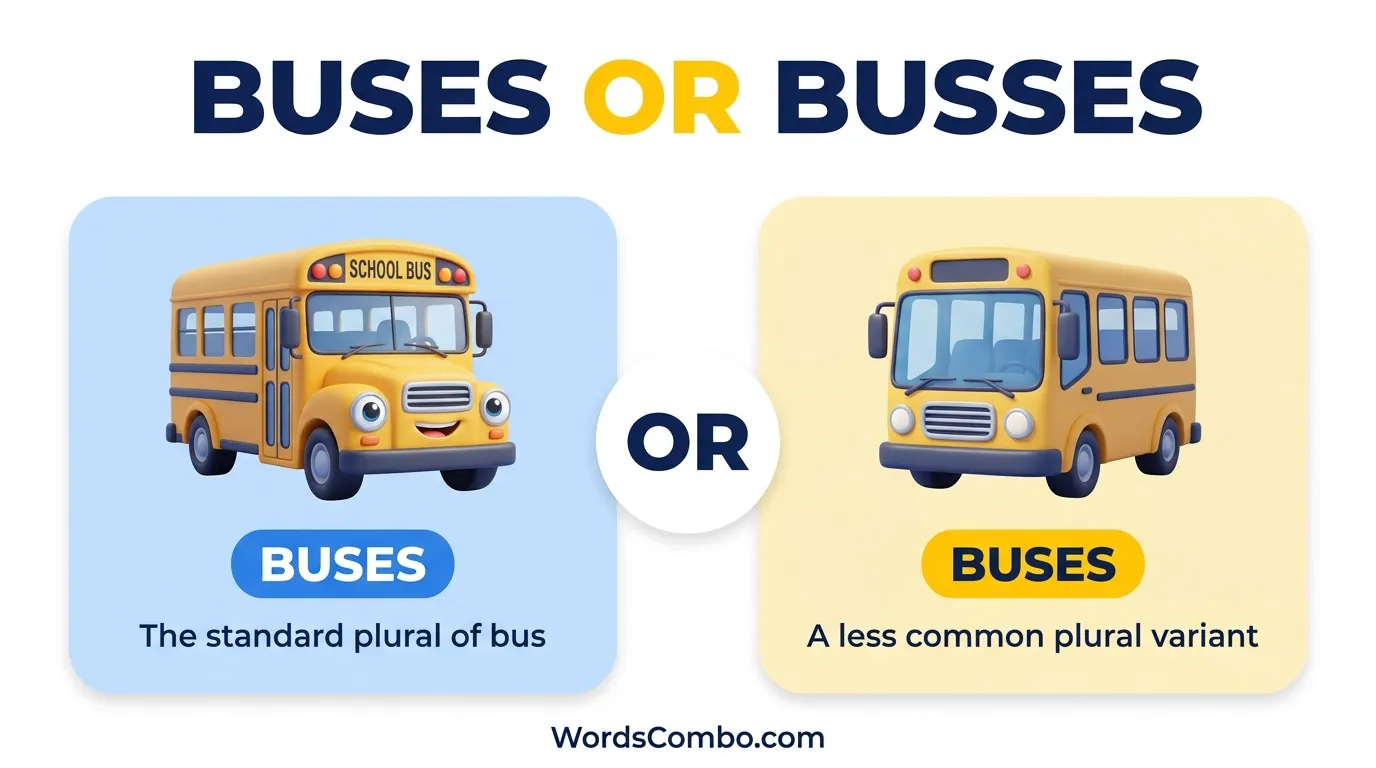
Buses is the correct and standard plural of bus. Busses is a rare alternative, but it is usually not the right choice when you mean more than one bus.
When you finish writing an email about school transport, you might pause at the word buses. Should you add one s or two? Both buses and busses appear in English, which makes this spelling confusing. However, if you are writing about school buses, city transport, or a trip with friends, buses is the spelling you should use. Let’s look at the difference, see real examples, and learn a simple way to remember the correct form.
Buses or Busses: Quick Answer
Buses is the standard plural form of bus. Use it when you are talking about two or more buses.
For example:
- Correct: Three buses arrived at the school.
- Incorrect in standard writing: Three busses arrived at the school.
However, busses can also be the plural of buss, an old-fashioned word for a kiss. It can also appear as a verb form related to kissing. That is why the two spellings do not always mean the same thing.
The Origin of Buses and Busses
The word bus comes from a longer Latin word, omnibus, which means “for all.” Over time, people shortened omnibus to bus as a name for a vehicle that carries passengers.
When English speakers needed to talk about more than one bus, the usual plural became buses. This follows the common spelling rule for many nouns that end in s: add -es to form the plural.
The word buss, meaning a kiss, has a different history. Because it already ends in two s’s, its plural is busses. So, although the words look almost alike, their meanings help explain why they have different spellings.
Buses or Busses Explained: Key Differences
The main difference is the meaning. Buses refers to passenger vehicles, while busses usually relates to kisses or the act of kissing.
When to Use Buses
Use buses whenever you mean more than one passenger bus. This is the standard spelling in American English and is also the usual spelling in British English.
Examples:
- The city added ten new buses to its fleet.
- School buses stop outside the main gate.
- We took two buses to reach the museum.
When to Use Busses
Use busses only when the context calls for the word buss, meaning a kiss, or a related verb form. This use is uncommon in everyday writing.
Examples:
- The old poem describes the lovers’ busses.
- In the story, the character busses her child on the cheek.
In modern writing, people usually choose kisses or kisses her child instead. Therefore, you are unlikely to need busses unless you are reading older writing or discussing a special use of the word.
Buses vs. Busses: A Simple Comparison
| Term | Meaning | When to Use | Region/Context |
| Buses | More than one bus | Talking about passenger vehicles | Standard American and British English |
| Busses | More than one buss, meaning a kiss | Rare writing about kisses | Old-fashioned or literary use |
| Busses | A form of the verb buss | Describing an act of kissing | Rare use |
Which One Should You Use?
In almost every case, use buses when you write about passenger vehicles. It is the usual spelling in both American and British English, so readers will recognize it right away.
Here is the best choice for different situations:
- For students: Write buses in schoolwork and exams because it is the usual plural.
- For teachers: Teach bus → buses as the normal spelling rule for this word.
- For writers and editors: Choose buses in articles, reports, emails, and other formal text.
- For English learners: Remember buses as your first choice because it is clear and widely used.
- For older texts: Keep busses if you are quoting or discussing a text that uses that spelling.
Although some dictionaries accept busses as a less common plural of bus, it is not the best everyday choice. Therefore, when you are unsure, write buses.
Common Mistakes with Buses or Busses
These spelling mistakes are easy to avoid once you know the rule.
Writing Busses in Schoolwork
Mistake: The school has twelve busses.
Correction: The school has twelve buses.
Why it happens: Many learners think the final s in bus must double before adding a plural ending. However, the standard spelling is buses.
Thinking Busses Is Always Wrong
Mistake: The word busses can never be correct.
Correction: Busses is a recognized but less common plural variant of bus.
Why it happens: People often learn only the most common spelling. Still, knowing that a rare variant exists helps you understand older books and other texts.
Confusing the Noun with the Verb
Mistake: The driver busses the children to school.
Correction: The driver buses the children to school in standard American English.
Why it happens: The verb bus can mean to carry people by bus. In American English, forms such as buses, bused, and busing are common, while British English often uses busses, bussed, and bussing.
Using Different Spellings in One Document
Mistake: The school ordered new buses, but the next page says busses.
Correction: Use buses throughout the document when you mean the vehicles.
Why it happens: Writers may switch spellings without noticing. Therefore, check your work before you send it or publish it.
Forgetting the Meaning of Buss
Mistake: She gave her child two buses on the cheek.
Correction: She gave her child two kisses on the cheek.
Why it happens: Bus and buss are different words. Since buss can mean a kiss, busses can have a meaning unrelated to transport.
Buses or Busses in Real-World Examples
The right spelling can make your writing look clear and professional. Here are examples from everyday situations.
Professional Email
Subject: School Transport Update
Hello Team,
The school has arranged three buses for tomorrow’s trip. Please ask students to arrive by 8 a.m.
Here, buses is the right choice because the email refers to several vehicles.
News Headline
Example headline
City Adds New Buses to Improve Public Transport
News headlines use buses when reporting on transport plans, new routes, or public travel.
Social Media Post
Our trip was a success! All the buses arrived on time, and everyone had a great day.
For a casual post, buses is still the natural spelling. You do not need to change it just because your writing is informal.
Formal Report
The transport department will add five buses to meet the growing needs of local passengers.
In a formal report, use the standard spelling to keep your message clear and consistent.
Buses or Busses: Data, Trends and Usage
People search for buses or busses because both spellings look possible. English has many words that double their final consonant, so it is easy to think that bus should follow the same pattern.
However, the most useful answer is simple: buses is the usual spelling for the plural of the vehicle. Although busses appears as a variant, it is much less common in everyday writing.
The main audiences for this spelling question include:
- Students and English learners who want to avoid spelling errors.
- Teachers and parents who help children learn plural forms.
- Writers and editors who need clear, standard English.
- People writing about transport for school, work, or the news.
The search intent is mainly informational. Readers want to know which spelling is correct, why the other form exists, and how to use the word in a sentence. Therefore, learning this one simple rule can help you write with more confidence.
Frequently Asked Questions
Is it buses or busses?
Buses is the usual spelling for more than one passenger bus. Although busses is also listed as a less common plural variant, buses is the safest choice for everyday writing.
Why is buses spelled with one s at the end?
The word bus forms its usual plural by adding -es. Therefore, the correct standard form is buses, not busses, when you want the most widely used spelling.
Is busses ever correct in American English?
Yes, busses is recognized as a less common plural of bus. However, American writers usually choose buses when talking about vehicles, so that is the better option for most situations.
Is buses or busses correct in British English?
Buses is the usual plural noun in British English, just as it is in American English. However, British English often uses busses, bussed, and bussing as forms of the verb bus.
What is the plural of bus?
The standard plural of bus is buses. For example, you can write, “Four buses are waiting at the station.”
Where does the word bus come from?
The word bus is a shortened form of omnibus, a Latin word meaning “for all.” Over time, the shorter word became the common name for a vehicle that carries passengers.
Should I write buses or busses in a formal email?
Use buses in a formal email because it is the usual modern spelling. This choice also works well in reports, school assignments, business documents, and online articles.
Final Thoughts on Buses or Busses
Choosing between buses or busses is easy once you know the main rule. If you mean more than one vehicle, buses is the standard spelling you should use in everyday English.
Remember these key points:
- Buses is the usual plural of bus.
- Busses is a less common accepted variant when referring to vehicles.
- Busses can also relate to buss, an old word for a kiss.
- American and British English both use buses as the usual plural noun.
So, before you send an email, finish an assignment, or publish an article, choose buses for clear, natural writing. Keep practicing these small spelling rules, and you will feel more confident with English every day.
Curious about other confusing spellings? Explore [ANCHOR TEXT] to learn more.
SEO & Image Metadata
SEO Meta Title: Buses or Busses? The Correct Spelling and Easy Rule
SEO Meta Description:

I studied English literature and have spent years editing content for blogs and digital platforms. I noticed most people struggle with choosing between two similar words. At WordsCombo, I make that choice simple and clear.