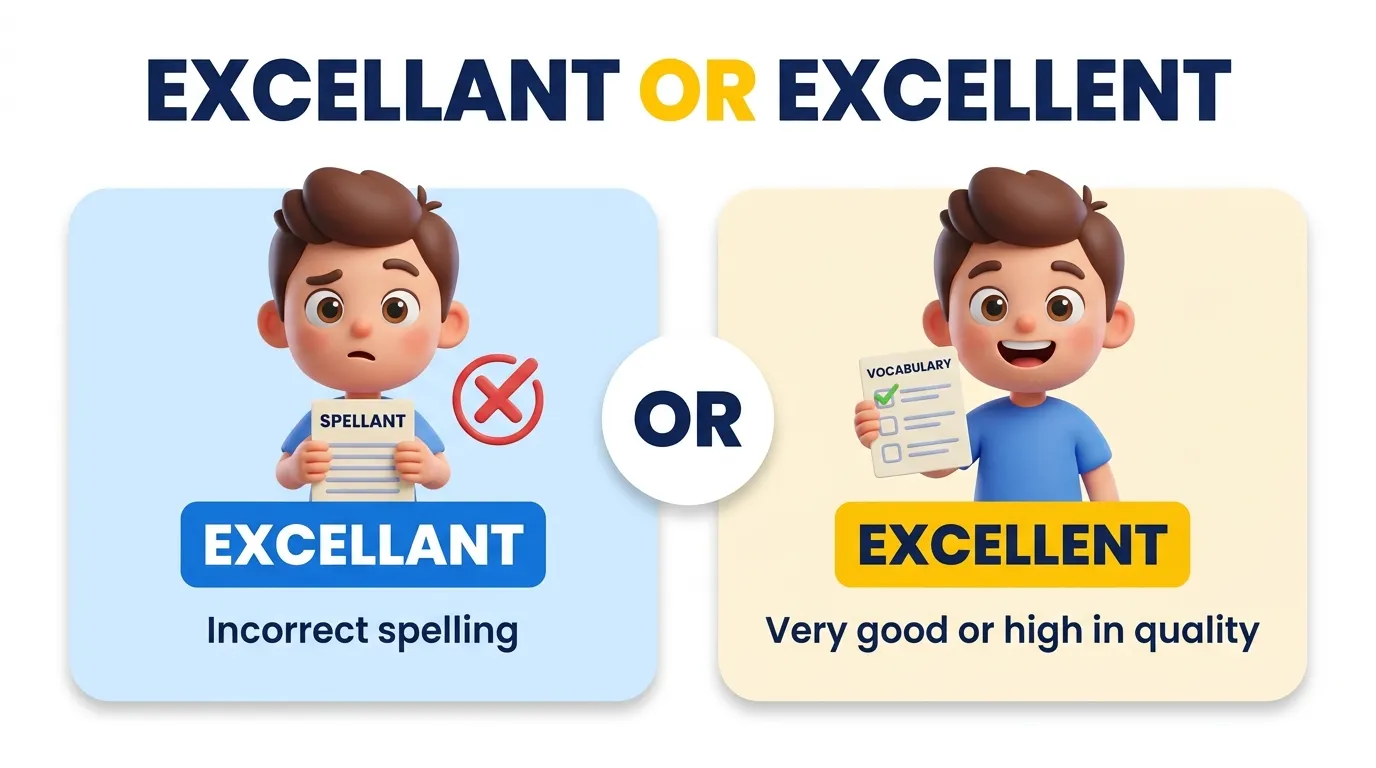
Excellant is incorrect. Excellent is the correct spelling for something very good, high in quality, or outstanding.
You are about to send a work email, and the last line reads, “You did an excellant job.” The red spelling line makes you pause. Excellant or excellent looks like a tiny difference, but only one spelling is correct.
In standard English, excellent is the right word. It means very good or of high quality. However, the misspelling excellant often happens because the ending sounds like “ant” when people say the word quickly.
Excellant or Excellent: Quick Answer
In short, the correct spelling is excellent. Excellant is a misspelling and should not be used in standard English.
For example, write, “She received an excellent score on her test.” You can also say, “The food was excellent.”
The Origin of Excellant or Excellent
The word excellent has a long history. It comes from Latin roots linked to the idea of rising above or being better than others.
Over time, English kept the spelling pattern with -ent at the end, so the modern form still remains excellent.
The spelling can feel tricky because the final sound is weak in normal speech. As a result, your ear may make the ending seem closer to “ant.”
A useful memory trick is to look at the middle of the word. Excellent contains cell: ex-cell-ent. That small pattern can help you remember the spelling.
Excellant or Excellent Explained: Key Differences
The main difference is simple. Excellent is a real English word, while excellant is not the standard spelling.
Also, excellent is usually an adjective. It describes a person, thing, result, idea, skill, or experience that is very good.
For example, you can write:
- She is an excellent teacher.
- We had an excellent meal.
- Your answer was excellent.
- The hotel has excellent service.
For clarity, here is the difference at a glance:
| Term | Meaning | When to Use | Region/Context |
| Excellent | Very good or outstanding | Use this spelling in normal English | Standard English |
| Excellant | No standard English meaning | Do not use it as a spelling of excellent | Common misspelling |
The ending is the key. Excellent ends in -ent, not -ant. In fact, thinking of the word as ex-cell-ent makes the correct spelling easier to recall.
Excellant or Excellent: Comparison at a Glance
| Term/Variant | Meaning | Region/Context | Best Used When |
| Excellent | Extremely good or high in quality | Standard English | Emails, schoolwork, business writing, and everyday speech |
| Excellant | Incorrect spelling of excellent | Not a standard regional form | Avoid it |
In fact, there is no British versus American spelling difference here. Both forms of standard English use excellent.
So, if a spell checker marks excellant, change it to excellent.
Which One Should You Use?
For school assignments, use excellent because it is the standard spelling.
For work emails, choose excellent because it looks correct and polished. A simple sentence such as “You did an excellent job” works well in a professional message.
Likewise, for social posts and casual writing, excellent is still the right choice. You may even use it alone as a cheerful response, such as “Excellent!”
For formal documents, keep excellent as your choice. The misspelling excellant should not be used just because the word sounds that way when spoken.
Common Mistakes with Excellant or Excellent
Writing “excellant” because of the sound
Mistake: The team did an excellant job.
Correction: The team did an excellent job.
However, the final sound can be misleading. The written ending is -ent, so keep the E before the N and T.
Dropping one L
Mistake: The service was excelent.
Correction: The service was excellent.
Remember, the word has two Ls. A useful memory clue is ex-cell-ent, which places “cell” in the middle.
Writing “exellent”
Mistake: She gave an exellent answer.
Correction: She gave an excellent answer.
Also, the second E belongs in the middle of the word. Therefore, remember the full pattern: e-x-c-e-l-l-e-n-t.
Using “very excellent”
Mistake: That was a very excellent performance.
Correction: That was an excellent performance.
Because excellent already means extremely good, “very” can sound unnecessary. Still, phrases such as “truly excellent” or “absolutely excellent” can work when you want stronger praise.
Excellant or Excellent in Real-World Examples
Professional email
“Thank you for the excellent work on the report.”
As a result, this sounds clear and natural. It also gives direct praise without using a long sentence.
News headline
“Local Team Delivers an Excellent Performance”
Headlines often use short, strong words. Here, excellent clearly tells readers that the performance was very good.
Social post
“An excellent day with great people!”
Meanwhile, this use is casual and natural. You can also use “Excellent!” by itself to show approval or excitement.
Formal document
“The company received excellent feedback from its customers.”
Therefore, the word fits formal writing because it clearly describes a high level of quality.
Excellant or Excellent: Data, Trends & Usage
Usually, searches around excellant or excellent come from people who are checking a spelling before writing it. Related searches also focus on how to spell excellent, what it means, and whether excellant is correct.
Students may meet this word in spelling work, while workers may check it before sending an email or writing a report. English learners can also confuse the ending because spoken English does not always make the final letters easy to hear.
In short, the main search intent is informational and spelling-focused. Therefore, the most useful answer is a fast correction followed by examples and a simple memory trick.
Today, quick spelling checks matter because people write in many places, from emails and school tasks to social posts and work chats. Knowing the correct form helps your writing look clear and careful.
FAQs About Excellant or Excellent
Is excellant or excellent correct?
Excellent is correct. Excellant is a common misspelling, so use excellent in standard English.
What does excellent mean?
Excellent means very good or of high quality. For example, “She did an excellent job” means she did a very good job.
How do you spell excellent correctly?
The correct spelling is excellent. So, for an easy memory trick, use ex-cell-ent, which helps you keep the double L and the -ent ending.
Is excellant accepted in formal writing?
No, excellant is not the standard spelling used in formal English. Instead, write excellent in emails, reports, schoolwork, and other formal text.
Is excellent the same in British and American English?
Yes, the spelling excellent is used in both British and American English. There is no standard spelling change between these two varieties.
Where does the word excellent come from?
Excellent comes from Latin roots connected with the idea of rising above or surpassing. English later kept the -ent spelling that appears in the modern word.
Can I say “excellent” in a work email?
Yes, excellent works well in a work email. For example, you can write, “You did an excellent job on the presentation.”
Final Thoughts on Excellant or Excellent
The correct spelling is excellent, while excellant is a misspelling. Remember the double L and the -ent ending. The simple pattern ex-cell-ent can make the word easier to remember.
Use excellent in schoolwork, emails, reports, social posts, and everyday English. Also, remember that the word describes something very good or high in quality, so it fits many situations.
Next time you see excellant, change it to excellent before you send or publish your writing. Keep the correct spelling handy, and your word choice will look clear and polished.
Curious about similar words? Explore Journies or Journeys.

I started writing about English word differences after years of teaching students who kept making the same mistakes. My focus is on making spelling rules feel simple and easy to remember. At WordsCombo, I turn confusing word pairs into clear comparisons.







2 thoughts on “Excellant or Excellent: Get the Spelling Right”