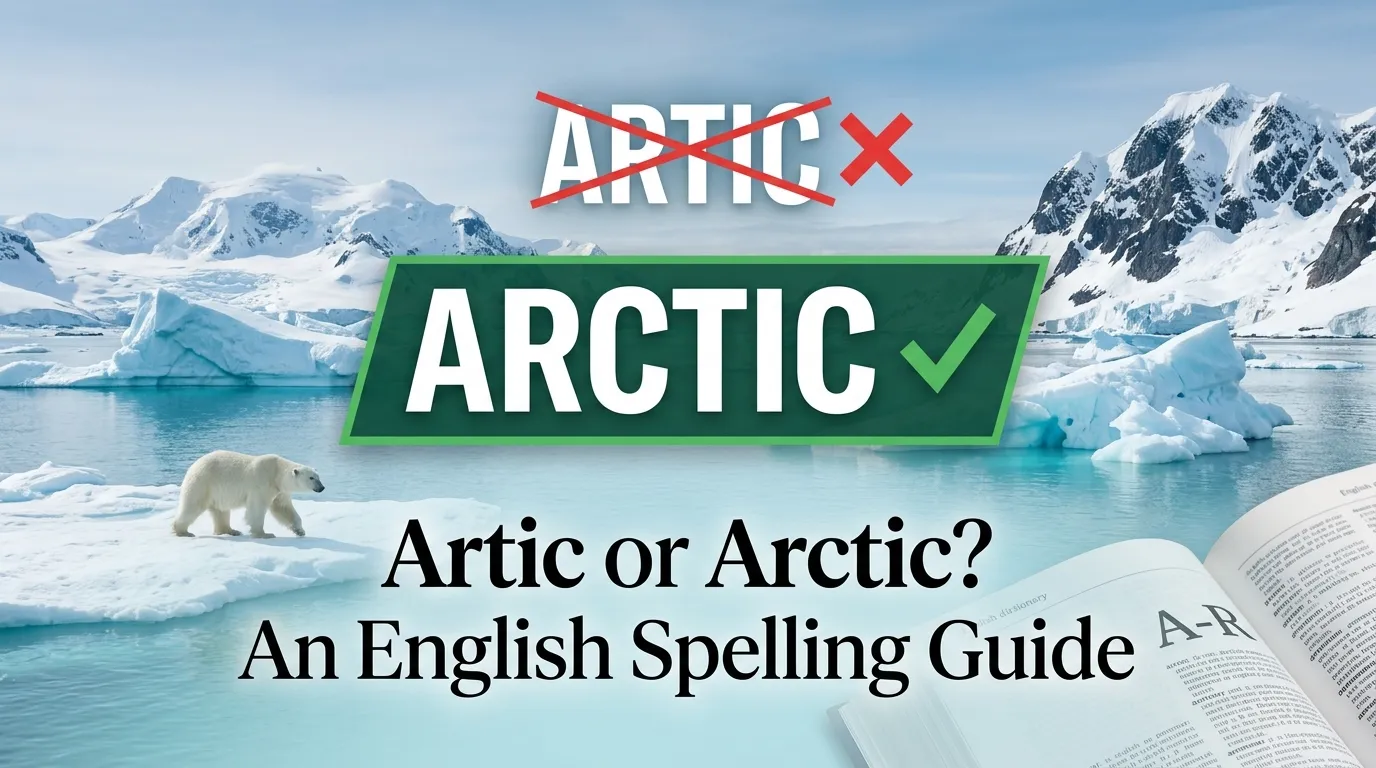
Arctic is the correct spelling for the far-northern polar region and its related climate. Artic is usually a misspelling of Arctic, although it can appear as a proper name or abbreviation in rare cases.
Artic or Arctic: Quick Answer
If you are wondering whether to write artic or arctic, choose Arctic in normal English writing.
Arctic refers to the region around the North Pole. It can also describe something related to that region or its very cold conditions.
For example:
- The Arctic is home to polar bears.
- We experienced Arctic temperatures last winter.
- Scientists study changes in the Arctic climate.
The spelling artic is not the standard spelling of this word. It is most often a simple spelling mistake caused by dropping the second c in Arctic.
That small missing letter can cause a surprising amount of confusion. If you have ever typed “artic weather” and wondered whether it looked right, you are not alone.
The good news is that the rule is simple:
Use Arctic, not artic, when you mean the polar region or something extremely cold.
The Origin and Background of Arctic
The word Arctic has a fascinating link to the night sky.
It comes from the Greek word arktikos, meaning “of the bear.” That may sound strange at first. The word does not refer to polar bears.
Instead, it relates to the Great Bear and Little Bear, two constellations visible in the northern sky. The Greek name arktos means “bear.”
Over time, the word moved through Latin and French before becoming Arctic in English.
The word now has a much wider meaning.
It can describe:
- The region around the North Pole
- The Arctic Ocean
- Arctic animals and plants
- Arctic weather
- Arctic research
- Very cold conditions
The capitalized form Arctic is common when the word refers to the geographic region.
For example:
Correct: The expedition traveled across the Arctic.
When it works as an adjective, you will also often see Arctic capitalized when it refers specifically to the region.
Example: Arctic sea ice is shrinking.
This history also explains why the spelling is Arctic, not Artic.
Arctic Explained: Key Differences and Variations
The main difference is simple, but it helps to understand what each form actually does.
| Term | Meaning | When to Use | Region/Context |
|---|---|---|---|
| Arctic | The northern polar region or something related to it | Standard English writing | North Pole and surrounding region |
| artic | Usually a misspelling of Arctic | Avoid in standard writing | Common spelling error |
| Arctic | Extremely cold or related to Arctic conditions | Descriptions of cold weather | General and geographic use |
What Does Arctic Mean?
Arctic can be a noun or an adjective.
As a noun, the Arctic means the area around the North Pole.
The Arctic has a unique ecosystem.
As an adjective, Arctic describes something connected with the Arctic region.
Scientists are studying Arctic ice.
It can also describe something that feels extremely cold.
An Arctic wind swept through the town.
Why Do People Write Artic?
The mistake is easy to understand.
When people say Arctic, the second c can be hard to hear. The word sounds somewhat like “ar-tic,” so some writers spell it artic.
This is similar to other spelling mistakes where pronunciation does not clearly reveal every letter.
Still, in standard English, artic is not the spelling you should use for the polar region.
Is Artic Ever a Real Word?
You may sometimes see Artic used in a name, brand, business name, product name, or other proper name.
That does not make it the standard spelling of the geographic word.
For normal English writing, schoolwork, articles, reports, and professional documents, use Arctic.
Which Version Should You Use?
For almost every standard English situation, the answer is easy:
Use Arctic.
Here is practical advice for different readers.
For Students
Use Arctic in essays, assignments, exams, and research papers.
Correct:
The Arctic is one of the coldest regions on Earth.
Writing artic may be marked as a spelling error.
For Bloggers and Content Writers
Use Arctic in articles, headings, image descriptions, and captions.
For example:
Arctic Wildlife: Animals That Survive Extreme Cold
This is both grammatically correct and clear to readers.
For Professional Writers
Use Arctic in reports, emails, presentations, and formal documents.
If your document discusses climate, geography, wildlife, or environmental science, consistent spelling matters.
For Global or Neutral English
Again, choose Arctic.
There is no major British-versus-American spelling difference here. Unlike words such as colour/color or centre/center, English speakers generally use Arctic across major varieties of English.
Common Mistakes With Arctic
A few mistakes appear again and again.
1. Writing Artic Instead of Arctic
Wrong: The artic region is very cold.
Correct: The Arctic region is very cold.
The second c belongs in the word.
2. Using “Artic” in School Writing
Wrong: Many animals live in the artic.
Correct: Many animals live in the Arctic.
This mistake can look small, but spelling errors matter in academic writing.
3. Confusing Arctic With Antarctic
These words look similar, but they describe opposite ends of Earth.
Arctic → North Pole
Antarctic → South Pole
A simple memory trick is:
Arctic = North. Antarctic = South.
4. Assuming Arctic Always Means Snow
The Arctic is strongly linked with snow and ice, but the word can describe much more.
You can talk about Arctic wildlife, Arctic communities, Arctic research, or Arctic ecosystems.
5. Forgetting the Capital Letter
When referring specifically to the geographic region, Arctic is normally capitalized.
Correct: The Arctic is warming rapidly.
When discussing a broader concept or established compound, capitalization can depend on the style and context. In most general writing, however, Arctic is the safe choice.
Arctic in Real-World Examples
Seeing the word in different settings makes the correct usage easier to remember.
Professional Email
Subject: Arctic Research Project
Our team will review the latest Arctic climate data before Friday’s meeting.
Here, Arctic describes the type of climate data.
News Headline
New Study Examines Rapid Changes in the Arctic
The word refers to the northern polar region.
Social Media Post
The photos from our Arctic expedition are incredible. The landscape looks almost unreal!
The word describes the expedition and its location.
Formal Report
Arctic sea ice plays an important role in the Earth’s climate system.
This is a natural use in scientific and formal writing.
Everyday Conversation
That wind feels absolutely Arctic today!
Here, Arctic is used to suggest that the weather is extremely cold.
Arctic: Data, Trends, and Usage
People search for “artic or arctic” mainly because the spelling is easy to confuse.
The search intent is clearly informational. Most people want a quick answer to one question:
“Which spelling is correct?”
The answer is Arctic.
The confusion is not really about British or American English. Both forms of English use Arctic for the polar region.
The word also appears often in topics such as:
- Climate change
- Polar research
- Geography
- Wildlife
- Ocean science
- Environmental studies
- Weather
- Travel and exploration
This matters because Arctic is more than a spelling word. It is a major geographic and scientific term.
If you write about climate, geography, or nature, knowing the correct spelling helps your content look accurate and trustworthy.
Artic vs Arctic: Side-by-Side Comparison
| Term/Variant | Meaning | Region/Context | Best Used When |
|---|---|---|---|
| Arctic | Northern polar region or related to it | North Pole | Always use this in standard English |
| artic | Usually a spelling mistake | None in standard geographic usage | Avoid it |
| Arctic climate | Very cold climate associated with the polar north | Polar regions | Scientific or general writing |
| Arctic Ocean | Ocean surrounding the North Pole | Northern Hemisphere | Geography and science |
| Arctic Circle | Latitude marking an important Arctic boundary | Northern Earth | Geography and education |
| Antarctic | Relating to the southern polar region | South Pole | When discussing Antarctica |
A Simple Trick to Remember Arctic
Still worried that you will write artic by accident?
Try this memory trick:
Think: Arctic has two Cs.
Break the word into:
Ar + ctic
But do not actually remove the first c when spelling it.
A better visual reminder is:
ARCTIC = AR + C + TIC
That extra C is the letter people often forget.
You can also connect it with Antarctic.
Both words contain ctic near the end:
- Arctic
- Antarctic
If you remember ctic, you are much less likely to write artic.
Frequently Asked Questions
Q: Is it artic or Arctic?
A: Arctic is the correct spelling when you mean the region around the North Pole or something related to it. Artic is normally a spelling mistake.
Q: What does Arctic mean?
A: Arctic refers to the region around the North Pole. It can also describe things connected with that region, such as Arctic wildlife or Arctic weather.
Q: How do you use Arctic correctly?
A: Use Arctic when talking about the northern polar region or things related to it. For example, “The Arctic has a unique climate.”
Q: Is Arctic acceptable in formal writing?
A: Yes. Arctic is the standard spelling and is completely appropriate for academic, professional, scientific, and formal writing.
Q: Which is correct, artic or arctic?
A: Arctic is correct. The form artic is generally an error caused by leaving out the second c.
Q: Where does the word Arctic come from?
A: Arctic comes from Greek arktikos, meaning “of the bear.” It is linked to the constellations known as the Great Bear and Little Bear.
Q: Is Arctic the same as Antarctic?
A: No. The Arctic is in the far north around the North Pole. The Antarctic refers to the far south around Antarctica.
Q: Can Arctic mean very cold?
A: Yes. In everyday English, Arctic can describe extremely cold conditions. For example, “An Arctic wind hit the city.”
Q: Should Arctic always have a capital A?
A: When it refers to the geographic region, Arctic is normally capitalized. You will also commonly see it capitalized in terms such as Arctic Ocean and Arctic Circle.
Q: Why do people spell Arctic as artic?
A: The pronunciation can make the second c easy to miss. Because the letter is not strongly noticeable when spoken, some writers leave it out.
Final Verdict: Artic or Arctic?
When you are choosing between artic and Arctic, there is no need to overthink it.
Arctic is the correct standard spelling.
Use it when you mean the region around the North Pole, something connected with that region, or something extremely cold.
Remember these three points:
- Arctic is correct.
- Artic is usually a spelling mistake.
- Arctic and Antarctic refer to opposite polar regions.
The easiest way to remember the spelling is to watch for that extra c. If you are writing about Arctic wildlife, Arctic weather, Arctic ice, or the Arctic Ocean, keep the c in place.
A tiny spelling detail can make a big difference in polished writing. Now you know exactly which form to choose.
Bookmark this guide so you never second-guess “artic or arctic” again, and share it with someone who keeps dropping that second C.
Learn more: Response or Respond, Responce or Response: The Complete Easy Guide

I started writing about English word differences after years of teaching students who kept making the same mistakes. My focus is on making spelling rules feel simple and easy to remember. At WordsCombo, I turn confusing word pairs into clear comparisons.










1 thought on “Artic or Arctic: The Complete Easy Guide”