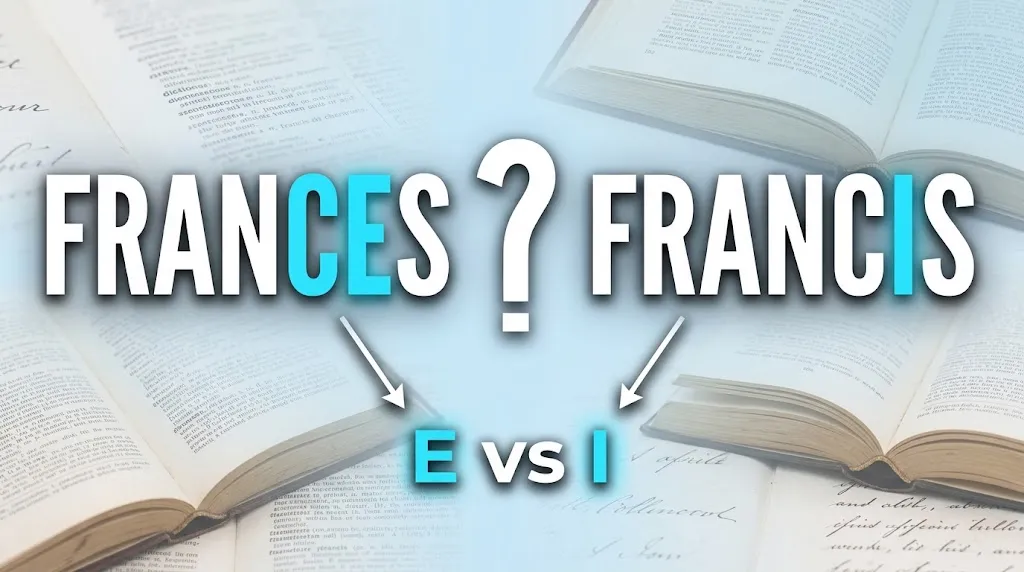
Frances is traditionally the feminine form of the name, while Francis is traditionally the masculine form. They usually sound the same in English, so the spelling is what tells them apart.
“Is it Frances or Francis?”
I have seen this small spelling choice cause a surprising amount of confusion. The reason is simple. Both names are usually pronounced the same in English. When someone says “Fransis,” you cannot always tell which spelling they use.
That can become a real problem in an email, school record, invitation, article, or official document. One letter can change a person’s name.
The good news is that the basic rule is easy.
Frances is traditionally the feminine English form. Francis is traditionally the masculine English form. But there is one rule that matters even more: always use the spelling that the person actually uses.
This guide explains the meaning, history, spelling, pronunciation, differences, common mistakes, and real world use of Frances and Francis. By the end, you will know exactly which version to choose.
Frances or Francis
The traditional difference is:
- Frances → traditionally feminine
- Francis → traditionally masculine
Both names come from the same historical name family. Francis comes from the Latin Franciscus, linked with France and the Franks. Frances developed as the feminine form in English. The distinction between the masculine and feminine forms became established in English over time, especially by the 17th century.
Simple examples
Frances Perkins was a famous American government official.
Francis Ford Coppola is a famous American filmmaker.
So if you are writing about Coppola, Francis is correct. If you are writing about Perkins, Frances is correct.
The key is not pronunciation. It is spelling.
The Origin and Background of Frances and Francis
Both names have a long history.
The root is connected to the Latin Franciscus. It was associated with the Franks and later with France. The name became widely known across Europe through Christian history and famous religious figures.
One of the best known bearers was Saint Francis of Assisi, whose name helped spread Francis across Europe. The name later appeared in many languages and forms.
English eventually developed two familiar forms:
Francis became the standard masculine form.
Frances became the standard feminine form.
This distinction did not appear instantly. Older records can contain different spelling habits because names were not always written in a fixed way.
That explains why historical names can sometimes look inconsistent.
Today, however, English readers normally expect the Francis/Frances distinction.
There are also related forms in other languages:
- Italian: Francesco / Francesca
- Spanish: Francisco / Francisca
- French: François / Françoise
- Portuguese: Francisco / Francisca
- German: Franz / Franziska
- Catalan: Francesc / Francesca
These are related names, but they are not simply interchangeable spellings.
Frances vs Francis Explained: The Key Difference
The biggest difference is the final vowel.
| Term | Meaning | When to Use | Region/Context |
|---|---|---|---|
| Frances | Traditional feminine form of Francis | Usually for women/girls | English |
| Francis | Traditional masculine form | Usually for men/boys | English |
| Francesca | Feminine related form | Italian and some other contexts | Italian |
| Francesco | Masculine related form | Italian | Italian |
| Francisco | Masculine related form | Spanish/Portuguese | Spanish/Portuguese |
| Francisca | Feminine related form | Spanish/Portuguese | Spanish/Portuguese |
There is an important detail here.
Traditional use is a guide, not a rule for changing someone’s name.
A person may use a name in a way that does not follow the traditional pattern. If someone tells you their name is Francis, use Francis. If they spell it Frances, use Frances.
The person’s own spelling always wins.
Why are they so easy to confuse?
Because they usually sound alike.
In common English pronunciation, both are generally pronounced close to “FRAN sis.”
That means you cannot always solve the problem by listening.
If someone says:
“My name is Frances.”
You may still need to ask:
“Could you spell that for me?”
That is especially useful when entering names into a database or writing a formal document.
Which Version Should You Use?
Use the version that matches the person or context.
For a traditional female name
Use Frances.
Example:
Frances sent the report this morning.
For a traditional male name
Use Francis.
Example:
Francis joined the meeting at noon.
For global or international writing
Do not automatically translate the name.
If someone’s official name is Francesca, keep Francesca.
If their name is Francisco, keep Francisco.
Do not change a person’s name just because an English version exists.
For formal documents
Be especially careful.
Use the exact spelling shown on the person’s:
- ID
- passport
- school record
- work record
- email signature
- official profile
A name is not a word you should “correct” based on a spelling rule.
Common Mistakes with Frances and Francis
1. Writing Francis when the name is Frances
Mistake:
Dear Francis,
Correction:
Dear Frances,
Why it happens: Both names sound almost identical.
2. Writing Frances when the name is Francis
Mistake:
Francis Ford Coppola was born in Detroit.
If you accidentally write Frances, you have changed his name.
Correction:
Francis Ford Coppola was born in Detroit.
3. Assuming the spelling from pronunciation
Mistake: Hearing “Fransis” and guessing the spelling.
Correction: Check the person’s written name.
Pronunciation does not reliably tell you whether the final vowel is e or i.
4. Treating traditional gender use as an absolute rule
Mistake:
“Frances must always be female.”
Better approach:
Frances is traditionally feminine, while Francis is traditionally masculine.
Names can be chosen and used in many ways. The person’s own spelling matters most.
5. Changing an international name into an English name
Mistake: Changing Francesca to Frances without a reason.
Correction: Keep the person’s established name.
This is especially important in biographies, passports, academic work, and professional writing.
Frances and Francis in Real World Examples
Professional email
Dear Frances,
Thank you for sending the updated report.
I will review it this afternoon.
Here, Frances is used as the recipient’s name.
News article
Francis Ford Coppola directed The Godfather.
The spelling Francis identifies the filmmaker correctly.
Social media post
Happy birthday, Frances! Hope you have a wonderful day!
The spelling should match the person’s preferred or official name.
Formal document
Francis will serve as the project coordinator.
If the person’s legal or professional name is Francis, do not change it to Frances.
Historical writing
Frances Perkins became a major figure in American political history.
The spelling Frances is part of the historical figure’s name.
Frances and Francis: Data, Trends and Usage
This topic has more depth than a simple spelling question.
Name data shows that Frances remains a recognizable and active name, especially as a traditional girl’s name in the United States. Recent U.S. data listed Frances at #318 for girls in 2025, with 960 births. That was higher than its #379 position in 2024.
Francis remains strongly established as a traditional male name. It is also sometimes used for girls, although that use is much less common.
This matters because modern naming is not completely fixed.
People still use classic names. At the same time, naming choices are becoming more flexible. A name that once had a strong gender association may appear in a wider range of contexts.
So when you see Frances or Francis, do not rely only on the traditional rule.
Check the person’s actual spelling.
That is the safest choice in modern writing.
Frances vs Francis: Standalone Comparison
| Term/Variant | Meaning | Region/Context | Best Used When |
|---|---|---|---|
| Frances | Feminine form related to Francis | English | The person’s name is Frances |
| Francis | Traditional masculine form | English | The person’s name is Francis |
| Francesca | Feminine related form | Italian | The established name is Francesca |
| Francesco | Masculine related form | Italian | The established name is Francesco |
| Francisco | Masculine related form | Spanish/Portuguese | The established name is Francisco |
| Francisca | Feminine related form | Spanish/Portuguese | The established name is Francisca |
| François | Masculine related form | French | The established French name is François |
| Françoise | Feminine related form | French | The established French name is Françoise |
FAQ About Frances and Francis
Q: What does Frances mean?
A: Frances is traditionally the feminine English form related to Francis. Its historical root is Latin Franciscus, associated with France and the Franks.
Q: What does Francis mean?
A: Francis is a traditional English name from the Latin Franciscus. It is often explained as meaning “Frenchman” or “from France,” with the name also commonly associated with the idea of being free.
Q: How do you use Frances correctly?
A: Use Frances when that is the person’s name. Traditionally, Frances is the feminine English form. The spelling should always match the person’s own established name.
Q: Frances vs Francis: what is the difference?
A: Frances is traditionally feminine, while Francis is traditionally masculine. They usually sound the same in English, which is why the spelling causes confusion.
Q: Is Frances acceptable in formal writing?
A: Yes. Frances is a standard personal name and is fully acceptable in formal writing. Use the exact spelling that belongs to the person.
Q: Which version is correct, Frances or Francis?
A: Both are correct names. The right choice depends on the person. As a traditional English pattern, Frances is feminine and Francis is masculine.
Q: Where do Frances and Francis come from?
A: Both are connected to the Latin name Franciscus. The name family spread through Europe and developed different forms in different languages.
Q: Can Francis be used for a girl?
A: Yes. Although Francis is traditionally masculine in English, it has also been used for girls. Modern naming does not always follow traditional patterns.
Conclusion
The difference between Frances and Francis is only one letter, but that letter can matter a lot.
Remember these three points:
- Frances is traditionally the feminine English form.
- Francis is traditionally the masculine English form.
- The person’s own spelling is always the final answer.
Both names share the same historical family. They are linked to the Latin Franciscus and have appeared in many forms across Europe.
The biggest reason people confuse them is pronunciation. In English, they are usually pronounced the same way. So if you are unsure, do not guess.
Check the spelling.
That one habit can save you from mistakes in emails, schoolwork, reports, invitations, and official documents.
And if you are choosing a name for a character, baby, story, or project, either spelling can work. Just remember the traditional distinction.
Frances = traditionally feminine.
Francis = traditionally masculine.
Bookmark this guide so you never have to second guess Frances or Francis again.
common spelling mistakes: Halves or Halfs? The Correct Spelling Might Surprise You

I started writing about English word differences after years of teaching students who kept making the same mistakes. My focus is on making spelling rules feel simple and easy to remember. At WordsCombo, I turn confusing word pairs into clear comparisons.





1 thought on “Frances or Francis: Which One Is Right?”